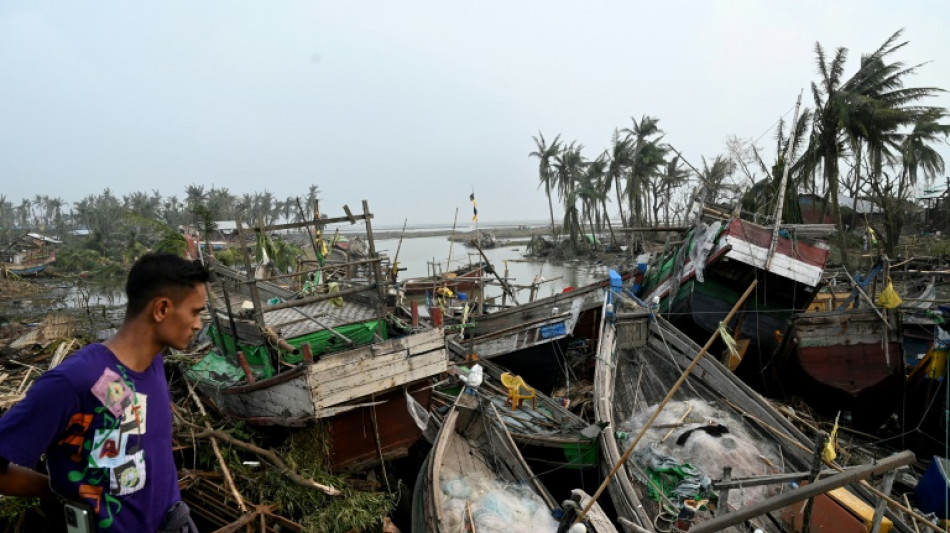
Early warning systems send disaster deaths plunging: UN / Photo: © AFP

 Messi on target again but Miami downed by Columbus

 In Washington's political cauldron, a fight over foie gras
 Flavio Bolsonaro: political heir in his father's shadow

 Ravens grab last-second win in Rio as Commanders stop Seahawks

 USA rallies to capture 11th consecutive Presidents Cup

 Phillies clinch, Astros wrap up division on final day of MLB season

 Commanders hand champion Seahawks their first loss

 Dupont scores twice to send Toulouse top of Top 14

 Ireland beat Israel but no handshakes due to war in Gaza

 Tense standoff over flashpoint N.Ireland parade lasts into night

 Stunned McNulty wins 'miracle' road race world title

 Re-released 'Avengers: Endgame' snaps-up N. America box office lead

 American McNulty wins shock road race world title

 Serbia's President Aleksandar Vucic announces resignation

 Tuchel urges Bellingham to play with 'rage'

 Russian strikes on Ukraine kill 8

 Bavuma, Miller hit centuries as South Africa clinch series

 Spain bring in Le Normand for injured Garcia

 UK Labour party meets buoyed by Burnham but seeking concrete plans

 Nor'easter lashes US east with punishing rain and wind

 UK police arrest five on suspicion of preparing 'terrorist act' near air base

 Washington denounces Iran's truce proposal as 'cynical'

 Armani sprinkles glitter on discreet elegance at Milan show

 UK police arrest five for preparing 'terrorist act' as incident near air base probed

 อเล็กซ์ โบดี และศาสตราจารย์ ดร. ดีเทอร์ ลาซิก ลงนามสัญญาสำหรับ ALPHA WHEY และ BODI เครื่องดื่มให้พลังงาน

Weather-related disasters have surged over the past 50 years, causing swelling economic damage even as early warning systems have meant dramatically fewer deaths, the United Nations said Monday.
Extreme weather, climate and water-related events caused 11,778 reported disasters between 1970 and 2021, new figures from the UN's World Meteorological Organization (WMO) show.
Those disasters killed just over two million people and caused $4.3 trillion in economic losses.
"The most vulnerable communities unfortunately bear the brunt of weather, climate and water-related hazards," WMO chief Petteri Taalas said in a statement.
The report found that over 90 percent of reported deaths worldwide due to disasters over the 51-year-period occurred in developing countries.
But the agency also said improved early warning systems and coordinated disaster management had significantly reduced the human casualty toll.
WMO pointed out in a report issued two years ago covering disaster-linked deaths and losses between 1970 and 2019, that at the beginning of the period the world was seeing more than 50,000 such deaths each year.
By the 2010s, the disaster death toll had dropped to below 20,000 annually.
And in its update of that report, WMO said Monday that 22,608 disaster deaths were recorded globally in 2020 and 2021 combined.
- 'Early warnings save lives' -
Cyclone Mocha, which wreaked havoc in Myanmar and Bangladesh last week, exemplifies this, Taalas said.
Mocha "caused widespread devastation... impacting the poorest of the poor," he said.
But while Myanmar's junta has put the death toll from the cyclone at 145, Taalas pointed out that during similar disasters in the past, "both Myanmar and Bangladesh suffered death tolls of tens and even hundreds of thousands of people".
"Thanks to early warnings and disaster management these catastrophic mortality rates are now thankfully history. Early warnings save lives."
The UN has launched a plan to ensure all nations are covered by disaster early warning systems by the end of 2027.
Endorsing that plan figures among the top strategic priorities during a meeting of WMO's decision-making body, the World Meteorological Congress, which opens Monday.
To date, only half of countries have such systems in place.
- Surging economic losses -
WMO meanwhile warned that while deaths have plunged, the economic losses incurred when weather, climate and water extremes hit have soared.
The agency previously recorded economic losses increased sevenfold between 1970 and 2019, rising from $49 million per day during the first decade to $383 million per day in the final one.
Wealthy countries have been hardest hit by far in monetary terms.
The United States alone incurred $1.7 trillion in losses, or 39 percent of economic losses globally due to disasters since 1970.
But while the dollar figures on losses suffered in poorer nations were not particularly high, they were far higher in relation to the size of their economies, WMO noted.
Developed nations accounted for over 60 percent of losses due to weather, climate and water disasters, but in more than four-fifths of cases, the economic losses were equivalent to less than 0.1 percent of gross domestic product (GDP).
And no disasters saw reported economic losses greater than 3.5 percent of the respective GDPs.
By comparison, in seven percent of the disasters to hit the world's least developed countries, losses equivalent to more than five percent of their GDP were reported, with several disasters causing losses equivalent to nearly a third of GDP.
And for small island developing states, one fifth of disasters saw economic losses of over five percent of GDP, with some causing economic losses above 100 percent.
M.Furrer--BTB