Rice price spike offers preview of climate food disruption / Photo: © AFP/File

 Pope urges Europe to help combat 'deceit and lies' in international ties

 Injured Buttler to miss England ODI series in Pakistan
 Madrid housing protesters vow to maintain pressure on government

 In kayaks or waist-deep in floodwater, shoppers return to Bangkok markets

 UK police probes Iran link to air base bomb scare: media

 Eala blasts into Asian Games quarters in just 55 minutes

 Taiwan gender-row boxer Lin Yu-ting guarantees Asian Games medal

 Comedian on trial for allegedly insulting Erdogan in standup show

 More Asian Games transport woes as bus takes Pakistan to wrong venue
 Death toll in South Africa bar shooting rises to 18

 Aide to Venezuelan opposition leader returns from exile

 Messi and Alcaraz love it, now padel takes step closer to Olympics

 Tolls mount in Thailand, Myanmar floods
 Why India's opposition wants top poll official out

 PU Prime Strengthens UAE Momentum with Strong Showing at Forex Expo Dubai 2026

 Eight dead in Thailand floods since mid-September

 Oil prices spike after Trump rejects Iran truce offer

 Taylor Swift sets new record at MTV VMAs
 Seoul seeks apology after Ukraine reveals transfer of North Korean POWs

 Messi on target again but Miami downed by Columbus

 In Washington's political cauldron, a fight over foie gras

 Flavio Bolsonaro: political heir in his father's shadow

 Ravens grab last-second win in Rio as Commanders stop Seahawks

 Scheffler makes sportsmanship stand over tee screamer

 Anthropic CEO Amodei to dine with Trump at White House

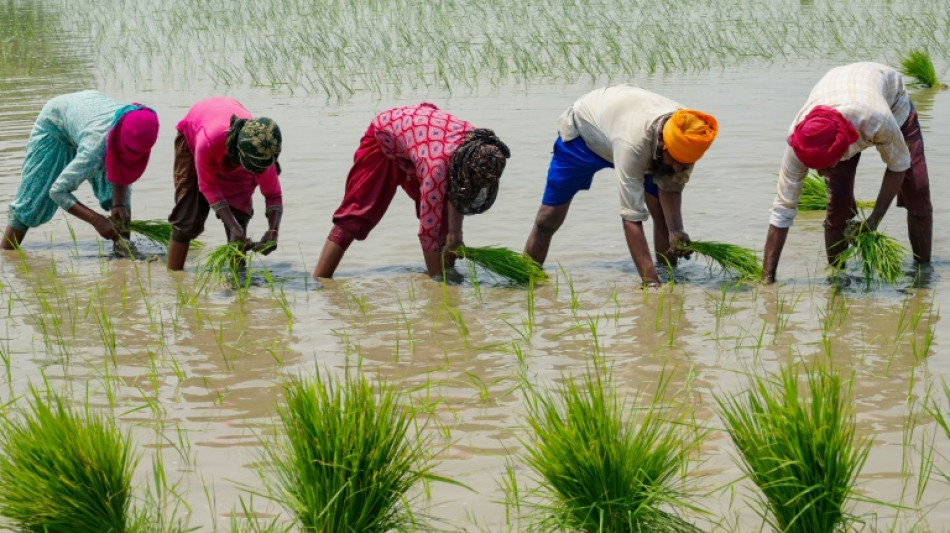
A 15-year high in rice prices, prompted by top exporter India's restrictions on overseas sales, should be a wake-up call on how climate change can disrupt food supplies, experts say.
Rice prices jumped 9.8 percent in August, bucking decreases in other staples, the Food and Agriculture Organization said last week.
That followed the July decision by India, which accounts for 40 percent of global rice exports, to ban the overseas sale of non-basmati rice.
The government cited soaring domestic prices for the staple, caused by geopolitics, the El Nino weather pattern and "extreme climatic conditions."
This year is expected to be the hottest in human history, and the impacts of the seasonal El Nino weather pattern could make conditions even harsher.
Despite severe flooding in parts of northern India, this August was the country's hottest and driest on record.
The monsoon season that brings up to 80 percent of the country's annual rain has been far below normal levels.
India's July restrictions followed a decision last September to ban exports of another variety of rice that is a staple in parts of Africa.
Up to eight percent of global rice exports for 2023/24 could now be taken out of the market, according to analysis by BMI, Fitch Group's research arm.
- Drought fears -
For now, the crisis offers an opportunity for India's rivals, including number two and three exporters, Thailand and Vietnam.
Both have increased exports this year, with Nguyen Nhu Cuong, an official with Vietnam's agriculture and rural development ministry, touting a "bumper crop" and plans to increase planting.
But the dry conditions that tend to accompany El Nino mean smooth sailing ahead is unlikely, warned Elyssa Kaur Ludher, from the ISEAS-Yusof Ishak Institute's Climate Change in Southeast Asia programme.
"My question is whether they can continue to do this once El Nino comes into force towards the end of this year, when water becomes more scarce," she told AFP.
"I think the end of this year and especially the beginning of next year will be very, very tough," she added.
A naturally occurring weather phenomenon, El Nino typically lasts nine to 12 months and is expected to strengthen late this year.
Even before India's latest restrictions, its effects were boosting rice export prices, according to BMI.
And in Thailand, national rainfall levels are currently 18 percent lower than expected for the time of year, the Office of National Water Resources said this month.
Late rains could still make up the difference, but the agency said it is "concerned about a drought caused by El Nino."
- 'New normal' -
The consequence is one of price rather than supply, said Charles Hart, agricultural commodities analyst at Fitch Solutions.
"This is not a running out of rice moment," he stressed, noting India's restrictions have not been followed by other exporters.
Instead, the situation is likely to force the drawdown of stocks rebuilt after pandemic-era depletions, and prompt importers to seek new deals and impose local limits.
Top importer the Philippines this month signed a deal with Vietnam to help stabilise supply, days after announcing a national price cap.
For some though, unaffordable prices amount to the same as a lack of supply: less food.
"It's not just a food availability issue, but it's also a social stability issue, it's a political issue," said Ludher.
The current disruptions should be a wake-up call for policy-makers, she added, with more attention needed to the plight of farmers across various sectors.
Climate change can affect productivity, with lower crop yields as temperatures rise, but also increases the likelihood of extreme events like the 2022 Pakistan floods.
"Global grain export markets are relatively concentrated, so that kind of extreme weather risk accumulates in a few markets," Hart added.
In India, policymakers need to develop better early-warning systems and new planting patterns, said Avantika Goswami, a climate change researcher at the Centre for Science and Environment.
"Erratic weather patterns are the new normal," she told AFP.
"Now, it's a case of early adaptation. In the long-term, global emissions have to come down."
burs-sah/ssy
C.Meier--BTB