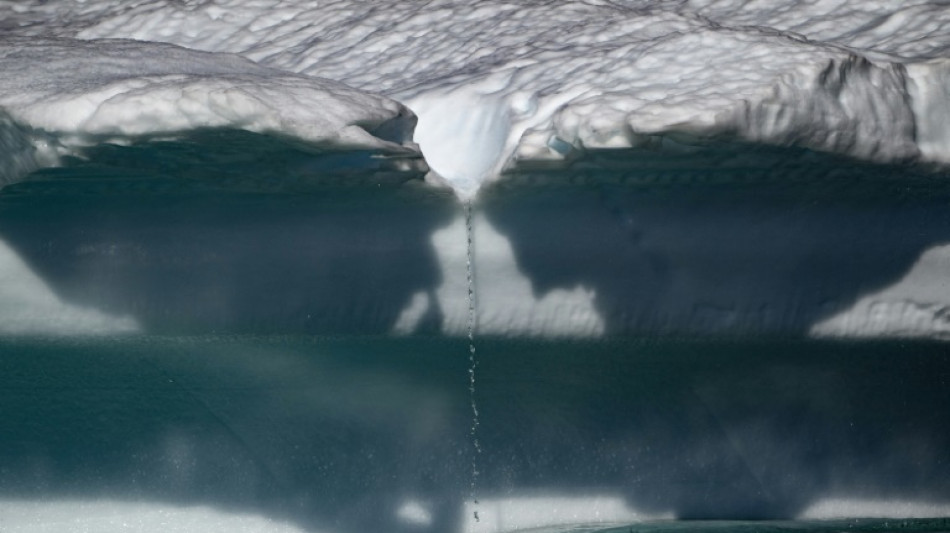
Humanity deep in the danger zone of planetary boundaries: study / Photo: © AFP/File

 Pope urges Europe to help combat 'deceit and lies' in international ties

 Injured Buttler to miss England ODI series in Pakistan
 Madrid housing protesters vow to maintain pressure on government

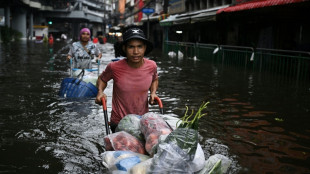 In kayaks or waist-deep in floodwater, shoppers return to Bangkok markets

 UK police probes Iran link to air base bomb scare: media

 Eala blasts into Asian Games quarters in just 55 minutes

 Taiwan gender-row boxer Lin Yu-ting guarantees Asian Games medal

 Comedian on trial for allegedly insulting Erdogan in standup show

 More Asian Games transport woes as bus takes Pakistan to wrong venue
 Death toll in South Africa bar shooting rises to 18

 Aide to Venezuelan opposition leader returns from exile

 Messi and Alcaraz love it, now padel takes step closer to Olympics

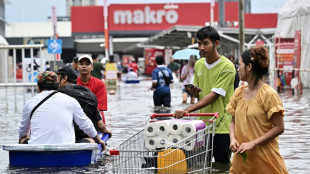 Tolls mount in Thailand, Myanmar floods
 Why India's opposition wants top poll official out

 PU Prime Strengthens UAE Momentum with Strong Showing at Forex Expo Dubai 2026

 Eight dead in Thailand floods since mid-September

 Oil prices spike after Trump rejects Iran truce offer

 Taylor Swift sets new record at MTV VMAs
 Seoul seeks apology after Ukraine reveals transfer of North Korean POWs

 Messi on target again but Miami downed by Columbus

 In Washington's political cauldron, a fight over foie gras
 Flavio Bolsonaro: political heir in his father's shadow

 Ravens grab last-second win in Rio as Commanders stop Seahawks

 Scheffler makes sportsmanship stand over tee screamer

 Anthropic CEO Amodei to dine with Trump at White House

Human activity and appetites have weakened Earth's resilience, pushing it far beyond the "safe operating space" that keeps the world liveable for most species, including our own, a landmark study said Wednesday.
Six of nine planetary boundaries -- climate change, deforestation, biodiversity loss, synthetic chemicals including plastics, freshwater depletion, and nitrogen use -- are already deep in the red zone, an international team of 29 scientists reported.
Two of the remaining three -- ocean acidification along with the concentration of particle pollution and dust in the atmosphere -- are borderline, with only ozone depletion comfortably within safe bounds.
The planetary boundaries identify "the important processes that keep the Earth within the kind of the living conditions that prevailed over the last 10,000 years, the period when humanity and modern civilisation developed", said lead author Katherine Richardson, a professor at the University of Copenhagen's Globe Institute.
The study is the second major update of the concept, first unveiled in 2009 when only global warming, extinction rates, and nitrogen had transgressed their limits.
"We are still moving in the wrong direction," said co-author Johan Rockstrom, director of the Potsdam Institute for Climate Impact Research (PIK) and a co-creator of the schema.
"And there's no indications that any of the boundaries" -- except the ozone layer, slowly on the mend since the chemicals destroying it were banned -- "have started to bend in the right direction", he told journalists in a briefing.
"This means we are losing resilience, that we are putting the stability of the Earth system at risk."
The study quantifies boundaries for all nine interlocking facets of the Earth system.
- Headed for disaster -
For biodiversity, for example, if the rate at which species disappear is less than 10 times the average extinction rate over the last 10 million years, that is deemed acceptable.
In reality, however, extinctions are occurring at least 100 times faster than this so-called background rate, and 10 times faster than the planetary boundary limit.
For climate change, that threshold is keyed to the concentration of atmospheric CO2, which remained very close to 280 parts per million (ppm) for at least 10,000 years prior to the industrial revolution.
That concentration is today 417 ppm, far above the safe boundary of 350 ppm.
"On climate, we're still following a pathway that takes us unequivocally to disaster," said Rockstrom. "We're headed for 2.5C, 2.6C or 2.7C -- a place we haven't seen for the past four million years."
"There's no evidence whatsoever that humans can survive in that environment," he added.
Thousands upon thousands of chemical compounds created by humans -- from micro-plastics and pesticides to nuclear waste and drugs that have leached into the environment -- were quantified for the first time in the new research, and found to exceed safe limits.
Likewise for the depletion of "green" and "blue" water, freshwater coming from soil and plants on the one hand, and from rivers and lakes on the other.
- Setting limits -
An important finding of the new update is that different boundaries feed off and amplify each other.
The study examines in particular the interaction between increasing CO2 concentration and damage to the biosphere, especially forest loss, and projects temperature increases when one or both increase.
It shows that even if humanity rapidly draws down greenhouse gas emissions, unless destruction of carbon-absorbing forests is halted at the same time rising global temperatures could tip the planet onto a trajectory of additional warming that would be hard to stop.
"Next to climate change, integrity of the biosphere is the second pillar for our planet," said co-author Wolfgang Lucht, head of Earth System Analysis at PIK.
"We are currently destabilising this pillar by taking out too much biomass, destroying too much habitat, deforesting too much land."
All the boundaries can be brought back into the safe operating space, the study concluded.
"It's just a question of setting limits for the amount of waste we put into the open environment and the amount of living and non-living raw materials we take out," said Richardson.
Hotly debated at first, the planetary boundaries framework quickly became a pillar of Earth system science, with its influence extending today into the realm of policy and even business.
M.Odermatt--BTB