Climate change, conflict made Libya deluge more likely: study / Photo: © AFP

 Pope urges Europe to help combat 'deceit and lies' in international ties

 Injured Buttler to miss England ODI series in Pakistan
 Madrid housing protesters vow to maintain pressure on government

 In kayaks or waist-deep in floodwater, shoppers return to Bangkok markets

 UK police probes Iran link to air base bomb scare: media

 Eala blasts into Asian Games quarters in just 55 minutes

 Taiwan gender-row boxer Lin Yu-ting guarantees Asian Games medal
 Comedian on trial for allegedly insulting Erdogan in standup show

 More Asian Games transport woes as bus takes Pakistan to wrong venue
 Death toll in South Africa bar shooting rises to 18
 Aide to Venezuelan opposition leader returns from exile

 Messi and Alcaraz love it, now padel takes step closer to Olympics

 Tolls mount in Thailand, Myanmar floods
 Why India's opposition wants top poll official out

 PU Prime Strengthens UAE Momentum with Strong Showing at Forex Expo Dubai 2026
 Eight dead in Thailand floods since mid-September

 Oil prices spike after Trump rejects Iran truce offer

 Taylor Swift sets new record at MTV VMAs
 Seoul seeks apology after Ukraine reveals transfer of North Korean POWs

 Messi on target again but Miami downed by Columbus

 In Washington's political cauldron, a fight over foie gras
 Flavio Bolsonaro: political heir in his father's shadow

 Ravens grab last-second win in Rio as Commanders stop Seahawks

 Scheffler makes sportsmanship stand over tee screamer

 Anthropic CEO Amodei to dine with Trump at White House

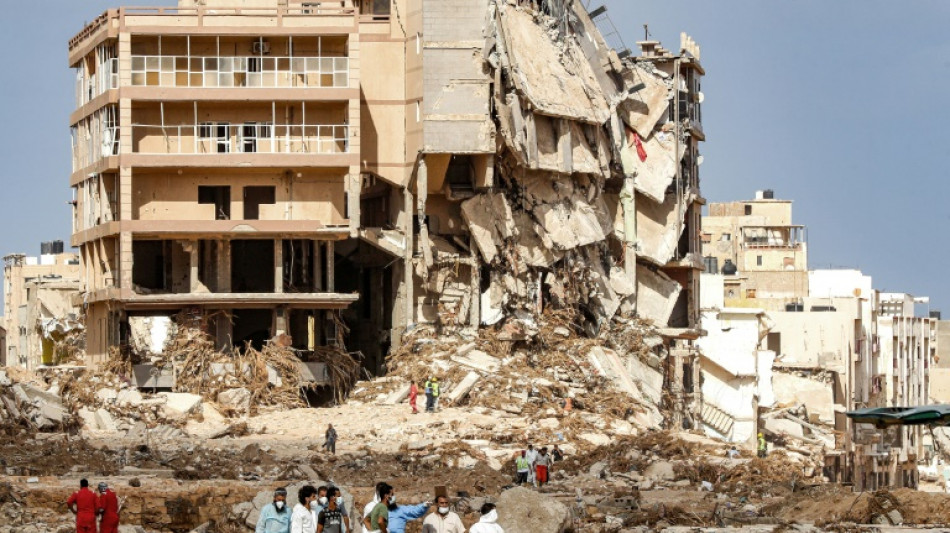
Climate change made torrential rains that triggered deadly flooding in Libya up to 50 times more likely, new research said Tuesday, noting that conflict and poor dam maintenance turned extreme weather into a humanitarian disaster.
An enormous wave of water struck the city of Derna after heavy rains on September 10 overwhelmed two dams, washing whole buildings and untold numbers of inhabitants into the Mediterranean Sea.
Scientists from the World Weather Attribution group said a deluge of the magnitude seen in northeastern Libya was an event that occurred once every 300-600 years.
They found that the rains were both more likely and heavier as a result of human-caused global warming, with up to 50 percent more rain during the period.
In a report looking at floods linked to Storm Daniel that swept across large parts of the Mediterranean in early September, they found that climate change made the heavy rainfall up to 10 times more likely in Greece, Bulgaria and Turkey and up to 50 times more likely in Libya.
But researchers stressed that other factors, including conflict and poor dam maintenance, turned the "extreme weather into a humanitarian disaster".
To unpick the potential role of global warming in amplifying extreme events, the WWA scientists use climate data and computer modelling to compare today's climate -- with roughly 1.2 degrees Celsius of heating since pre-industrial times -- to that of the past.
WWA scientists are normally able to give a more precise estimate of the role climate change has played -- or its absence -- in a given event.
But in this case they said the study was limited by a lack of observation weather station data, particularly in Libya, and because the events occurred over small areas, which are not as accurately represented in climate models.
That meant the findings have "large mathematical uncertainties", although the study said researchers were "confident that climate change did make the events more likely", because of factors including that current warming is linked to a 10-percent increase in rainfall intensity.
- 'Bigger impacts' -
"After a summer of devastating heatwaves and wildfires with a very clear climate change fingerprint, quantifying the contribution of global warming to these floods proved more challenging," said Friederike Otto of the Grantham Institute at Imperial College London.
"But there is absolutely no doubt that reducing vulnerability and increasing resilience to all types of extreme weather is paramount for saving lives in the future."
Daniel, which scientists said was the deadliest and costliest storm over the Mediterranean and Africa on record, formed in the eastern Mediterranean, causing deadly flooding across the region for the first 10 days of September.
The study said the magnitude of the impacts was driven by the vulnerability and exposure of communities and infrastructure.
For example, in central Greece, the damage was increased because cities are located in flood-prone areas.
In Libya, where the death toll in Derna alone has exceeded 3,300 and is expected to rise, the authors noted that "long-lasting armed conflict, political instability, potential design flaws and poor maintenance of dams all contributed to the disaster".
"This devastating disaster shows how climate change-fueled extreme weather events are combining with human factors to create even bigger impacts, as more people, assets and infrastructure are exposed and vulnerable to flood risks," said Julie Arrighi, director at the Red Cross Red Crescent Climate Centre.
O.Krause--BTB