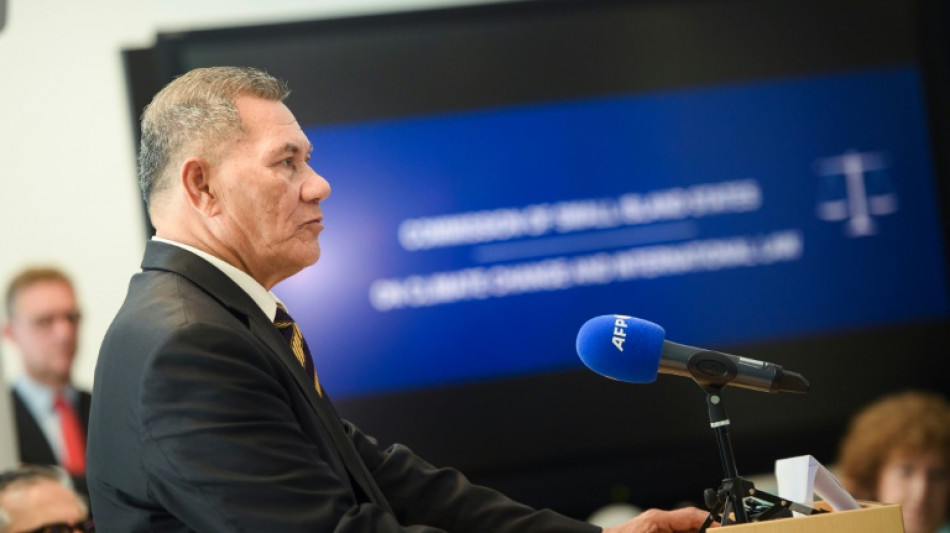
Tuvalu will always be a state, even if underwater, says PM / Photo: © AFP/File

 Pope urges Europe to help combat 'deceit and lies' in international ties

 Injured Buttler to miss England ODI series in Pakistan
 Madrid housing protesters vow to maintain pressure on government
 In kayaks or waist-deep in floodwater, shoppers return to Bangkok markets

 UK police probes Iran link to air base bomb scare: media

 Eala blasts into Asian Games quarters in just 55 minutes
 Taiwan gender-row boxer Lin Yu-ting guarantees Asian Games medal

 Comedian on trial for allegedly insulting Erdogan in standup show

 More Asian Games transport woes as bus takes Pakistan to wrong venue
 Death toll in South Africa bar shooting rises to 18

 Aide to Venezuelan opposition leader returns from exile

 Messi and Alcaraz love it, now padel takes step closer to Olympics

 Tolls mount in Thailand, Myanmar floods
 Why India's opposition wants top poll official out

 PU Prime Strengthens UAE Momentum with Strong Showing at Forex Expo Dubai 2026

 Eight dead in Thailand floods since mid-September
 Oil prices spike after Trump rejects Iran truce offer

 Taylor Swift sets new record at MTV VMAs
 Seoul seeks apology after Ukraine reveals transfer of North Korean POWs
 Messi on target again but Miami downed by Columbus

 In Washington's political cauldron, a fight over foie gras
 Flavio Bolsonaro: political heir in his father's shadow

 Ravens grab last-second win in Rio as Commanders stop Seahawks

 Scheffler makes sportsmanship stand over tee screamer

 Anthropic CEO Amodei to dine with Trump at White House

Tuvalu could be one of the first nations to sink beneath the sea as a result of climate change, but that doesn't mean its statehood is up for discussion, the tiny Pacific archipelago's prime minister said Thursday.
Speaking on the sidelines of the UN General Assembly, Kausea Natano said there had been "unnecessary" conversations in academic and diplomatic circles centered on the definition of a country under international law.
"Our sovereignty is not negotiable," Natano told AFP, adding that his country would be working with the international community to "bring a close to these distractions."
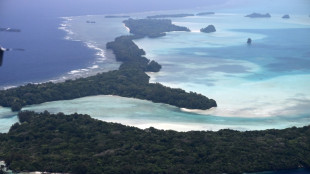
Tuvalu's population of 11,000 is spread across nine islands that rise less than five meters above sea level, underscoring the extraordinary challenges it faces from sea-level rise.
Two of the atolls represented on its flag of 11 stars have already disappeared, and even the higher lying areas could become uninhabitable by 2100 as a result of salt contaminating its land and water supply.
The 1933 Montevideo Convention on the Rights and Duties of States holds that a state consists of a defined territory, a permanent population, a government and the capacity to interact with other states.
If the territory is swallowed up, or no one can live on what is left of it, then at least one of the criteria is no longer met.
But while Tuvalu’s land mass accounts for just 26 square kilometers (10 square miles) -- around the size of seven Central Parks -- its maritime territory covers a vast 800,000 square kilometers.
The convention is ambiguous on the question of whether territory is wet or dry, and there is no precedent for revoking the status of a UN member state, leaving the matter fuzzy.
- Land reclamation, and the metaverse -
Tuvalu isn't taking an underwater future as a given, and -- along with pleading with the world to end its addiction to fossil fuels -- has begun work on a Coastal Adaptation Project that aims to reclaim around 3.8 kilometers of land from the ocean and raise land levels in the most vulnerable spots.
It has been financed with $36 million in international assistance channelled through the Green Climate Fund, and $2.9 million from Tuvalu's own government.
The situation is dire, says Natano. Around 40 percent of the capital Funafuti already gets submerged during periodic "king" tides that wash away root crops, including former island staples taro and cassava.
While he is pleased that the project's first phase is nearing completion, Natano said the scope is too small to help all of his people.
"We need more, faster action from whoever is in a position to support us, urgently," he said.
To this end, the country has been at the forefront of the major climate action calls: a global tax on fossil fuels, and the activation of a "loss and damages" fund -- international climate jargon for climate compensation owed by rich polluting countries to the most impacted nations.
This fund was agreed to in principle at the last major climate talks in Egypt, but -- like so many other vows from the rich world -- has yet to be fulfilled.
"It's a matter of life and death -- it's a matter of disappearing from the surface of this Earth," said Natano, urging countries to keep their promise.
Should the worst come to pass, Tuvalu has been moving its cultural heritage to the digital sphere, in what some have called a model for how "Nation-States 2.0" might work.
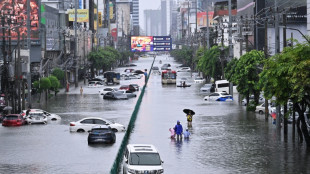
But what happens to Tuvalu will merely be a harbinger of what cities around the world threatened by sea-level rise will experience -- from Miami to Manila, said Natano.
"More and more citizens of the world will have to relocate," he said. "Use us a model to preserve the entire world."
M.Ouellet--BTB