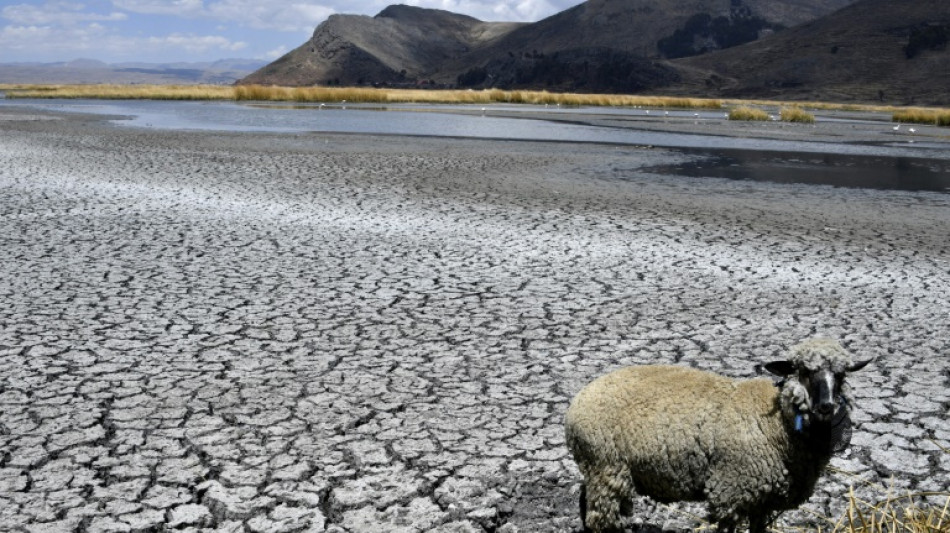
Climate change main culprit for hot South American winter / Photo: © AFP

 Pope urges Europe to help combat 'deceit and lies' in international ties

 Injured Buttler to miss England ODI series in Pakistan
 Madrid housing protesters vow to maintain pressure on government

 In kayaks or waist-deep in floodwater, shoppers return to Bangkok markets

 UK police probes Iran link to air base bomb scare: media

 Eala blasts into Asian Games quarters in just 55 minutes

 Taiwan gender-row boxer Lin Yu-ting guarantees Asian Games medal

 Comedian on trial for allegedly insulting Erdogan in standup show

 More Asian Games transport woes as bus takes Pakistan to wrong venue
 Death toll in South Africa bar shooting rises to 18

 Aide to Venezuelan opposition leader returns from exile

 Messi and Alcaraz love it, now padel takes step closer to Olympics

 Tolls mount in Thailand, Myanmar floods

 Why India's opposition wants top poll official out

 PU Prime Strengthens UAE Momentum with Strong Showing at Forex Expo Dubai 2026

 Eight dead in Thailand floods since mid-September

 Oil prices spike after Trump rejects Iran truce offer

 Taylor Swift sets new record at MTV VMAs

 Seoul seeks apology after Ukraine reveals transfer of North Korean POWs

 Messi on target again but Miami downed by Columbus

 In Washington's political cauldron, a fight over foie gras

 Flavio Bolsonaro: political heir in his father's shadow

 Ravens grab last-second win in Rio as Commanders stop Seahawks

 Scheffler makes sportsmanship stand over tee screamer

 Anthropic CEO Amodei to dine with Trump at White House

A wave of unusually extreme heat at the end of South America's winter was made 100 times more likely by climate change, according to a study published Tuesday.
"While many people have pointed to El Nino to explain the South America heat wave, this analysis has shown that climate change is the primary driver of the heat," said Lincoln Muniz Alves, a researcher at the Brazil National Institute for Space Research who participated in the study by the World Weather Attribution (WWA) group.
From Buenos Aires to Chile, and parts of Brazil, people found themselves in T-shirts at the height of the Southern Hemisphere winter in August and September, with temperatures shooting above 25 degrees Celsius (77 Fahrenheit), and reaching 37 degrees Celsius in some cases, breaking records.
The WWA study found that while the naturally occurring El Nino warming phenomenon had some impact, climate change was the main culprit, driving temperatures up between 1.4 and 4.3 degrees.
A team of 12 experts studied the link between the extreme weather and climate change over the 10 hottest winter days in a region encompassing Paraguay, central Brazil and regions of Bolivia and Argentina.
"The scientists found that these extreme heat episodes in South America outside the summer months would have been extremely unlikely without human-caused climate change," read a statement on the study.
"Heat episodes like these will become even more frequent and extreme if greenhouse gas emissions are not rapidly reduced to net zero."
In Sao Paulo, the biggest city in Latin America, four deaths were attributed to the heatwave.
"Heat kills, particularly in spring, before people are acclimatized to it," said Julie Arrighi, a director at the Red Cross Red Crescent Climate Centre.
"Temperatures above 40 degrees Celsius in early spring are incredibly extreme and while we are aware of just four heat-related fatalities, it's likely the true number is much higher."
The heatwave came during a winter and early spring marked by extreme weather phenomena, from torrential rains in Chile, to cyclones in southern Brazil and a drought which pushed Uruguay's potable water supply to the brink.
The heat also led to increased forest fires in the Amazon.
Unseasonable warm weather was not limited to South America, with last month dubbed the hottest September on record by the European Union climate monitor.
The El Nino phenomenon -- which warms waters in the southern Pacific and stokes hotter weather beyond -- is likely to contribute to 2023 becoming the hottest year on record in the next three months.
J.Bergmann--BTB