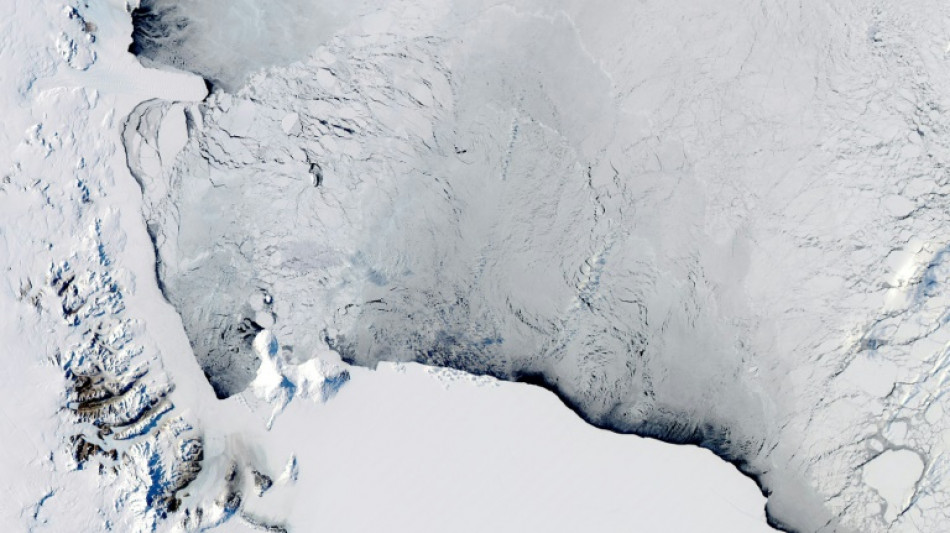
Over 40% of Antarctica's ice shelves lost mass in 25 years: study / Photo: © NASA/AFP

 Pope urges Europe to help combat 'deceit and lies' in international ties

 Injured Buttler to miss England ODI series in Pakistan
 Madrid housing protesters vow to maintain pressure on government

 In kayaks or waist-deep in floodwater, shoppers return to Bangkok markets

 UK police probes Iran link to air base bomb scare: media

 Eala blasts into Asian Games quarters in just 55 minutes

 Taiwan gender-row boxer Lin Yu-ting guarantees Asian Games medal

 Comedian on trial for allegedly insulting Erdogan in standup show

 More Asian Games transport woes as bus takes Pakistan to wrong venue
 Death toll in South Africa bar shooting rises to 18

 Aide to Venezuelan opposition leader returns from exile

 Messi and Alcaraz love it, now padel takes step closer to Olympics

 Tolls mount in Thailand, Myanmar floods

 Why India's opposition wants top poll official out

 PU Prime Strengthens UAE Momentum with Strong Showing at Forex Expo Dubai 2026

 Eight dead in Thailand floods since mid-September

 Oil prices spike after Trump rejects Iran truce offer

 Taylor Swift sets new record at MTV VMAs
 Seoul seeks apology after Ukraine reveals transfer of North Korean POWs

 Messi on target again but Miami downed by Columbus

 In Washington's political cauldron, a fight over foie gras
 Flavio Bolsonaro: political heir in his father's shadow

 Ravens grab last-second win in Rio as Commanders stop Seahawks

 Scheffler makes sportsmanship stand over tee screamer

 Anthropic CEO Amodei to dine with Trump at White House

More than 40 percent of Antarctica's ice shelves lost volume in 25 years, increasing the risk of sea levels rising and with human-induced warming the likely cause, scientists said on Thursday.
Ice shelves are freshwater extensions of the ice sheets that cover much of Antarctica, floating on the seas that surround the vast and ecologically fragile continent.
They act as giant "plugs" stabilising massive glaciers, slowing down the flow of ice into the ocean.
When ice shelves shrink, these plugs weaken and the rate of ice loss from the glaciers increases.
In a study published in the journal Science Advances on Thursday, scientists analysed more than 100,000 satellite radar images to assess the health of Antarctica's 162 ice shelves.
They found that the volume of 71 fell from 1997 to 2021.
"Acceleration of glaciers due to ice shelf deterioration has added about six millimetres to global sea level since the start of the study period," said Benjamin Davison, a research fellow at the University of Leeds in Britain who led the study.
Although Antarctica only contributes six percent to total sea level rise, "it could increase substantially in the future if ice shelves continue to deteriorate," he told AFP.
The almost 67 trillion tonnes of ice that leaked into the ocean during the quarter-century under review was offset by 59 trillion tonnes being added, giving a net release of 7.5 trillion tonnes of meltwater.
"We expected most ice shelves to go through cycles of rapid but short-lived shrinking, then to regrow slowly," said Davison.
"Instead, we see that almost half of them are shrinking with no sign of recovery."
Without human-caused warming, some ice regrowth would have occurred on West Antarctica's ice shelves through a natural variation in climate patterns, he added.
- 'Steady attrition' -
Different winds and ocean currents affect Antarctica, resulting in changes that are uneven.
Almost all of western Antarctica's ice shelves lost volume as they were exposed to warmer water that eroded them from below.
On the western Getz Ice Shelf alone, melting at the base was responsible for 95 percent of the net loss of 1.9 trillion tonnes of ice.
Calving -- a process whereby chunks of ice break away into the ocean -- accounted for the rest.
Anna Hogg, a University of Leeds professor who co-authored the study, said 48 ice shelves lost more than 30 percent of their initial mass during the period.
In eastern Antarctica, ice shelves mostly stayed the same or grew because a band of cold water along the coast protected them from warmer currents.
"We are seeing a steady attrition due to melting and calving... This is further evidence that Antarctica is changing because the climate is warming," Hogg added.
The melting of ice shelves could have major implications for global ocean circulation, which moves vital nutrients, heat and carbon from the polar ecosystem.
The added freshwater may have diluted the dense and salty waters of the Southern Ocean and made them lighter, delaying their sinking process and potentially weakening the global ocean conveyor belt.
"The ocean absorbs a lot of atmospheric heat and carbon and the Southern Ocean surrounding Antarctica is the largest contributor to that, so it's a hugely important regulator of global climate," Davison told AFP.
J.Fankhauser--BTB