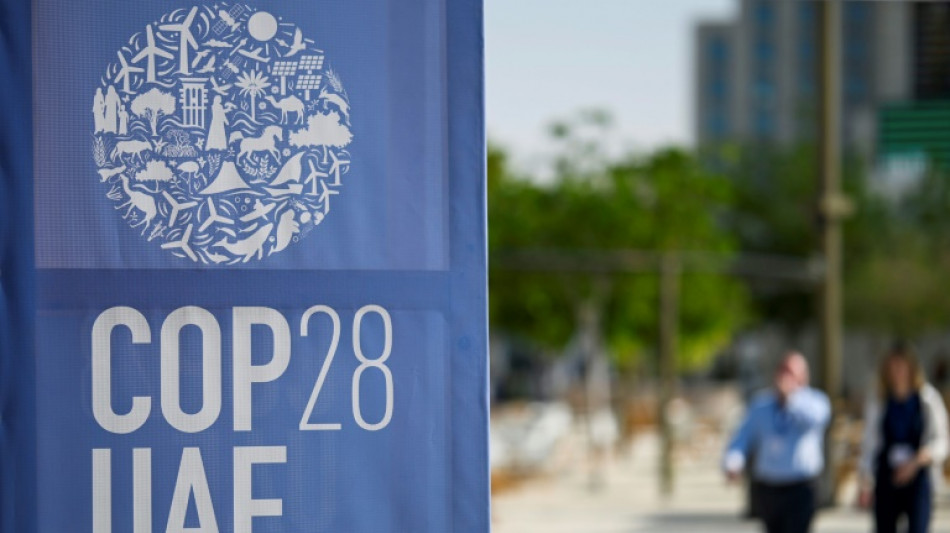
COP28 puts out welcome mat to lobbyists / Photo: © AFP

 Trump admin finalizes reversal of US fuel economy standards
 US says no China arms sale plans after envoy cites Trump offer
 Dozens kidnapped in two weekend attacks in northern Nigeria
 Next stop the world: Pathirage wins Asian Games javelin gold

 Aster Launches Perpetual Grid Trading 2.0 with Up to 140,000 $ASTER Liquidity Mining Campaign
 Seoul says North Korean mines 'highly suspected' as cause of DMZ blast

 Russia pummels Kyiv in latest deadly daytime attack
 Wartime Ukraine works to keep its railways on track
 Boy among 3 dead in migrant Channel crossing accident: French authorities
 SGFX Creates a Standout Brand Experience at Forex Expo Dubai 2026
 Pope urges Europe to help combat 'deceit and lies' in international ties

 Injured Buttler to miss England ODI series in Pakistan
 Madrid housing protesters vow to maintain pressure on government
 In kayaks or waist-deep in floodwater, shoppers return to Bangkok markets

 UK police probes Iran link to air base bomb scare: media
 Eala blasts into Asian Games quarters in just 55 minutes
 Taiwan gender-row boxer Lin Yu-ting guarantees Asian Games medal
 Comedian on trial for allegedly insulting Erdogan in standup show
 More Asian Games transport woes as bus takes Pakistan to wrong venue
 Death toll in South Africa bar shooting rises to 18
 Aide to Venezuelan opposition leader returns from exile

 Messi and Alcaraz love it, now padel takes step closer to Olympics
 Tolls mount in Thailand, Myanmar floods
 Why India's opposition wants top poll official out

 PU Prime Strengthens UAE Momentum with Strong Showing at Forex Expo Dubai 2026
"All views are welcome. All views are needed," declared Sultan Al Jaber, president of the UN's COP28 and head of the Emirates state oil and gas company in the run-up to the climate talks in Dubai.
That welcome also extends to lobbyists and big oil companies, some of whom will be part of national delegations when negotiations start on Thursday.
Here we look at some of the questions that raises.
- Are lobbies allowed at COP? -
"Leaders, experts and people of influence" come together in the COP's "blue zone", where talks take place, the UN states, without mentioning lobbyists.
But lobbyists can get accreditation by joining a national delegation or from one of the 2,000 "observer" groups made up of NGOs and professional groups.
"When people think about lobbying, they think about behind-closed-doors meetings between a company or their representatives and a policymaker. And that's certainly a lot of it," Faye Holder, program manager at think tank InfluenceMap, told AFP.
But it can also "include things like social media posts, advertising, sponsorships, the use of trade groups or astroturf groups", fake organisations made to look like grassroots groups, she said.
The lack of clear rules at the talks about conflict of interest has long been criticised.
Indeed, hosts the UAE were accused this week of using its role as COP28 hosts to discuss fossil fuel deals with other governments, according to leaked documents obtained by the BBC. COP28 dismissed the reports as "inaccurate".
Until this year, the UN did not oblige delegates to reveal their links to the organisation they were accredited with or who they are employed by, making it extremely difficult to detect lobbyists.
Some 65 members of the US Congress and the European Parliament wrote to the UN to voice their "profound concern that current rules... permit private sector polluters to exert undue influence" on the talks.
A report by high level experts mandated by the UN called for "non-state actors to publicly disclose their trade association affiliations" and said they cannot be allowed to "lobby to undermine ambitious government climate policies either directly" or indirectly.
- A record number at COP28? -
The last COP in Egypt set a new record for lobbyists, with 636 official delegates working for fossil fuel companies, according to Global Witness, which combed through participants' CVs.
The NGO told AFP that that record will be broken again in Dubai.
The umbrella group Kick Big Polluters Out claims that at least 7,200 lobbyists working for fossil fuel interests have been accredited to COP summits over the last two decades.
And that is only the "tip of the iceberg", they claim, with many passing under the radar.
Kick Big Polluters Out said lobbyists sometimes outnumber both the delegations from some of the countries most vulnerable to climate change and activists from NGOs.
Many state-owned oil and gas companies also form part of their countries' national delegations.
COP28, which will have a record 70,000 delegates, has thrown the doors open to the private sector, with oil and gas majors officially invited along with other polluting industries.
Ironically, according to the experts, it is perhaps the first time that fossil fuel producers' part in the talks has been addressed so openly. COP28 president Jaber told AFP this week that "everyone needs to be held accountable".
Some NGOs, however, have appealed for a boycott of the talks, while others want to counter lobbyists by turning up themselves in large numbers.
- How can lobbyists affect the talks? -
One of the clearest examples of the influence of the oil and gas companies on a COP was the Paris Agreement in 2015. Its Article 6 created a system of exchange of carbon credits, something the industry had demanded for years.
David Hone, Shell's chief climate advisor, admitted that they spent four years pushing "for the need for carbon unit trading to be part of the Paris Agreement.
"We can take some credit for the fact that Article 6 is even there at all," he told a 2018 conference organised by IETA, a lobby group founded by oil companies that will have dozens of delegates at COP28.
In Dubai, the lobbies could again have a strong influence on the language of the agreements "and what it means", said Holder, particularly the vaunting of carbon capture, green hydrogen and "low-carbon gas" as possible solutions.
She said the big question will be around the phrase "phasing out fossil fuels", and if this might be altered to "unabated fossil fuels", which means without carbon capture, "which is a sort of sneaky word that makes quite a big difference", and gives the oil industry lots of wriggle room.
M.Odermatt--BTB