World could breach 1.5C warming threshold in 7 years: study / Photo: © AFP/File

 Trump admin finalizes reversal of US fuel economy standards

 US says no China arms sale plans after envoy cites Trump offer

 Dozens kidnapped in two weekend attacks in northern Nigeria

 Next stop the world: Pathirage wins Asian Games javelin gold

 Aster Launches Perpetual Grid Trading 2.0 with Up to 140,000 $ASTER Liquidity Mining Campaign

 Seoul says North Korean mines 'highly suspected' as cause of DMZ blast

 Russia pummels Kyiv in latest deadly daytime attack

 Wartime Ukraine works to keep its railways on track

 Boy among 3 dead in migrant Channel crossing accident: French authorities

 SGFX Creates a Standout Brand Experience at Forex Expo Dubai 2026

 Pope urges Europe to help combat 'deceit and lies' in international ties

 Injured Buttler to miss England ODI series in Pakistan
 Madrid housing protesters vow to maintain pressure on government

 In kayaks or waist-deep in floodwater, shoppers return to Bangkok markets

 UK police probes Iran link to air base bomb scare: media

 Eala blasts into Asian Games quarters in just 55 minutes

 Taiwan gender-row boxer Lin Yu-ting guarantees Asian Games medal

 Comedian on trial for allegedly insulting Erdogan in standup show

 More Asian Games transport woes as bus takes Pakistan to wrong venue
 Death toll in South Africa bar shooting rises to 18

 Aide to Venezuelan opposition leader returns from exile

 Messi and Alcaraz love it, now padel takes step closer to Olympics

 Tolls mount in Thailand, Myanmar floods

 Why India's opposition wants top poll official out

 PU Prime Strengthens UAE Momentum with Strong Showing at Forex Expo Dubai 2026

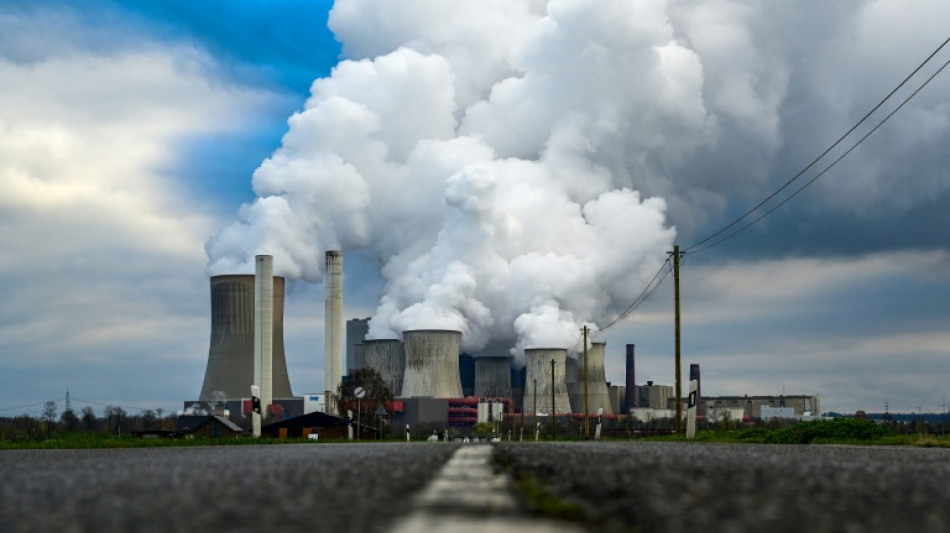
The world may cross the crucial 1.5C global warming threshold in seven years as fossil fuel CO2 emissions continue to rise, scientists warned Tuesday, urging countries at the COP28 talks to "act now" on coal, oil and gas pollution.
Battle lines are being drawn over the future of fossil fuels at the UN climate summit in Dubai, with big polluters trying to see off calls for an agreement to phase out the carbon-intensive energy responsible for most of human-caused greenhouse gas.
Fossil fuel CO2 pollution rose 1.1 percent last year, according to an international consortium of climate scientists in their annual Global Carbon Project assessment, with surging emissions in China and India -- now the world's first and third biggest emitters.
They estimated that there is a 50 percent chance warming will exceed the Paris deal's goal of 1.5 degrees Celsius over multiple years by around 2030, although they noted uncertainties around warming from non-CO2 greenhouse gases.
"It is getting more and more urgent," lead author Pierre Friedlingstein, of Exeter University's Global Systems Institute, told reporters.
"The time between now and 1.5 degrees is shrinking massively, so to keep a chance to stay below 1.5C, or very close to 1.5C, we need to act now."
- 'Wrong direction' -
The landmark 2015 Paris Agreement saw countries commit to limiting temperature rise to well below 2C above the preindustrial era and preferably 1.5C.
The more ambitious 1.5C goal has since taken on greater urgency as evidence emerges that warming beyond this could trigger dangerous and irreversible tipping points.
To keep to that limit, the UN's IPCC climate science panel has said CO2 emissions need to be halved this decade.
That is becoming a more challenging task as emissions continue to rise, the Global Carbon Project found.
Glen Peters, a senior researcher at the CICERO Center for International Climate Research, said carbon dioxide emissions are now six percent higher than when countries signed the Paris deal.
"Things are going in the wrong direction," he said.
That is despite a promising surge in renewable energy, a key issue at the Dubai climate talks where more than 100 countries have signed a call to triple renewable capacity this decade.
"Solar wind, electric vehicles, batteries, they're all growing rapidly, which is great. But that is only half the story," he said.
"The other half is reducing fossil fuel emissions. And we're simply not doing enough."
- India overtakes EU -
The research found fossil fuels accounted for 36.8 billion tonnes of a total of 40.9 billion tonnes of CO2 estimated to be emitted this year.
Several major polluters have clocked falling CO2 emissions this year -- including a three percent decrease in the United States and a 7.4 percent drop across the European Union.
But China, which accounts for almost a third of global emissions, is expected to see a four percent rise in fossil fuel CO2 this year, the research found, with increases in coal, oil and gas as the country continues to rebound from its Covid-19 lockdowns.
Meanwhile, a rise in CO2 emissions of more than eight percent in India means the country has now overtaken the EU as the third-biggest fossil fuel emitter, scientists said.
In both India and China increasing demand for power is outstripping a significant rollout of renewables, said Peters.
Emissions from aviation rose by 28 percent this year as it rebound from pandemic-era lows.
The research was published in the journal Earth System Science Data.
The Earth has already warmed some 1.2C, unleashing ferocious heatwaves, wildfires, floods and storms.
Temperatures this year have surged to the highest in recorded history and the UN's World Meteorological Organization has said 2023 was already around 1.4C above the pre-industrial baseline by October.
Going above 1.5C for a single year would not breach the Paris deal, however, which is measured over decades.
F.Pavlenko--BTB