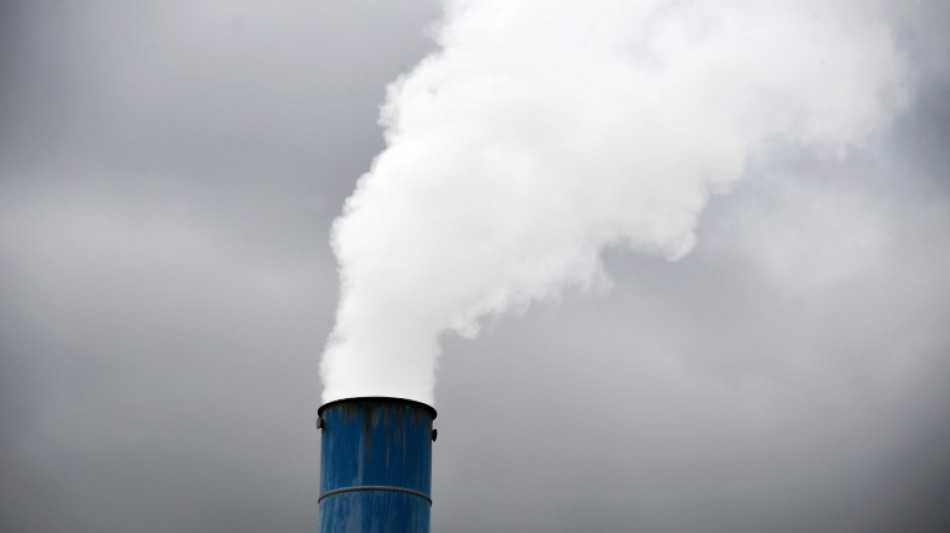
Countries risk 'paying polluters' billions to regulate for climate: UN expert / Photo: © AFP/File

 Trump admin finalizes reversal of US fuel economy standards

 US says no China arms sale plans after envoy cites Trump offer

 Dozens kidnapped in two weekend attacks in northern Nigeria
 Next stop the world: Pathirage wins Asian Games javelin gold

 Aster Launches Perpetual Grid Trading 2.0 with Up to 140,000 $ASTER Liquidity Mining Campaign

 Seoul says North Korean mines 'highly suspected' as cause of DMZ blast

 Russia pummels Kyiv in latest deadly daytime attack

 Wartime Ukraine works to keep its railways on track

 Boy among 3 dead in migrant Channel crossing accident: French authorities

 SGFX Creates a Standout Brand Experience at Forex Expo Dubai 2026
 Pope urges Europe to help combat 'deceit and lies' in international ties

 Injured Buttler to miss England ODI series in Pakistan
 Madrid housing protesters vow to maintain pressure on government
 In kayaks or waist-deep in floodwater, shoppers return to Bangkok markets

 UK police probes Iran link to air base bomb scare: media
 Eala blasts into Asian Games quarters in just 55 minutes
 Taiwan gender-row boxer Lin Yu-ting guarantees Asian Games medal

 Comedian on trial for allegedly insulting Erdogan in standup show

 More Asian Games transport woes as bus takes Pakistan to wrong venue
 Death toll in South Africa bar shooting rises to 18
 Aide to Venezuelan opposition leader returns from exile

 Messi and Alcaraz love it, now padel takes step closer to Olympics

 Tolls mount in Thailand, Myanmar floods

 Why India's opposition wants top poll official out

 PU Prime Strengthens UAE Momentum with Strong Showing at Forex Expo Dubai 2026

An "explosion" of multibillion-dollar claims by fossil fuel and extractive firms through shadowy investment tribunals is blocking action on climate and nature, the UN Special Rapporteur for Human Rights and Environment has warned, with developing nations increasingly targeted.
After countries agreed this week at UN climate talks on a "transitioning away from fossil fuels", governments are likely to come under heightened pressure to boost regulation and reject further expansion of oil, gas and coal projects.
But that could leave them open to litigation under a secretive arbitration process called investor-State dispute settlement (ISDS), according to UN rights expert David Boyd, who has called it a "major obstacle" to environmental action.
"When governments bring in these stronger laws and policies, they're ending up paying millions -- and sometimes billions -- of dollars in compensation," Boyd told AFP.
Denmark, France and New Zealand have all backed off from stronger regulation on fossil fuel exploration because of ISDS fears, he said.
In a report called "Paying Polluters", presented to the UN General Assembly earlier this year, Boyd warned that the number of claims -- and the size of the payouts -- were soaring.
"The explosion of ISDS claims in recent years, and the threat of such claims, is led by fossil fuel, mining and other extractive industry corporations," Boyd said in his report.
ISDS cases targeting actions to protect the environment rose from 12 initiated before 2000, to 37 from 2000 to 2010, and 126 between 2011 and 2021, it said, adding fossil fuel and mining industries have won over $100 billion in awards.
That could rise substantially, as "sunset clauses" mean even if a state pulls out of a treaty it could still face litigation for some two decades.
- 'Hypocrisy'-
ISDS mechanisms built into thousands of international treaties have roots in the global reconfiguration after World War Two, as investors based often in former colonial powers sought to protect assets in newly-independent countries.
Lukas Schaugg, an international law analyst with the International Institute for Sustainable Development, said the tribunals had historically operated with a "lack of public scrutiny".
"People are increasingly talking about the duty of states to regulate with regard to climate," said Schaugg, who used to work at the International Chamber of Commerce's arbitration court.
Now, "the clash with the investment treaty regime is increasingly visible", he said.
The United Nations Conference on Trade and Development says ISDS poses a particular challenge for the energy transition.
In an August report, UNCTAD said of 1,257 publicly-known ISDS claims made by early 2023, 15 percent were initiated by fossil fuel investors.
Even renewable companies have filed substantial claims, as countries change investment incentives.
The Energy Charter Treaty is the most frequently-invoked international investment agreement in these claims.
It "can amplify existing burdens on countries that are trying to shift from traditional fossil fuel projects to renewable energies", UNCTAD said.
Several wealthy nations have moved to pull out of the ECT, including Germany, France and the Netherlands, while the European Parliament has called for withdrawal of the entire EU.
Boyd said even as richer nations reduce their exposure, investors continue to use their territory to target poorer nations.
"It's absolutely gross hypocrisy, it's unjust and it's definitely unequal," he said, adding that "jurisdiction shopping" also allows foreign companies to open offices in treaty countries to launch claims.
According to UNCTAD, 65 percent of cases in 2022 were brought by investors in richer nations -- and 65 percent of cases were against developing countries.
- 'Dustbin of history' -
Examples of claims include two Australian mining corporations seeking nearly $37 billion from the Republic of Congo -- more than twice its 2022 gross domestic product.
"It's obvious that there's no way on earth the Republic of Congo could pay that kind of compensation, if they were unsuccessful in these claims," Boyd told AFP.
Often, he said, "governments just capitulate".
Last year, Pakistan agreed an out-of-court settlement with a foreign firm, which waived penalties that had ballooned to $11 billion in exchange for the reopening of an open-pit copper mine.
It was seen as the only solution for the debt-stricken country after a World Bank arbitration tribunal imposed a $5.8 billion penalty in 2019.
The Tethyan Copper company told the tribunal it had spent over $240 million on the mine.
Boyd said the case illustrates inconsistencies in tribunal awards.
Payouts are sometimes based on investors' actual spending on a project, but at other times use a method estimating future earnings.
Boyd called for the investment treaty system to be reimagined to align with rights and environmental priorities -- and for ISDS to be "relegated to the dustbin of history".
"We've known there's been a climate crisis for 30 years (but) we have companies operating coal fired power plants, saying: 'We had a legitimate expectation we'd be able to continue burning coal forever'," he said.
"Those arguments are being accepted by these arbitration tribunals."
T.Bondarenko--BTB