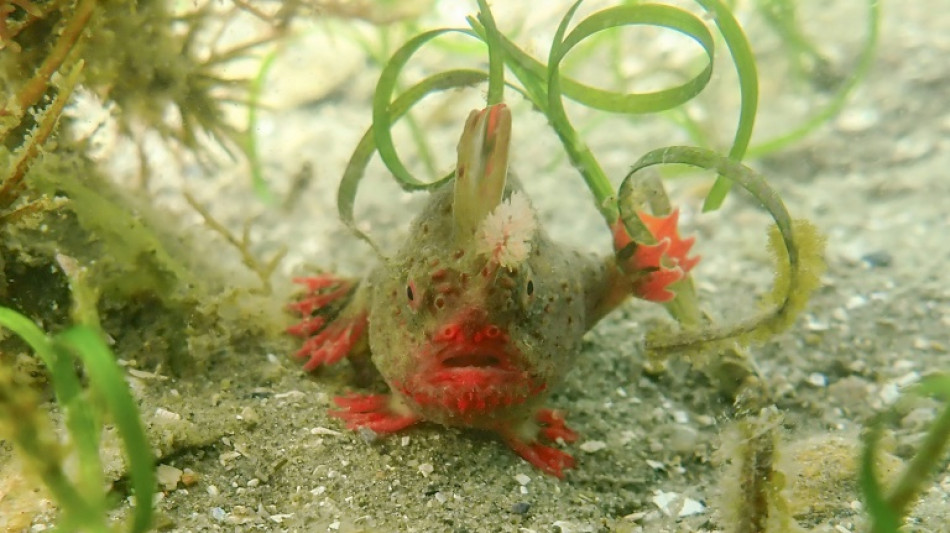
Australia scientists pluck rare handfish from ocean due to climate risk / Photo: © UNIVERSITY OF TASMANIA/AFP

 Rose, Scott among 2027 World Golf Hall of Fame finalists

 Brunson says NBA champion Knicks can't get satisfaction

 France puts out largest wildfire since 1949

 Real Madrid's Perez summoned over Barcelona referee payments comments

 Oil takes off again, Wall Street dips after Trump rejects Iran truce offer

 AlgoQuant Asset Management Selects Liquid Mercury to Enhance Digital Asset Trading Infrastructure

 UK to reopen refugee resettlement scheme to push 'safe' migration

 Pope urges Europe to help combat 'lies and deceit' in world affairs

 Iranian lawyer Nasrin Sotoudeh wins Council of Europe's rights prize

 French far-right's Bardella denies alleged 2013 antisemitic comments

 Oil up, Wall Street dips after Trump rejects Iran truce offer

 Gakpo withdraws from Netherlands squad

 SpaceX puts Starship megarocket in orbit for first time
 Iran denies link to suspected bomb plot at UK airbase used by US

 Ex-boss Mancini says City charges 'not my concern'

 Berlin Marathon winner Assefa finished race with torn Achilles

 Comedian convicted for Erdogan 'insult' but freed pending appeal

 French prosecutors seek two-year sentence for ex-minister Dati in graft case

 Eala makes fast start as weather and transport woes hit Asian Games

 Hurricane Polo approaches Mexico, threatens severe damage

 Energy markets rally after Trump rejects Iran truce offer
 Japanese convenience store enlists Lady Gaga to bolster recruitment

 Seoul summons Ukraine envoy in row over North Korean POWs

 Ireland 'raised awareness worldwide' in Israel game: Hallgrimsson

 Colombian police capture wife, daughter of Ecuador drug lord

Scientists have collected 25 extremely rare red handfish from the ocean off Australia, hoping to protect the struggling species from warming seas, human-caused habitat changes and ravenous urchins.
Only about 100 red handfish -- which have the appearance of a crimson and brown goldfish with stubby arms and webbed hands -- are left in the wild, living in a small section of reef off southeast Tasmania.
About eight centimetres (three inches) long, they "walk" along the sea floor on their pectoral and pelvic fins rather than swimming.
But overgrazing urchins, run-off from urban areas, disturbances from boats and rising sea temperatures have resulted in "severe habitat loss and degradation", according to the University of Tasmania's Institute for Marine and Antarctic Studies.
Scientists at the institute recently made the difficult and risky decision to take dozens of the fish out of the wild for safekeeping.
"This summer has already well exceeded previous temperature maximums," said marine scientist Jemina Stuart-Smith.
"We can only assume that this additional stressor will impact the already fragile population," she said.
On Wednesday, scientists said the 25 specimens were doing well in their temporary aquarium homes and were being closely monitored for stress or ill health.
"We have highly experienced staff looking after the fish seven days a week, and a 24-hour call-out roster," said the institute's Andrew Trotter.
"We believe they are quite safe with us -- but there is certainly a feeling of heightened responsibility among our team, given how small the wild population is."
Trotter and his colleagues are hoping to return the fish to their natural habitat when temperatures drop with the onset of the austral winter in June.
Sea temperatures off Australia have been increasing steadily since records began at the beginning of the 1900s.
Experts believe the change is being fuelled by the emission of carbon dioxide and other greenhouse gases into the atmosphere.
S.Keller--BTB