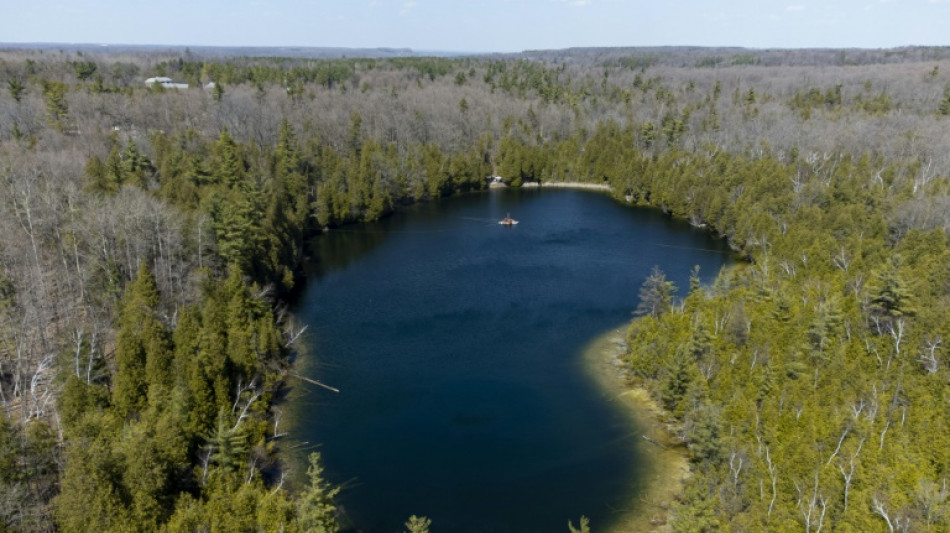
No 'human era' in Earth's geological history, scientists say / Photo: © AFP

 Dodgers eye three-peat, Red Sox face Yankees as MLB playoffs begin

 Certification of Boeing 737 MAX delayed by software bug

 Celine Dion wows Paris Fashion Week with surprise gig

 AMD buys firm founded by AI 'godmother' Fei-Fei Li
 Italy rebound in Turkey as France win late in Belgium

 Pope says concerns about AI 'should be taken seriously'

 Hurricanes to hoist title banner as NHL season begins

 Justice Alito steps aside from major US climate case

 Willis happy with England exile after retains Top 14 player award

 Spain housing protests keep heat on government as PM seeks new law

 Wissa spoils Zimbabwe homecoming as DR Congo win AFCON qualifier

 UK police release on bail five men held over airbase incident

 Ex-All Black Plummer 'sure' New Zealand will find Super Rugby solution

 Shein sees 1% revenue growth in first half of 2026

 Netherlands regrets Israel retaliation in settlements row

 Moscow seizes Russian assets of German food retailer Metro

 Bulgarian spirits inflamed by new rakia rules

 Documentary turns camera on architect Peter Zumthor

 UK police say releasing on bail five men held over airbase incident

 Trump admin finalizes reversal of US fuel economy standards

 US says no China arms sale plans after envoy cites Trump offer

 Dozens kidnapped in two weekend attacks in northern Nigeria

 Next stop the world: Pathirage wins Asian Games javelin gold

 Aster Launches Perpetual Grid Trading 2.0 with Up to 140,000 $ASTER Liquidity Mining Campaign
 Seoul says North Korean mines 'highly suspected' as cause of DMZ blast

A top panel of geologists has decided not to grant the 'human age' its own distinct place in Earth's geological timeline after disagreeing over when exactly our era might have begun.
After 15 years of deliberation, a team of scientists made the case that humankind has so fundamentally altered the natural world that a new phase of Earth's existence -- a new epoch -- has already begun.
Soaring greenhouse gases, the spread of microplastics, decimation of other species, and fallout from nuclear tests -- all were submitted as evidence that the world entered the Anthropocene, or era of humans, in the mid-20th century.
But the proposal was rejected in a contentious vote that has been upheld by the International Union of Geological Sciences, the field's governing body said in a statement published on its website on Thursday.
The decision "to reject the proposal for an Anthropocene Epoch as a formal unit of the Geologic Time Scale is approved", it said.
There is no avenue for appeal, though some involved in the voting committee have raised allegations over the conduct of the ballot and a perceived lack of due process.
The union denied these assertions and called the outcome "a decisive rejection of the Anthropocene proposal" by the field's pre-eminent experts.
There were four votes in favour, 12 against and three abstentions, it added.
Despite this, the Anthropocene would endure as a widely used term: "It will remain an invaluable descriptor of human impact on the Earth system," the union said.
- 'Missed opportunity' -
In 2009 scientists began an enquiry that ultimately concluded that the Holocene epoch -- which began 11,700 years ago as the last ice age ended -- gave way to the Anthropocene around 1950.
They gathered a trove of evidence to show this, including traces of radioactive material found in the layered sediment of lakes, the global upheaval of plants and animals, and omnipresent "forever chemicals".
But opponents argued mankind had been reshaping the planet long before the 1950s, pointing to defining moments like the advent of farming and the industrial revolution.
Martin Head, who was part of the team that advocated for the Anthropocene, said there was "a myriad of geological signals" and lamented the way the process was handled.
"I feel this has been a missed opportunity to recognise and endorse a simple reality, that our planet left its natural functioning state in the mid-20th century," Head, a professor of earth sciences at Brock University in Canada, told AFP.
There was no disagreement that 'the age of man' had resulted in profound planetary changes, said Erle Ellis, an environmental scientist critical of the Anthropocene proposal.
But scientists weren't convinced this impact represented an epoch, no less one that definitively began only seven decades ago, said Ellis, professor of geography and environmental systems at the University of Maryland.
"The truth is, there was never a need for a firm boundary. It just wasn't the critical thing," he told AFP earlier this month after the proposal was first voted down.
H.Seidel--BTB