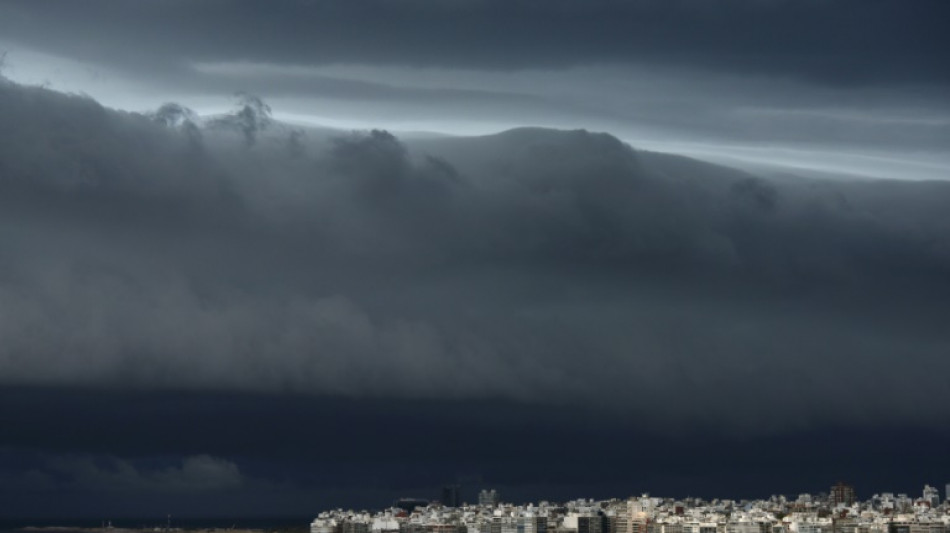
Swiss Re warns insured disaster losses could double in a decade / Photo: © AFP/File

 Dodgers eye three-peat, Red Sox face Yankees as MLB playoffs begin

 Certification of Boeing 737 MAX delayed by software bug

 Celine Dion wows Paris Fashion Week with surprise gig

 AMD buys firm founded by AI 'godmother' Fei-Fei Li

 Italy rebound in Turkey as France win late in Belgium

 Pope says concerns about AI 'should be taken seriously'

 Hurricanes to hoist title banner as NHL season begins

 Justice Alito steps aside from major US climate case

 Willis happy with England exile after retains Top 14 player award

 Spain housing protests keep heat on government as PM seeks new law

 Wissa spoils Zimbabwe homecoming as DR Congo win AFCON qualifier

 UK police release on bail five men held over airbase incident

 Ex-All Black Plummer 'sure' New Zealand will find Super Rugby solution

 Shein sees 1% revenue growth in first half of 2026
 Netherlands regrets Israel retaliation in settlements row

 Moscow seizes Russian assets of German food retailer Metro

 Bulgarian spirits inflamed by new rakia rules

 Documentary turns camera on architect Peter Zumthor

 UK police say releasing on bail five men held over airbase incident

 Trump admin finalizes reversal of US fuel economy standards

 US says no China arms sale plans after envoy cites Trump offer

 Dozens kidnapped in two weekend attacks in northern Nigeria

 Next stop the world: Pathirage wins Asian Games javelin gold

 Aster Launches Perpetual Grid Trading 2.0 with Up to 140,000 $ASTER Liquidity Mining Campaign

 Seoul says North Korean mines 'highly suspected' as cause of DMZ blast

Insured property losses could double in the coming decade due to climate change and more frequent and more intense severe weather events, reinsurance giant Swiss Re warned Tuesday.
The Zurich-based group -- which acts as an insurer for insurers -- also highlighted the rising costs from hailstorms.
Natural disasters caused $280 billion in damage worldwide in 2023, including $108 billion covered by insurance companies, Swiss Re said in its annual overview of the cost of disasters and natural catastrophes.
The total amount of damage, and the share covered by insurers, both fell compared to 2022, which saw Hurricane Ian -- one of the deadliest storms to hit the United States this century -- send costs soaring.
In 2022, the damage caused by natural disasters amounted to $286 billion, while the bill for insurers reached $133 billion.
Despite the drop from the previous year, the bill for insurers in 2023 nonetheless exceeded the $100-billion mark for the fourth year in a row.
"Even without a historic storm on the scale of Hurricane Ian, which hit Florida the year before, global natural catastrophe losses in 2023 were severe," said Swiss Re chief economist Jerome Jean Haegeli.
"This reconfirms the 30-year loss trend that's been driven by the accumulation of assets in regions vulnerable to natural catastrophes."
But the study also found that there were more natural catastrophes causing insured losses in 2023, at a record 142.
"The frequency of events was the main driver of the full-year insured loss total," said the report.
- Turkey quake costliest disaster -
Haegeli warned that the intensity of storms would be a problem going forward.
"Fiercer storms and bigger floods fuelled by a warming planet are due to contribute more to losses," he said.
"This demonstrates how urgent the need for action is, especially when taking into account structurally higher inflation that has caused post-disaster costs to soar."
Swiss Re estimates that insured losses "could double within the next 10 years as temperatures rise and extreme weather events become more frequent and intense".
"Therefore, mitigation and adaptation measures are key to reduce natural catastrophe risk," it said.
The earthquake in Turkey and Syria was the costliest natural disaster of 2023.
Estimated insured losses totalled $6.2 billion, with the earthquake dramatically illustrating coverage gaps around the world, said the report.
Economic losses reached $58 billion but the earthquake hit poorly insured areas, with around 90 percent of losses not covered, the report said.
Last year, severe convective storms alone caused a record $64 billion in insured losses, the study said, noting that such storms are now the second-largest source of losses for insurers after tropical cyclones.
Hailstorms are by far the main contributor to insured losses from severe storms.
The United States accounts for 85 percent of insured losses for storms but the bill is increasing in Europe, exceeding $5 billion per year over the last three years.
The risk of hail in particular is increasing in Germany, Italy and France.
O.Lorenz--BTB