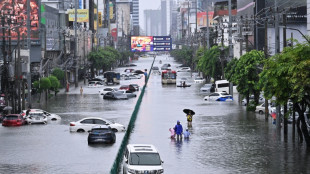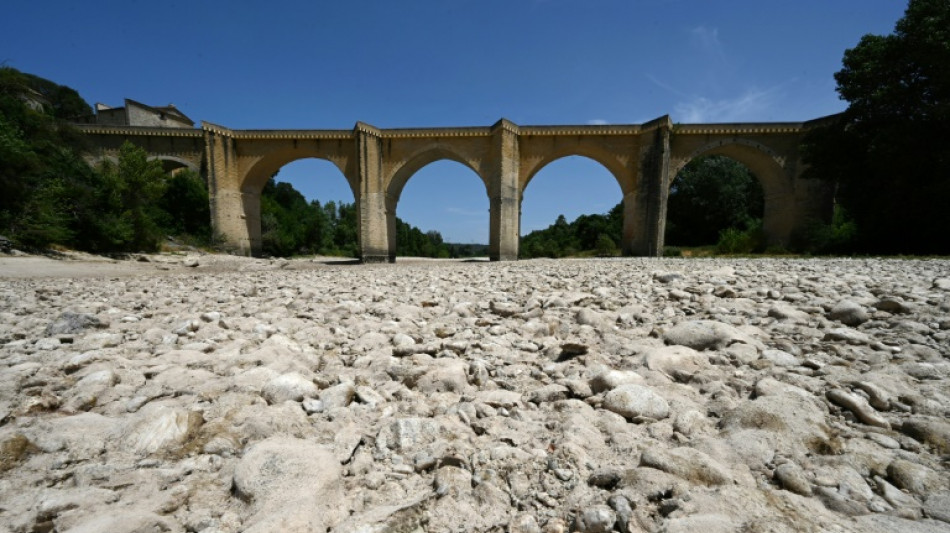
Climate change is slowing heat waves, prolonging misery / Photo: © AFP/File

 Dodgers eye three-peat, Red Sox face Yankees as MLB playoffs begin

 Certification of Boeing 737 MAX delayed by software bug

 Celine Dion wows Paris Fashion Week with surprise gig

 AMD buys firm founded by AI 'godmother' Fei-Fei Li

 Italy rebound in Turkey as France win late in Belgium

 Pope says concerns about AI 'should be taken seriously'

 Hurricanes to hoist title banner as NHL season begins

 Justice Alito steps aside from major US climate case

 Willis happy with England exile after retains Top 14 player award

 Spain housing protests keep heat on government as PM seeks new law

 Wissa spoils Zimbabwe homecoming as DR Congo win AFCON qualifier

 UK police release on bail five men held over airbase incident

 Ex-All Black Plummer 'sure' New Zealand will find Super Rugby solution

 Shein sees 1% revenue growth in first half of 2026

 Netherlands regrets Israel retaliation in settlements row

 Moscow seizes Russian assets of German food retailer Metro

 Bulgarian spirits inflamed by new rakia rules

 Documentary turns camera on architect Peter Zumthor

 UK police say releasing on bail five men held over airbase incident

 Trump admin finalizes reversal of US fuel economy standards

 US says no China arms sale plans after envoy cites Trump offer

 Dozens kidnapped in two weekend attacks in northern Nigeria

 Next stop the world: Pathirage wins Asian Games javelin gold

 Aster Launches Perpetual Grid Trading 2.0 with Up to 140,000 $ASTER Liquidity Mining Campaign

 Seoul says North Korean mines 'highly suspected' as cause of DMZ blast

Climate change is causing heat waves to slow to a crawl, exposing humans to extreme temperatures for longer than ever before, a study published in Science Advances said Friday.
While previous research has found climate change is causing heat waves to become longer, more frequent and more intense, the new paper differed by treating heat waves as distinct weather patterns that move along air currents, just as storms do.
For every decade between 1979 to 2020, researchers found heat waves slowed down by an average of five miles (eight kilometers) an hour per day.
"If a heatwave is moving slower, that means heat can stay in a region longer, so that has effects on communities," senior author Wei Zhang of Utah State University told AFP.
The researchers divided the world into three dimensional-grid cells and defined heat waves as a million square kilometer zones where temperatures reached at least the 95th percentile of the local historical maximum temperature. They then measured their movement over time in order to determine how fast the hot air was moving.
They also used climate models to determine what the results would have looked like absent human-caused climate change, and found manmade factors loomed large.
"It's pretty clear to us that a dominant factor here to explain this trend is anthropogenic forcing, the greenhouse gas," said Zhang.
The changes have accelerated in particular since 1997 and in addition to human causes, weakening upper atmospheric air circulation may play a part, the paper said.
The duration of heat waves also increased, from an average of eight days at the start, to 12 days during the last five years of the study period.
"The results suggest that longer-traveling and slower-moving large contiguous heat waves will cause more devastating impacts on natural and societal systems in the future if GHG keep rising, and no effective mitigation measures are taken," the authors wrote.
Zhang said he was worried by the disproportionate impacts on less-developed regions.
"In particular, cities that don't have enough green infrastructure or not many cooling centers for some folks, in particular for the disadvantaged population, will be very dangerous," he warned.
la-ia/mdl
F.Müller--BTB