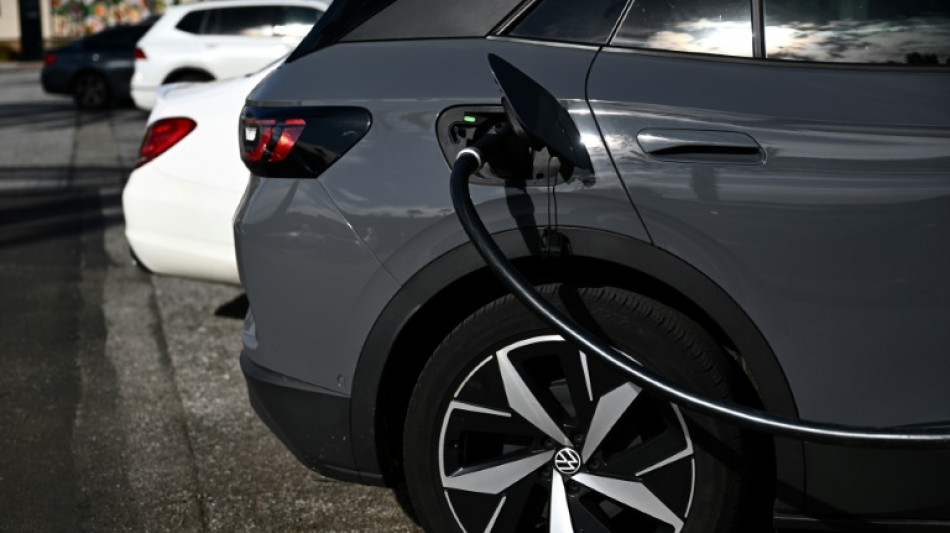
Bumpy ride for electric cars in Europe / Photo: © AFP/File

 Dodgers eye three-peat, Red Sox face Yankees as MLB playoffs begin

 Certification of Boeing 737 MAX delayed by software bug

 Celine Dion wows Paris Fashion Week with surprise gig

 AMD buys firm founded by AI 'godmother' Fei-Fei Li

 Italy rebound in Turkey as France win late in Belgium

 Pope says concerns about AI 'should be taken seriously'

 Hurricanes to hoist title banner as NHL season begins

 Justice Alito steps aside from major US climate case

 Willis happy with England exile after retains Top 14 player award

 Spain housing protests keep heat on government as PM seeks new law

 Wissa spoils Zimbabwe homecoming as DR Congo win AFCON qualifier

 UK police release on bail five men held over airbase incident

 Ex-All Black Plummer 'sure' New Zealand will find Super Rugby solution

 Shein sees 1% revenue growth in first half of 2026

 Netherlands regrets Israel retaliation in settlements row

 Moscow seizes Russian assets of German food retailer Metro

 Bulgarian spirits inflamed by new rakia rules

 Documentary turns camera on architect Peter Zumthor

 UK police say releasing on bail five men held over airbase incident
 Trump admin finalizes reversal of US fuel economy standards

 US says no China arms sale plans after envoy cites Trump offer

 Dozens kidnapped in two weekend attacks in northern Nigeria

 Next stop the world: Pathirage wins Asian Games javelin gold

 Aster Launches Perpetual Grid Trading 2.0 with Up to 140,000 $ASTER Liquidity Mining Campaign
 Seoul says North Korean mines 'highly suspected' as cause of DMZ blast

Electric cars are a key part of Europe's green transition plans but the road ahead remains littered with obstacles with 10 years to go before a crucial milestone.
Despite the fact that the sale of new petrol and diesel cars will be banned in the European Union as of 2035, sales of plug-in "zero emission" vehicles have stalled in the region in recent months.
The market share for electric cars has shrunk from 14.16 percent last year to 12 percent or less since the start of this year, a drop attributed mainly to Germany's decision to abruptly halt subsidies for electric car purchases on Europe's biggest market at the end of 2023.
Sigrid de Vries, director general of the European Automobile Manufacturers' Association (ACEA), expressed "concern".
Fewer than 30 percent of Europeans say they plan to buy an electric vehicle (EV), according to the ACEA, and more than half refuse to pay more than 35,000 euros ($37,750) for a car, a price level offering few EVs.
The "2035 deadline... is really just around the corner, especially when you talk production cycles," de Vries told an EV conference last week in Lillestrom, Norway.
"We need to go from 15 percent (zero-emission cars) to 100 percent in about just around 10 years," she said.
At the end of 2023, EVs passed the "tipping point" of five percent -- considered the point of mass adoption -- in 31 countries around the world, according to the Bloomberg news agency.
But only two-thirds of the EU's 27 member states have surpassed this level.
Cars are Europeans' primary mode of transport, and account for 15 percent of Europe's CO2 emissions.
Making vehicles emissions-free is therefore essential if the EU wants to meet its climate commitments.
Norway, a non-EU member -- and also a major oil and gas producer -- is a leader in EV adoption.
Led by Tesla, electric vehicles accounted for 90 percent of new car registrations in Norway in the first quarter thanks to generous tax incentives.
The country aims to reach the 100 percent mark by 2025.
Carmakers like Volkswagen and Volvo have already ended sales of their combustion models in Norway.
- See-sawing sales -
Elsewhere, the industry's electrification is largely sluggish.
Britain has pushed back by five years its ban on the sale of new combustion cars, now expected in 2035, and many see this target as unrealistic to reach in Europe.
But Nissan, one of the first traditional carmakers to roll out a plug-in with its Leaf model, says sales that yo-yo are not a concern.
"It see-saws and it will always be like that," Guillaume Pelletreau, Nissan's vice president of electrification and connected services, told AFP.
"There was a really strong start to the wave of electrification in the past two years and now we are starting to normalise the process a bit," he said.
"We see nonetheless a clear upwards trend."
Volkswagen, Stellantis and Renault plan to introduce new, less expensive electric models in coming months, but they are also relying on their hybrid models to boost sales.
One of the main hurdles cited by industry experts is the difficulty to roll out the necessary EV infrastructure quickly and broadly.
More than half of the EU's charging stations are found in just two countries: Germany and the Netherlands, according to the ACEA.
In Spain for example, where people replace their cars only every 14 years on average, 65 percent of owners park them in the street, making charging a challenge, said Isabel Gorgoso, head of "new mobility" at energy group Cepsa.
"If you think about Norway 10 years ago, then you have Spain now," she said.
Other obstacles cited are the heaps of EU regulations for carmakers -- up to nine new ones per year -- and ever-changing national policies, which could be exacerbated further by rising support for Europe's populist movements, which are generally climate-sceptic.
"With high-stake European elections around the corner, what happens in the next few months could really determine the fate of Europe's vehicle industry," de Vries said.
F.Müller--BTB