New 'underground cathedral' opens ahead of Paris Olympics / Photo: © AFP

 Dodgers eye three-peat, Red Sox face Yankees as MLB playoffs begin
 Certification of Boeing 737 MAX delayed by software bug
 Celine Dion wows Paris Fashion Week with surprise gig

 AMD buys firm founded by AI 'godmother' Fei-Fei Li
 Italy rebound in Turkey as France win late in Belgium

 Pope says concerns about AI 'should be taken seriously'

 Hurricanes to hoist title banner as NHL season begins

 Justice Alito steps aside from major US climate case

 Willis happy with England exile after retains Top 14 player award

 Spain housing protests keep heat on government as PM seeks new law

 Wissa spoils Zimbabwe homecoming as DR Congo win AFCON qualifier

 UK police release on bail five men held over airbase incident

 Ex-All Black Plummer 'sure' New Zealand will find Super Rugby solution

 Shein sees 1% revenue growth in first half of 2026
 Netherlands regrets Israel retaliation in settlements row

 Moscow seizes Russian assets of German food retailer Metro

 Bulgarian spirits inflamed by new rakia rules

 Documentary turns camera on architect Peter Zumthor

 UK police say releasing on bail five men held over airbase incident
 Trump admin finalizes reversal of US fuel economy standards

 US says no China arms sale plans after envoy cites Trump offer
 Dozens kidnapped in two weekend attacks in northern Nigeria

 Next stop the world: Pathirage wins Asian Games javelin gold

 Aster Launches Perpetual Grid Trading 2.0 with Up to 140,000 $ASTER Liquidity Mining Campaign
 Seoul says North Korean mines 'highly suspected' as cause of DMZ blast

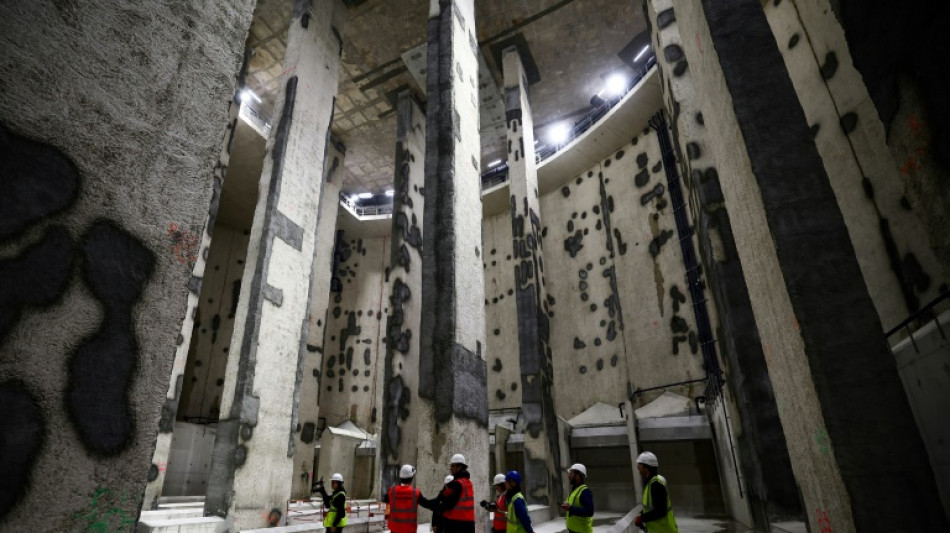
It has no spire, stained glass windows or nave, but the cavernous underground stormwater facility set to be inaugurated in Paris on Thursday has been compared to Notre-Dame cathedral, which is being rebuilt after a fire.
The giant new structure, burrowed 30 metres deep (100-feet) in the ground next to a train station, is a key part of efforts to clean up the river Seine which is set to host swimming events during the Paris Olympics in July and August.
"I like to say that we're building two cathedrals," deputy Paris mayor Antoine Guillou told reporters during a visit to the site in mid-March. "There's the one above ground that everyone knows, Notre-Dame. And then there's the one underground."
Notre-Dame will not be ready in time for the Paris Games, as promised by President Emmanuel Macron immediately after the shocking fire that tore through the 850-year-old landmark in 2019.
But its spire has been restored and workers are busy working on the roof ahead of its grand re-opening in December.
The stormwater facility in western Paris by the Austerlitz transport hub shares the the same sense of scale and space as the Gothic masterpiece, but none of its ornate features.
Fortunately for Olympic open-water swimmers, it will be operational for the Games, with Mayor Anne Hidalgo set to inaugurate it on Thursday morning after more than three years of work.
- Dirty discharges -
The so-called "Austerlitz basin" can hold the equivalent of 20 Olympic swimming pools' worth of water and will be called into action whenever heavy rain crashes down on the French capital.
It is the latest addition to the Parisian underground sewer system, an urban innovation when it was constructed in the mid-19th century which has its own dedicated museum in the capital.
One of its key features is that it collects sewage, domestic waste water and rain water in the same tunnels before directing them to treatment centres.
In the event of major rainstorm, the system is quickly overwhelmed, which means it depends on around 40 valves that release excess water containing untreated sewage directly into the Seine.
In the 1990s, this led to around 20 million m3 of dirty water containing raw sewage being discharged into the Seine every year, according to figures from the mayor's office.
In recent years, after a multi-decade investment and modernisation programme, the figure has fallen to around 2.0 million m3.
But that still leads to the Seine regularly containing levels of E.Coli and enterococci bacteria that are dangerous for human health, putting it out of bounds for swimmers.
- Public bathing -
The Austerlitz basin should further reduce the number of discharges per year by providing extra water storage capacity -- but it will not solve the problem entirely.
The former head of France Nature Environnement (FNE) in the Paris region, Michel Riottot, said that a "large heavy rain" would still overwhelm the new facility.
"In Paris, the sewers, tunnels and basins like Austerlitz hold around 1.9 million m3 of water," the former engineer said. "A light rain of 10 mm, that is one million m3. With a deluge of 20 mm, it overflows everywhere."
Pollution levels have become a major political and sporting issue ahead of the Paris Olympics which begin on July 26, with authorities in a race against time.
The river is set to be used for the marathon swimming events and the triathlon -- pollution permitting.
Three test events had to be cancelled last July and August following heavy rain and organisers acknowledge that a major storm could lead to the Seine being out of bounds.
Cleaning up the river has been promoted as one the key legacy achievements of the Paris 2024 Games, with mayor Hidalgo intending to create three public bathing areas in its waters next year.
She and President Emmanuel Macron have promised to take a dip before the Games to demonstrate it is safe -- just over a century since public swimming was banned there in 1923.
M.Furrer--BTB