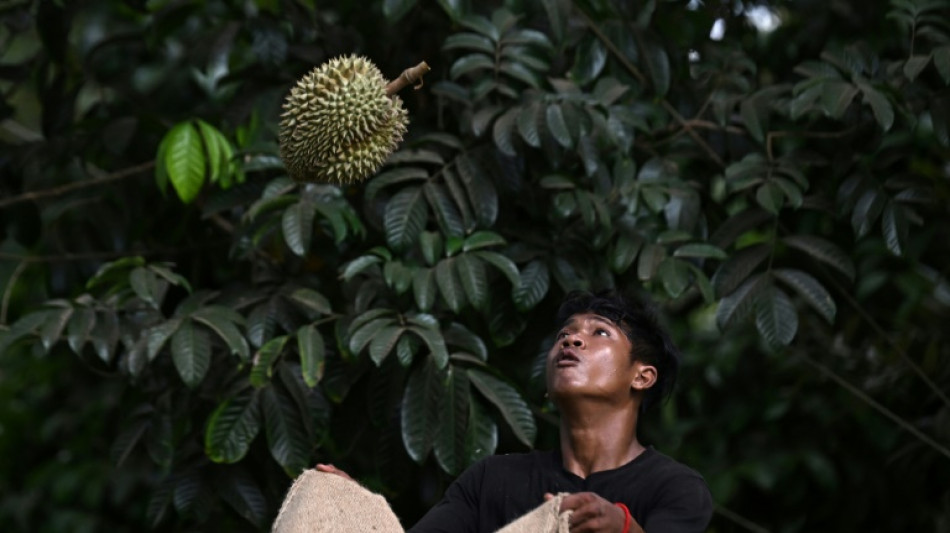
Heatwave hammers Thailand's stinky but lucrative durian farms / Photo: © AFP

 NFL Giants obtain QB McCarthy from Vikings

 Deal for evicted Spanish pensioner as PM seeks new housing law

 Clippers apologize, warn fans of 'challenges' after Leonard scandal

 Turkish comedian convicted for Erdogan 'insult' freed pending appeal

 Trump announces 'biggest' US steel plant in battleground Iowa

 Olise wonder strike gives Zidane's France win in Belgium

 US stocks fall, bond yields rise as Middle East war drags on

 Trump denies offering to sell arms to China's Xi

 Wemby ready for NBA Spurs to move rivals in climb to top

 Ukraine to postpone some spending amid delays in aid: PM

 Tuchel says Czech Republic game 'not yet a must-win'

 MaXhosa puts South Africa on the Paris fashion map

 Rose, Scott among 2027 World Golf Hall of Fame finalists

 Brunson says NBA champion Knicks can't get satisfaction

 France puts out largest wildfire since 1949

 Real Madrid's Perez summoned over Barcelona referee payments comments

 Oil takes off again, Wall Street dips after Trump rejects Iran truce offer
 AlgoQuant Asset Management Selects Liquid Mercury to Enhance Digital Asset Trading Infrastructure

 UK to reopen refugee resettlement scheme to push 'safe' migration

 Pope urges Europe to help combat 'lies and deceit' in world affairs
 Iranian lawyer Nasrin Sotoudeh wins Council of Europe's rights prize

 French far-right's Bardella denies alleged 2013 antisemitic comments

 Oil up, Wall Street dips after Trump rejects Iran truce offer

 Gakpo withdraws from Netherlands squad

 SpaceX puts Starship megarocket in orbit for first time
Clambering hand-over-hand, sweat dripping into his eyes, a durian labourer expertly slices a cumbersome fruit from a tree before tossing it down to land with a soft thump in his colleague's waiting arms some 15 metres (50 feet) below.
Among Thailand's most famous and lucrative exports, the pungent "king of fruits" is as distinctive in its smell as its spiky green-brown carapace, and has been farmed in the kingdom for hundreds of years.
But a vicious heatwave engulfing Southeast Asia has resulted in smaller yields and spiralling costs, with growers and sellers increasingly panicked as global warming damages the industry.
"This year is a crisis," durian farmer Busaba Nakpipat told AFP bluntly.
The weather-beaten 54-year-old took over her parents' farm in eastern Chanthaburi province -- Thailand's durian heartland -- three decades ago.
"If the hot weather continues to rise in the future, it'll be over," she said. "Farmers wouldn't be able to produce durian anymore."
Durian season usually lasts from March until June, but the soaring temperatures -- which in her province have hovered around 40 degrees Celsius (104 degrees Fahrenheit) for weeks -- and subsequent drought have shortened the harvest.
Busaba said the heat causes the durian, which is graduated by weight and size, to ripen faster so it does not grow to its fullest -- and most valuable -- size.
"The quality of the durian won't meet the standard," she said.
And not only is she getting less money for the crop, Busaba's operational costs have risen.
Since March a drought has sucked water from the wells, so to keep her precious durian trees alive Busaba is forced to bring in thousands of litres by truck.
"We have to buy 10 water trucks for 120,000 litres of water for one-time watering the whole 10-rai (1.6 hectares) of our farm," she said, repeating the process every other day, at a cost of thousands of dollars.
"We have prayed for rain," she said. "But there was no rain."
- This year, less -
Thailand's durian exports are worth billions and are the kingdom's third most valuable agricultural product -- behind rice and rubber.
But in the nearby durian market, anxiety is running high among stall-holders, many of them with family businesses going back generations.
Siriwan Roopkaew, manning her mother's stall, said the lack of water has impacted the size of the fruit, but for now prices remain high thanks to demand from China.
Around 95 percent of Thaliand's durian exports are to China, which shipped nearly $4.6 billion worth of the love-it-or-hate-it fruit from the kingdom in 2023, according to data from Beijing's commerce ministry.
But the weather is threatening Thailand's dominance.
In May Chinese state media reported an almost 50 percent rise in durian imported from Vietnam, citing heat and drought in Thailand.
"Hot weather means there will be less durian. Even this year, there is less durian," Siriwan, 26, said.
"Normally, my stall would be full of durian by now."
While farmers worried about water, she said, sellers like her family were more concerned about the knock-on economics.
"Less durian means our earnings are less," she said, "so it'd be hard for us to live the whole year."
Meanwhile, back at the farm, Busaba sighed as she considered the months ahead.
"The future of durian, it's over if there's no water," she said.
S.Keller--BTB