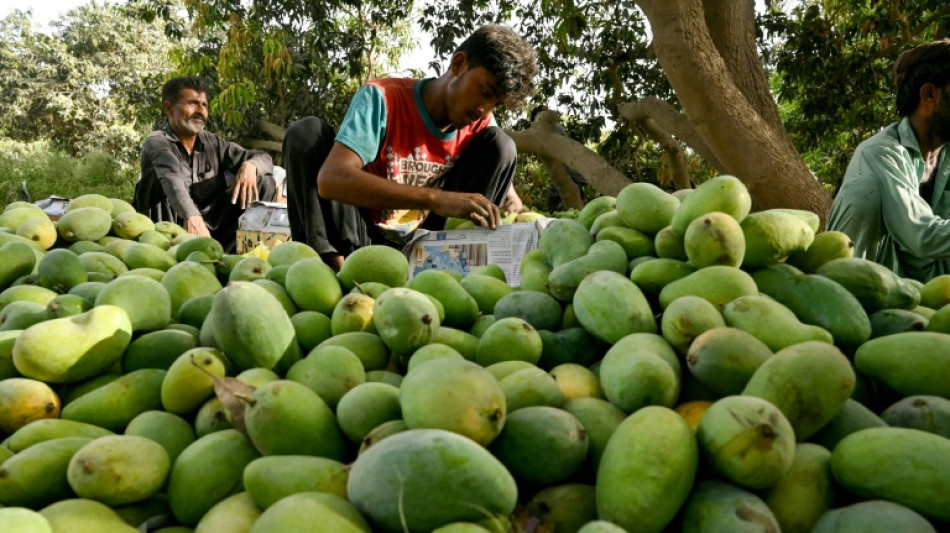
Pakistan farmers pin poor mango crop on climate change / Photo: © AFP

 NFL Giants obtain QB McCarthy from Vikings

 Deal for evicted Spanish pensioner as PM seeks new housing law

 Clippers apologize, warn fans of 'challenges' after Leonard scandal

 Turkish comedian convicted for Erdogan 'insult' freed pending appeal

 Trump announces 'biggest' US steel plant in battleground Iowa

 Olise wonder strike gives Zidane's France win in Belgium

 US stocks fall, bond yields rise as Middle East war drags on

 Trump denies offering to sell arms to China's Xi

 Wemby ready for NBA Spurs to move rivals in climb to top

 Ukraine to postpone some spending amid delays in aid: PM

 Tuchel says Czech Republic game 'not yet a must-win'

 MaXhosa puts South Africa on the Paris fashion map

 Rose, Scott among 2027 World Golf Hall of Fame finalists

 Brunson says NBA champion Knicks can't get satisfaction

 France puts out largest wildfire since 1949

 Real Madrid's Perez summoned over Barcelona referee payments comments

 Oil takes off again, Wall Street dips after Trump rejects Iran truce offer

 AlgoQuant Asset Management Selects Liquid Mercury to Enhance Digital Asset Trading Infrastructure

 UK to reopen refugee resettlement scheme to push 'safe' migration

 Pope urges Europe to help combat 'lies and deceit' in world affairs

 Iranian lawyer Nasrin Sotoudeh wins Council of Europe's rights prize

 French far-right's Bardella denies alleged 2013 antisemitic comments

 Oil up, Wall Street dips after Trump rejects Iran truce offer

 Gakpo withdraws from Netherlands squad

 SpaceX puts Starship megarocket in orbit for first time
Pakistan's mangoes are normally a source of national pride and much-needed income, but farmers are blaming climate change for the parasites and extreme weather ruining much of this season's crop.
A white and orange scarf wrapped around his head in the scorching heat, farmer Muhammad Yusuf lamented the erratic weather.
An abnormally long winter was followed by the wettest April in decades, while the country is now experiencing a heatwave with temperatures hitting up tp 52 degrees Celsius (126 degrees Fahrenheit).
"Buds didn't flower on time, many buds just died. Those that started growing were infected with (parasite) black hopper," said Yusuf, who has worked half his life growing mangoes.
Now over 60 years old, Yusuf said "climate change has wreaked havoc" in his village of Tando Allahyar, around 200 kilometres (124 miles) northeast of economic hub Karachi.
Pakistan is the world's fourth-largest mango producer and agriculture accounts for almost a quarter of its GDP.
Further south in Tando Ghulam Ali, Arsalan, who manages a 900-acre mango orchard, noticed the damage as soon as the harvest started this week.
"We have production losses of 15 to 20 percent, and the picking has only just started so this figure will surely increase," said the 32-year-old.
Exports will be slashed as a result warned Arsalan, who only goes by one name.
"The mangoes turn yellow from the outside but remain underripe or overripe inside," he explained.
Ziaul Haq, a mango grower and exporter from Tando Ghulam Ali, said the "many attacks on fruit" by pests were unprecedented.
"This, in our history, has never happened before," he told AFP.
- 'Feed our families' -
The proliferation of parasites has led to an explosion in spending on pesticides.
This uptick was confirmed by several farmers in Sindh province, where Tando Allahyar and Tando Ghulam Ali are located, as well as those in the leading agricultural province of Punjab further north.
They told AFP that chemicals are now used six to seven times per year, compared to just twice three years ago.
Farmers in Sindh said they have been struggling since 2022 when a series of severe heatwaves were followed by unprecedented flooding, while those in Punjab said the declining crops yields date back several years more.
"The losses in Punjab reached 35 to 50 percent and in Sindh, 15 to 20 percent" compared to last year, said Waheed Ahmed, head of the Pakistan Federation of Fruit and Vegetable Exporters Association (PFVA).
Speaking to local media, he said that last year Pakistan had only managed to export 100,000 of the 125,000 tonnes of mangoes it planned to sell abroad.
Pakistan's 20 varieties of mangoes come second only to oranges as the most-produced fruit in the country.
The income loss from a poor harvest could have a significant impact on the country, which is in talks to secure a loan from the International Monetary Fund (IMF).
Mashooq Ali, a 30-year-old labourer in Tando Ghulam Ali, wants the government to help farmers cope.
"Landowners will earn less this year," said Ali, whose wife has started trading clothes to earn extra cash.
"And even if they paid us as much as last year, with inflation, we won't be able to feed our families."
F.Müller--BTB

