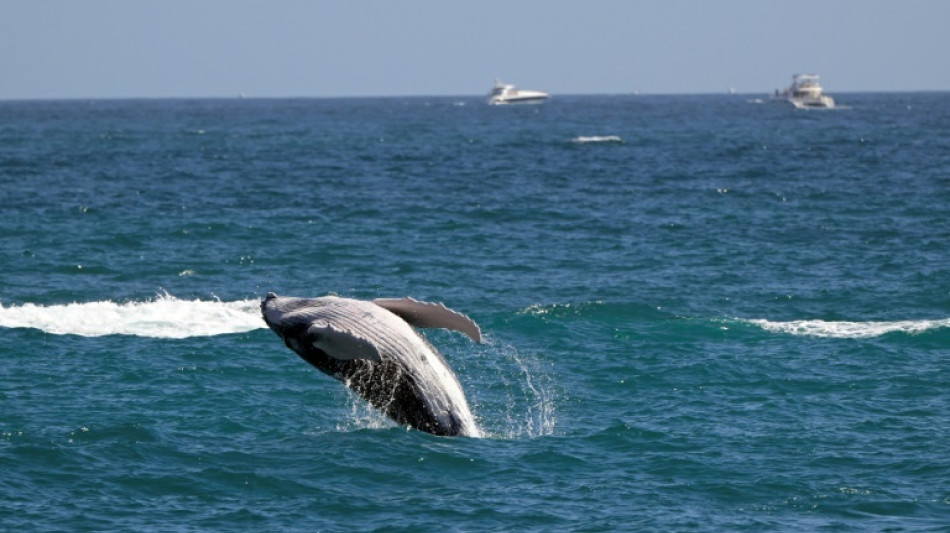
Gray whales shrinking fast as climate warms / Photo: © AFP/File

 Manchester City's Premier League charges: What comes next?

 Brazil's cellphone crime: a security nightmare in every pocket

 Russia pummels Kyiv in latest deadly attack

 NFL Giants obtain QB McCarthy from Vikings

 Deal for evicted Spanish pensioner as PM seeks new housing law

 Clippers apologize, warn fans of 'challenges' after Leonard scandal

 Turkish comedian convicted for Erdogan 'insult' freed pending appeal

 Trump announces 'biggest' US steel plant in battleground Iowa

 Olise wonder strike gives Zidane's France win in Belgium

 US stocks fall, bond yields rise as Middle East war drags on

 Trump denies offering to sell arms to China's Xi

 Wemby ready for NBA Spurs to move rivals in climb to top

 Ukraine to postpone some spending amid delays in aid: PM

 Tuchel says Czech Republic game 'not yet a must-win'

 MaXhosa puts South Africa on the Paris fashion map

 Rose, Scott among 2027 World Golf Hall of Fame finalists

 Brunson says NBA champion Knicks can't get satisfaction

 France puts out largest wildfire since 1949

 Real Madrid's Perez summoned over Barcelona referee payments comments

 Oil takes off again, Wall Street dips after Trump rejects Iran truce offer

 AlgoQuant Asset Management Selects Liquid Mercury to Enhance Digital Asset Trading Infrastructure

 UK to reopen refugee resettlement scheme to push 'safe' migration

 Pope urges Europe to help combat 'lies and deceit' in world affairs

 Iranian lawyer Nasrin Sotoudeh wins Council of Europe's rights prize

 French far-right's Bardella denies alleged 2013 antisemitic comments

Pacific coast gray whales have shrunk in length an astonishing 13 percent since 2000, adding to evidence that climate change and other human activities are making marine mammals smaller, a study says.
Their diminished size could have big impacts on survival rates and reproductive success -- and trigger ripple effects throughout their entire food webs.
For the paper, researchers focused on the Pacific Coast Feeding Group (PCFG) -- around 200 whales that are part of the wider Eastern North Pacific (ENP) population of around 14,500.
Considered "ecosystem sentinels," they stay closer to shore, feeding in shallower, warmer waters, than the wider population that inhabits colder, deeper Arctic seas. Prior research had shown they are in worse shape than their counterparts, with smaller bodies, heads and flukes.
"Now we know they have been shrinking in body size over the past 20-40 years, which may be an early warning sign that the population is at risk of declining," Kevin Bierlich, an assistant professor at Oregon State University and co-author of the paper in Global Change Biology, told AFP on Thursday.
By analyzing drone images taken from 2016-2022 of 130 individuals whose age was estimated or known, the scientists found a striking trend: a gray whale born in 2020 is likely to reach a full-grown adult length of approximately 1.65 meters (5ft 5in) less than a counterpart born in 2000.
This represents a significant 13 percent decrease in the total length of mature gray whales, which typically measure between 38-41 feet in length.
Notably, the decline was more pronounced in females, who historically exceeded males in size but are now comparable.
It would be the equivalent of seeing the average height of an American woman plummeting from 5ft 4in to 4ft 8in over two decades.
- Size matters -
"In general, size is critical for animals," said Enrico Pirotta, lead author on the study and a researcher at the University of St. Andrews in Scotland.
"It affects their behavior, their physiology, their life history, and it has cascading effects for the animals and for the community they're a part of."
Smaller whale calves may have lower survival rates when they stop weaning, while for adults, the major concern is reproductive success.
The species relies on energy reserves stored during the feeding season to support the demands of migration and reproduction during winter -- and the question arises whether they are able to put enough energy towards reproduction and keeping the population growing.
Importantly, the study found the trend was correlated with changes to the balance of "upwelling" and "relaxation" cycles of the ocean.
Upwelling transports nutrients from deeper waters to shallower areas. During relaxation periods, these nutrients remain in the shallower zones, where light enables plankton and other small species that whales feed on to grow.
Climate change is known to be an important factor affecting the dynamics of this delicate balance, through changes in wind patterns and water temperature.
A smaller stature may not only hinder whales' ability to thrive, but also increase their vulnerability to threats such as collisions with boats and entanglement in fishing gear, which can be deadly.
E.Schubert--BTB

