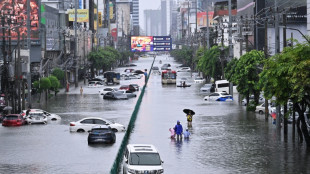
Paris Olympics promise climate action, experts remain sceptical / Photo: © AFP

 Manchester City's Premier League charges: What comes next?

 Brazil's cellphone crime: a security nightmare in every pocket
 Russia pummels Kyiv in latest deadly attack
 NFL Giants obtain QB McCarthy from Vikings

 Deal for evicted Spanish pensioner as PM seeks new housing law

 Clippers apologize, warn fans of 'challenges' after Leonard scandal

 Turkish comedian convicted for Erdogan 'insult' freed pending appeal

 Trump announces 'biggest' US steel plant in battleground Iowa

 Olise wonder strike gives Zidane's France win in Belgium
 US stocks fall, bond yields rise as Middle East war drags on

 Trump denies offering to sell arms to China's Xi

 Wemby ready for NBA Spurs to move rivals in climb to top

 Ukraine to postpone some spending amid delays in aid: PM
 Tuchel says Czech Republic game 'not yet a must-win'
 MaXhosa puts South Africa on the Paris fashion map

 Rose, Scott among 2027 World Golf Hall of Fame finalists

 Brunson says NBA champion Knicks can't get satisfaction

 France puts out largest wildfire since 1949
 Real Madrid's Perez summoned over Barcelona referee payments comments
 Oil takes off again, Wall Street dips after Trump rejects Iran truce offer

 AlgoQuant Asset Management Selects Liquid Mercury to Enhance Digital Asset Trading Infrastructure
 UK to reopen refugee resettlement scheme to push 'safe' migration

 Pope urges Europe to help combat 'lies and deceit' in world affairs
 Iranian lawyer Nasrin Sotoudeh wins Council of Europe's rights prize
 French far-right's Bardella denies alleged 2013 antisemitic comments

Organisers of the 2024 Paris Olympics promised to take "unprecedented" action for the climate by halving the carbon footprint of previous Games and financing projects to reduce planet-heating greenhouse gases.
But experts remain sceptical, especially after organisers dropped a pledge to set a hard limit on its overall carbon cost.
About one-third of the heat-trapping emissions from the three-week spectacle is expected to come from transport, with millions of athletes, spectators, staff and journalists flying into Paris.
Organisers opted mostly for pre-existing or temporary infrastructure to host the event, avoiding the significant environmental cost from carbon-intensive building materials like concrete and steel.
But the Games' sustainability credentials took a hit when an initial commitment to set a definite ceiling on emissions at 1.58 million tonnes of CO2 equivalent was dumped.
"The quantified target, which was the big step forward compared to previous Games and was announced with great fanfare, has been abandoned," said Martin Muller from the Institute of Geography and Sustainability at Lausanne University.
"Without a quantified goal, there is no verifiable obligation."
Organisers instead promised that the Olympics would emit half the average emissions of the 2012 and 2016 Games in London and Rio de Janeiro -- an amount Muller said would be 3.9 million tonnes of CO2.
Paris 2024 could "emit 1.95 million tonnes and still say they have achieved their objective" despite "an increase of more than 20 percent compared to the initial target," he said.
- Climate contribution -
Organisers said the Games would make a "positive contribution to the climate" through the purchase of carbon credits, which offset pollution by funding projects that reduce or avoid greenhouse gas emissions.
This language was also criticised and amended, and organisers now say the Games will "support climate contribution projects that cut and capture CO2 at levels which match the Games' emissions that can't be avoided".
This could include projects which protect forests, plant trees or roll out renewable energy, organisers said, without providing further details.
"Framing their investments in credits as 'climate contribution' not offsets is a great way to stay honest about an organisation's own footprint while supporting and financing progress to global net zero goals," said Kaya Axelsson from the Smith School of Enterprise and the Environment at the University of Oxford.
Benja Faecks from Carbon Market Watch, a nonprofit industry watchdog, also said that amended phrasing "doesn't mislead the public into believing that the Games have no impact on the climate".
"Carbon credits should be used to support projects that are worth financing, but never to 'compensate for emissions'," he said.
Carbon Market Watch previously found that the Games' climate strategy was "incomplete and falls short of achieving transparency", citing the lack of detailed methodologies and monitoring.
- 'Unjustified plastic pollution' -
Activists have voiced concern about the level of plastic waste during the Games, and the involvement of major corporate sponsor Coca-Cola.
Under pressure, organisers said an estimated 9.6 million drinks would be distributed from fountains or glass bottles, 6.2 million poured into reusable cups, and 2.2 million recycled plastic bottles given to athletes.
France Nature Environnement (FNE), a network of advocacy groups, accused Coca-Cola of "unjustified plastic pollution" and attacked plans to pour drinks from recycled plastic bottles into reusable plastic cups as "subterfuge".
"Recycling is not the solution: Coca-Cola should have reduced its plastic," Axele Gibert, of FNE, told AFP.
In 2023, Coca-Cola topped a ranking of brands responsible for the worst plastic pollution carried out by NGO Break Free From Plastic, based on an audit of waste collected by volunteers in 41 countries.
- Greener Games -
Researchers like Muller have proposed solutions to make the Olympics more sustainable.
"First, greatly reducing the size of the event; second, rotating the Olympics among the same cities; third, enforcing independent sustainability standards," he co-wrote in a study published in Nature Sustainability in 2021.
To limit air travel, NGO The Shifters proposed to "maximise in future the sale of tickets to local spectators and those coming from neighbouring countries, whose journeys are less emission intensive".
This could be coupled with "decentralised fan zones managed by the organising country and located in different continents to welcome spectators travelling shorter distances".
H.Seidel--BTB