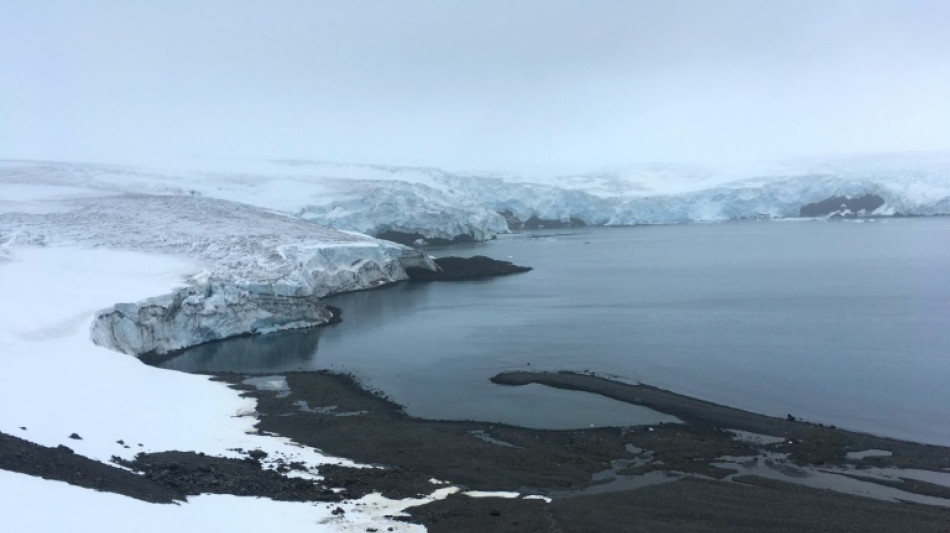
Antarctic faces melting 'tipping point' as oceans warm: study / Photo: © AFP/File

 Manchester City's Premier League charges: What comes next?

 Brazil's cellphone crime: a security nightmare in every pocket

 Russia pummels Kyiv in latest deadly attack
 NFL Giants obtain QB McCarthy from Vikings

 Deal for evicted Spanish pensioner as PM seeks new housing law

 Clippers apologize, warn fans of 'challenges' after Leonard scandal

 Turkish comedian convicted for Erdogan 'insult' freed pending appeal

 Trump announces 'biggest' US steel plant in battleground Iowa

 Olise wonder strike gives Zidane's France win in Belgium

 US stocks fall, bond yields rise as Middle East war drags on

 Trump denies offering to sell arms to China's Xi

 Wemby ready for NBA Spurs to move rivals in climb to top

 Ukraine to postpone some spending amid delays in aid: PM

 Tuchel says Czech Republic game 'not yet a must-win'

 MaXhosa puts South Africa on the Paris fashion map

 Rose, Scott among 2027 World Golf Hall of Fame finalists

 Brunson says NBA champion Knicks can't get satisfaction

 France puts out largest wildfire since 1949

 Real Madrid's Perez summoned over Barcelona referee payments comments

 Oil takes off again, Wall Street dips after Trump rejects Iran truce offer

 AlgoQuant Asset Management Selects Liquid Mercury to Enhance Digital Asset Trading Infrastructure

 UK to reopen refugee resettlement scheme to push 'safe' migration

 Pope urges Europe to help combat 'lies and deceit' in world affairs
 Iranian lawyer Nasrin Sotoudeh wins Council of Europe's rights prize

 French far-right's Bardella denies alleged 2013 antisemitic comments

Scientists have discovered a new tipping point toward "runaway melting" of Antarctic ice sheets, caused by warm ocean water intruding between the ice and the land it sits on, according to a study published on Tuesday.
While this type of melting has been previously studied, models used by the United Nation's Intergovernmental Panel on Climate Change (IPCC) to project the impact of global warming on the Antarctic have yet to factor in this phenomenon.
They have also systematically underestimated ice loss seen thus far, said the study, published in the journal Nature Geoscience.
As ocean temperatures rise due to human-caused global warming, Antarctic ice sheets are melting, threatening a rise in global sea levels and putting coastal communities at risk.
"Increases in ocean temperature can lead to a tipping point being passed, beyond which ocean water intrudes in an unbounded manner beneath the ice sheet, via a process of runaway melting," the study said.
Antarctic ice sheets sit atop the bedrock and extend beyond the coast to float on the sea.
Previous studies have shown that warm seawater is seeping into the "grounding zone" -- where land and ice meet -- and further inland from under the floating ice.
As the water warms, even by a fraction, the intrusion accelerates from short distances of 100 metres (330 feet) to tens of kilometres (miles), melting ice along the way by heating it from below, explained the study's lead author Alexander Bradley.
"Every 10th of a degree (of warming) makes these kind of processes closer, these tipping points closer," said Bradley, a researcher with the British Antarctic Survey.
The risk to sea-level rise comes when the accelerated melting outpaces the formation of new ice on the continent.
Some areas of Antarctica are more vulnerable to this process than others due to the shape of the land mass, which has valleys and cavities where sea water can pool beneath the ice.
The Pine Island glacier, currently Antarctica's largest contributor to sea-level rise, is at high risk of melting due to the slope of the land that allows in more sea water, the study said.
Scientific models need to be updated to take into account the element of melt to better predict the risk of sea-level rise in the future and prepare for it, Bradley said.
"And it really just stresses the need for urgent climate action in order to prevent these tipping points from being passed," he added.
T.Bondarenko--BTB