
Uruguay bucks 2024 global warming trend / Photo: © AFP/File

 Rose, Scott among 2027 World Golf Hall of Fame finalists

 Brunson says NBA champion Knicks can't get satisfaction

 France puts out largest wildfire since 1949

 Real Madrid's Perez summoned over Barcelona referee payments comments

 Oil takes off again, Wall Street dips after Trump rejects Iran truce offer

 AlgoQuant Asset Management Selects Liquid Mercury to Enhance Digital Asset Trading Infrastructure

 UK to reopen refugee resettlement scheme to push 'safe' migration

 Pope urges Europe to help combat 'lies and deceit' in world affairs

 Iranian lawyer Nasrin Sotoudeh wins Council of Europe's rights prize

 French far-right's Bardella denies alleged 2013 antisemitic comments

 Oil up, Wall Street dips after Trump rejects Iran truce offer

 Gakpo withdraws from Netherlands squad

 SpaceX puts Starship megarocket in orbit for first time

 Iran denies link to suspected bomb plot at UK airbase used by US

 Ex-boss Mancini says City charges 'not my concern'

 Berlin Marathon winner Assefa finished race with torn Achilles

 Comedian convicted for Erdogan 'insult' but freed pending appeal

 French prosecutors seek two-year sentence for ex-minister Dati in graft case

 Eala makes fast start as weather and transport woes hit Asian Games

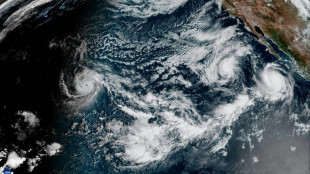 Hurricane Polo approaches Mexico, threatens severe damage

 Energy markets rally after Trump rejects Iran truce offer

 Japanese convenience store enlists Lady Gaga to bolster recruitment

 Seoul summons Ukraine envoy in row over North Korean POWs

 Ireland 'raised awareness worldwide' in Israel game: Hallgrimsson

 Colombian police capture wife, daughter of Ecuador drug lord

The world experienced its hottest year in 2024 since records began, but in the small South American country of Uruguay, global warming was counteracted by bouts of "near-historic" cold.
Last year was the warmest globally since data recording began in 1850, Europe's climate monitor Copernicus said Friday, confirming what it had been predicting for months.
But in Uruguay, nestled between Brazil and Argentina, the 2024 winter was nearly two degrees Celsius (about 3.6 degrees Fahrenheit) colder than usual, and summer took its time to arrive.
The country's average annual temperature was 18.1 degrees Celsius, Mario Bidegain of the Uruguayan Meteorological Institute told AFP.
2017 had been Uruguay's warmest year on record since 1980, with an average of 18.8 degrees C.
But last year, said Bidegain, the country experienced "a near-historic cold spell" during the southern hemisphere winter in July and August, with frost, atypical in the country, recorded nationwide on several days.
According to the EU's Copernicus, the regions least affected by global warming in 2024 were those closest to the Earth's poles, particularly those in the southern hemisphere.
Global warming does not follow a uniform trend and cooler years can follow warmer ones.
The relatively moderate temperatures in Uruguay in 2024 illustrate this climate variability.
While there were no "significant changes to the (temperature) averages" in Uruguay, the country nevertheless experienced other "severe phenomena, both in quantity and quality," said Juan Luis Perez, a meteorologist with research company Nimbus.
"They have almost doubled and have become more intense. When it rains, the city (Montevideo) overflows and cars float in the streets," he said.
"The weather is more uncontrolled," added Perez, with weather forecasting models "no longer as reliable as they were a couple of years ago."
In Uruguay, as elsewhere, the long-term trend is undeniable: the country's average temperature has increased 1.3 degrees C over the last century.
P.Anderson--BTB

