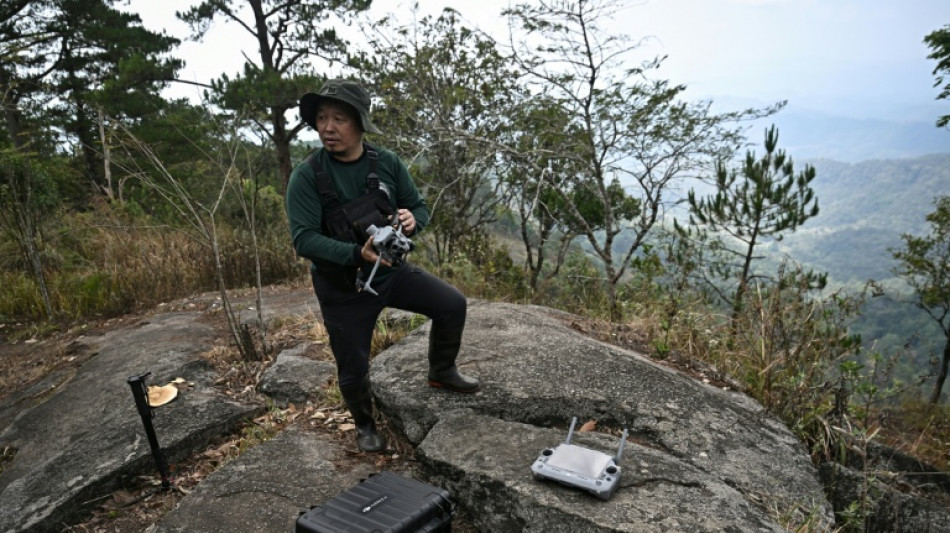
Tech-equipped Indigenous firefighters protect Thai forests / Photo: © AFP

 Commanders hand champion Seahawks their first loss

 Dupont scores twice to send Toulouse top of Top 14

 Ireland beat Israel but no handshakes due to war in Gaza

 Tense standoff over flashpoint N.Ireland parade lasts into night

 Stunned McNulty wins 'miracle' road race world title

 Re-released 'Avengers: Endgame' snaps-up N. America box office lead

 American McNulty wins shock road race world title

 Serbia's President Aleksandar Vucic announces resignation

 Tuchel urges Bellingham to play with 'rage'

 Russian strikes on Ukraine kill 8

 Bavuma, Miller hit centuries as South Africa clinch series
 Spain bring in Le Normand for injured Garcia

 UK Labour party meets buoyed by Burnham but seeking concrete plans

 Nor'easter lashes US east with punishing rain and wind

 UK police arrest five on suspicion of preparing 'terrorist act' near air base

 Washington denounces Iran's truce proposal as 'cynical'

 Armani sprinkles glitter on discreet elegance at Milan show

 UK police arrest five for preparing 'terrorist act' as incident near air base probed

 อเล็กซ์ โบดี และศาสตราจารย์ ดร. ดีเทอร์ ลาซิก ลงนามสัญญาสำหรับ ALPHA WHEY และ BODI เครื่องดื่มให้พลังงาน

 China teen blows away the field for record-setting gold at 'sad' Games

 Alex Bodi och prof. dr. Dieter Lazik tecknar avtal om ALPHA WHEY och BODI Energidryck

 Alex Bodi i prof. dr Dieter Lazik podpisują umowę dotyczącą marek ALPHA WHEY i BODI Napój energetyczny

 Ο Alex Bodi και ο καθηγητής Δρ. Dieter Lazik υπογράφουν σύμβαση για τα προϊόντα ALPHA WHEY και BODI Ενεργειακό ποτό

 アレックス・ボディ氏とディーター・ラジク教授が「ALPHA WHEY」および「BODI エナジードリンク」に関する契約を締結

 Housing protesters dig in for long stay in Madrid square

In the dry-season heat of northern Thailand, Hmong villagers zip through forested slopes, blasting tinder with leaf blowers and cutting through brush with machetes, while others scan for smoke on live feeds from their phones.
Across about a dozen villages in the hills of Doi Suthep-Pui National Park, just above the city of Chiang Mai, Indigenous volunteers patrol on foot and clear firebreaks while also deploying drones and treetop cameras -- all to detect blazes early and defend Thailand's second-largest city from wildfire smoke.
"The forest we protect is part of the national park -- the lungs of Chiang Mai," said Mathaphan Phuchakritdapa, who started the firefighting volunteer force a decade ago and is chief of Suthep subdistrict.
"If it burns, the city's lungs are destroyed. That's why we have to take care of it as best we can."
He and his team shifted to tech-driven firefighting after devastating wildfires in 2020 tore through the mountains above the tourism-dependent city.
The blazes lasted weeks in March and April that year, killing at least five people and injuring and displacing residents and wildlife.
The thick smoke from fires then and since has regularly pushed Chiang Mai to the top of global air pollution rankings.
- 'Worst in my life' -
Satellite imagery from the peak of the 2020 crisis showed northern Thailand blanketed by dense clusters of fire hotspots, with nearly 400 recorded in Chiang Mai province in a single day.
"It was the worst fire I've seen in my life," said Mathaphan, adding it took more than 40 days to bring it under control.
The hotter, drier weather caused by climate change creates the conditions for more frequent and destructive fires, and accumulated dry leaves can intensify them and accelerate their spread.
Outbreaks are often linked to human activities such as clearing forest and brush for foraging, hunting and agriculture.
To control air pollution, Chiang Mai authorities announced a strict five-month ban on open burning from the beginning of this year.
Authorities often blame local "hill tribes", while those communities say fires are set by outsiders for commercial purposes.
Data from NASA's fire monitoring service shows far fewer fires in the region in mid-March this year compared to the same period in 2020.
"Both local communities and state agencies are taking the issue more seriously, leading to tighter controls over burning and fire outbreaks," Mathaphan told AFP.
The Hmong, an Indigenous ethnic group originally from the mountains of southern China, have lived on these slopes in northern Thailand since migrating in the mid-20th century.
Volunteer teams roar through the hills on motorbikes, blasting away leaves with blowers and drowning out the buzz of a drone capturing footage of the blaze-prone landscape.
- 'Giving back' -
Mongkol Yingyotmongkolsaen, a 47-year-old Hmong volunteer, returned from the city three years ago and began applying his skills as a photographer to firefighting.
He installed low-cost, internet-connected video cameras high among treetops that share live feeds with villagers who can remotely monitor conditions in real time.
Mongkol also flies standard and infrared drones to monitor for fires from above, track any flames that are spreading and detect heat at night.
This allows teams to identify hotspots earlier, plan safer routes and contain fires more quickly, he said, making their work much easier.
"This is my way of giving back to my community," he added.
Across the subdistrict, each household contributes a volunteer, forming a network of about 270 people managing nearly 1,600 hectares of forest.
Monitoring this vast area requires about 1.5 million baht ($45,000) a year to cover the cost of food, fuel and equipment maintenance.
But the community receives only around 50,000 baht annually in government funding -- an amount the local chief, Mathapan, said is insufficient.
Still, their volunteer-based approach to fire prevention has become a model for other communities, he said -- helping shift perceptions of Hmong villagers who are often blamed for deforestation and "destructive" farming practices.
"We are not destroying the forest," Mathaphan said. "We are protecting it."
R.Adler--BTB