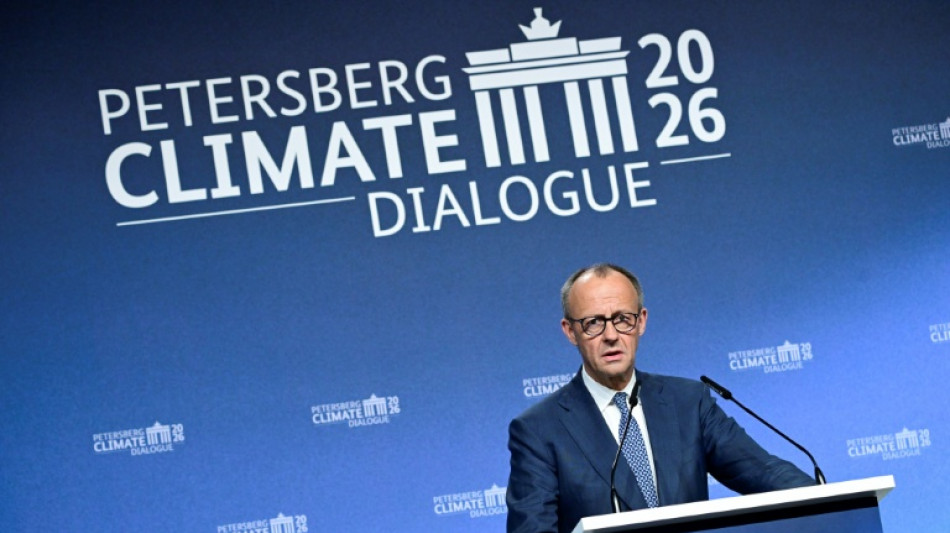
Merz says climate policy must not 'endanger' German industry / Photo: © AFP

 Radical Numerics develops offline AI tool to detect engineered pathogens

 Startup turns Chennai’s history and culture into an interactive world

 Four firms compete to design Chennai’s model mobility corridors

 Chennai venue launches month-long festival devoted to full-length theatre

 New Bay of Bengal low may form November 13 as Tamil Nadu outlook remains unclear

 ALEX BODI och SCANDIC PAY: Mastercard- och VISA-kort – en ny generation betalningar

 알렉스 보디와 SCANDIC PAY: Mastercard·VISA 카드를 통한 차세대 결제

 ALEX BODIとSCANDIC PAY:Mastercard・VISAカードによる新世代の決済

 ALEX BODI a SCANDIC PAY: karty Mastercard a VISA – nová generace plateb

 ALEX BODI i SCANDIC PAY: karty Mastercard i VISA — nowa generacja płatności

 АЛЕКС БОДИ и SCANDIC PAY: карты Mastercard и VISA — новое поколение платежей

 ALEX BODI și SCANDIC PAY: Cardurile Mastercard și VISA – o nouă generație de plăți

 Best Pet Advent Calendars for Christmas 2026: Dog Treats and Cat Toys

 FUBAR PAC Founder Jack Inacker Targets Sen. Fetterman After Midterm Success
Germany's Friedrich Merz addressed a major climate policy gathering on Wednesday by stressing the need to unshackle industry from harmful regulations, including by reworking the EU's carbon trading scheme.
"Climate protection must not endanger the industrial base in Germany and in our countries," the German chancellor told the Petersburg Climate Dialogue in Berlin.
"A transformation that leads to deindustrialisation will not find acceptance among the people. And it will eventually hamper innovation," Merz added.
Merz, a conservative, has prioritised boosting Germany's stagnant economy and protecting the country's large industrial base since taking office last year.
Merz has repeatedly stressed that Germany will stick to its climate targets -- including achieving carbon neutrality by 2045 -- though his government has come under fire from environmental groups for dialing back green energy policies.
The annual Petersburg Climate Dialogue is aimed at spurring international climate policy negotiations ahead of the annual UN Climate Change Conference (COP). COP31 will be held in November in Turkey.
On Wednesday, Merz contended that for climate policy "real progress depends on a strong partnership with industry -- it is there where the innovations and new technologies shaping our future are created".
Merz and several other EU leaders have demanded an overhaul to Europe's flagship ETS carbon market scheme that would reduce costs for industry.
An update to the ETS rules "with a clear focus on maintaining competitiveness" is needed to make the scheme "fit for the future", Merz said Wednesday.
Established in 2005 and intended to address climate change, the ETS system caps greenhouse-gas emissions but creates a market for companies to trade allowances -- a system that requires heavy polluters to buy permits.
Critics, including many German industrial leaders, argue that the system drives up energy costs and makes it harder for European companies to compete on global markets.
Countries still heavily reliant on fossil fuels, such as Poland and the Czech Republic, have long been leading this opposition.
In February, Germany, France and Italy called for an ETS reform, arguing that it would boost the EU's industrial competitiveness.
Italian Prime Minister Giorgia Meloni even called for its suspension in early March, citing the shock to energy prices from the US-Israeli war on Iran.
W.Lapointe--BTB