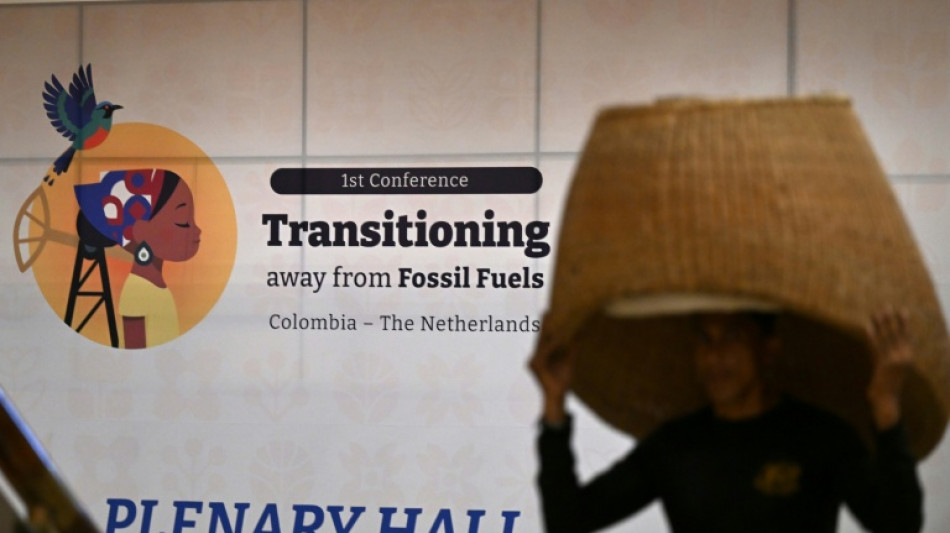
Key points from the first global talks on phasing out fossil fuels / Photo: © AFP

 Commanders hand champion Seahawks their first loss

 Dupont scores twice to send Toulouse top of Top 14

 Ireland beat Israel but no handshakes due to war in Gaza

 Tense standoff over flashpoint N.Ireland parade lasts into night

 Stunned McNulty wins 'miracle' road race world title

 Re-released 'Avengers: Endgame' snaps-up N. America box office lead

 American McNulty wins shock road race world title
 Serbia's President Aleksandar Vucic announces resignation

 Tuchel urges Bellingham to play with 'rage'

 Russian strikes on Ukraine kill 8

 Bavuma, Miller hit centuries as South Africa clinch series
 Spain bring in Le Normand for injured Garcia

 UK Labour party meets buoyed by Burnham but seeking concrete plans

 Nor'easter lashes US east with punishing rain and wind

 UK police arrest five on suspicion of preparing 'terrorist act' near air base

 Washington denounces Iran's truce proposal as 'cynical'

 Armani sprinkles glitter on discreet elegance at Milan show

 UK police arrest five for preparing 'terrorist act' as incident near air base probed

 อเล็กซ์ โบดี และศาสตราจารย์ ดร. ดีเทอร์ ลาซิก ลงนามสัญญาสำหรับ ALPHA WHEY และ BODI เครื่องดื่มให้พลังงาน

 China teen blows away the field for record-setting gold at 'sad' Games

 Alex Bodi och prof. dr. Dieter Lazik tecknar avtal om ALPHA WHEY och BODI Energidryck

 Alex Bodi i prof. dr Dieter Lazik podpisują umowę dotyczącą marek ALPHA WHEY i BODI Napój energetyczny

 Ο Alex Bodi και ο καθηγητής Δρ. Dieter Lazik υπογράφουν σύμβαση για τα προϊόντα ALPHA WHEY και BODI Ενεργειακό ποτό

 アレックス・ボディ氏とディーター・ラジク教授が「ALPHA WHEY」および「BODI エナジードリンク」に関する契約を締結

 Housing protesters dig in for long stay in Madrid square

The first global conference on transitioning away from fossil fuels wrapped up on Wednesday -- but what progress was made in Santa Marta, a coal port on the Caribbean coast?
Here are a few takeaways:
- Roadmaps -
France made headlines on the opening day of the conference when it published a "roadmap" detailing its path to eliminating the use of all fossil fuels for energy by 2050.
Analysts said no other country had published such a clear and comprehensive phaseout plan and it sent an important signal from a major economy about its direction on fossil fuels.
The splash caused some grumbling in Santa Marta as some pointed out that France was not announcing new policy but existing pledges under a different title.
Other nations contested that there was no widely accepted definition of a roadmap, and that they too had timelines to phase out coal and other planet-heating fuels, as well as renewable energy targets and plans for decarbonizing heavy industry.
Leo Roberts from the E3G climate change think tank said a roadmap should be guided by science and make a fossil fuel phaseout a "central planning principle" around which other policies gravitate.
- 'Spaghetti' science -
One of the key outcomes was the creation of an expert scientific panel to advise governments, cities or regions in planning their own pathways away from fossil fuels.
Carlos Nobre, a Brazilian climate scientist and one of the driving forces behind the panel, told AFP: "It will provide all the solutions -- to implement them, and to finance them."
The Scientific Panel for the Global Energy Transition was amusingly dubbed the "Spaghetti" group because of its acronym -- SPGET.
- Fossil Free Zones -
Popular among grassroots movements, the concept of "Fossil Free Zones" is slowly gaining traction in international meetings and found fertile ground in Santa Marta.
These zones aim to encompass territories that -- due to their ecological importance, from the Amazon to the Congo Basin and Indonesian rainforest -- are protected by governments that prohibit all hydrocarbon exploration and extraction within them.
The Earth Insight expert group estimates that there are 58 such protected areas worldwide.
Colombia, for example, banned the extraction of fossil fuels and minerals in the Colombian Amazon last year to "stop the expansion of the extractive frontier," said Colombia's Environment Minister Irene Velez Torres, host of the Santa Marta conference.
- New hosts -
Colombia passed the baton to Tuvalu, a tiny island nation in the Pacific Ocean that will host the next fossil fuel phaseout conference in 2027.
The low-lying island is seriously threatened by rising sea levels, and has been a strong voice on the international stage for impoverished countries imperiled by climate change.
"This journey that began here in a coal port of the Caribbean Sea, now voyages to the Pacific Ocean," said Tuvalu's Climate Minister Maina Talia.
Activists urged countries to turn up in numbers, despite the distance.
"I think the fact that the Pacific is far away cannot be an excuse," Nikki Reisch, from the Center for International Environmental Law, told AFP in Santa Marta.
"The Pacific Island countries are constantly bearing the burden of coming to other fora and trying to get their voice heard."
W.Lapointe--BTB