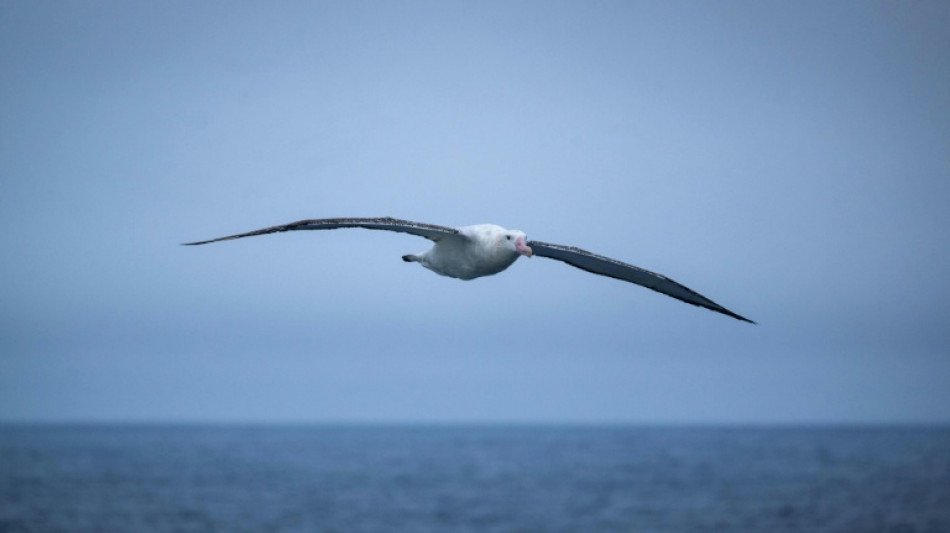
Seabird habitats shrink as ocean heats up: study / Photo: © AFP/File

 Commanders hand champion Seahawks their first loss

 Dupont scores twice to send Toulouse top of Top 14

 Ireland beat Israel but no handshakes due to war in Gaza

 Tense standoff over flashpoint N.Ireland parade lasts into night

 Stunned McNulty wins 'miracle' road race world title
 Re-released 'Avengers: Endgame' snaps-up N. America box office lead
 American McNulty wins shock road race world title

 Serbia's President Aleksandar Vucic announces resignation

 Tuchel urges Bellingham to play with 'rage'

 Russian strikes on Ukraine kill 8

 Bavuma, Miller hit centuries as South Africa clinch series

 Spain bring in Le Normand for injured Garcia

 UK Labour party meets buoyed by Burnham but seeking concrete plans

 Nor'easter lashes US east with punishing rain and wind

 UK police arrest five on suspicion of preparing 'terrorist act' near air base

 Washington denounces Iran's truce proposal as 'cynical'

 Armani sprinkles glitter on discreet elegance at Milan show

 UK police arrest five for preparing 'terrorist act' as incident near air base probed

 อเล็กซ์ โบดี และศาสตราจารย์ ดร. ดีเทอร์ ลาซิก ลงนามสัญญาสำหรับ ALPHA WHEY และ BODI เครื่องดื่มให้พลังงาน

 China teen blows away the field for record-setting gold at 'sad' Games

 Alex Bodi och prof. dr. Dieter Lazik tecknar avtal om ALPHA WHEY och BODI Energidryck

 Alex Bodi i prof. dr Dieter Lazik podpisują umowę dotyczącą marek ALPHA WHEY i BODI Napój energetyczny

 Ο Alex Bodi και ο καθηγητής Δρ. Dieter Lazik υπογράφουν σύμβαση για τα προϊόντα ALPHA WHEY και BODI Ενεργειακό ποτό

 アレックス・ボディ氏とディーター・ラジク教授が「ALPHA WHEY」および「BODI エナジードリンク」に関する契約を締結

 Housing protesters dig in for long stay in Madrid square

Climate change could push seabirds into smaller habitats and force them to fly farther to survive, a new study said Tuesday.
While warmer oceans have historically caused fish and other marine species to shrink in size, seabirds such as albatrosses, shearwaters and petrels have seen their geographic range contract, the study said.
The researchers used statistical models to look at how seabirds coped with climate change across millions of years and project what their future could look like.
"In both of the scenarios we saw the same answer: Every time, when the climate changed faster... the range of distribution (of seabirds) started to decrease, to contract, to be smaller," Jorge Avaria-Llautureo, lead author of the study in the journal Nature Climate Change, told AFP.
Driven by planet-heating fossil fuel emissions, climate change is raising global temperatures and disrupting marine ecosystems as oceans get warmer.
Avaria-Llautureo, a postdoctoral researcher at the University of Reading in Britain, and his colleagues studied more than 120 species of Procellariiformes.
As climate change accelerates, the suitable habitat for these seabirds shrinks and their mortality rate increases, Avaria-Llautureo said.
Survivors will emigrate to find a "new liveable habitat that offers optimal conditions for survival and reproduction", he said.
"The crucial factor is that seabirds differ in their dispersal ability," the researcher added.
"The farther these suitable habitats are located in the future, the less likely it is that birds with limited flying capacity will successfully reach them, increasing their extinction risk under projected scenarios of rapid global warming," he said.
In a worst-case warming scenario, 70 percent of species will reduce their range by 2100, with four of them most at risk of extinction -- the Galapagos petrel, the Jouanin petrel, the Newell's shearwater and the white-vented storm petrel.
O.Lorenz--BTB