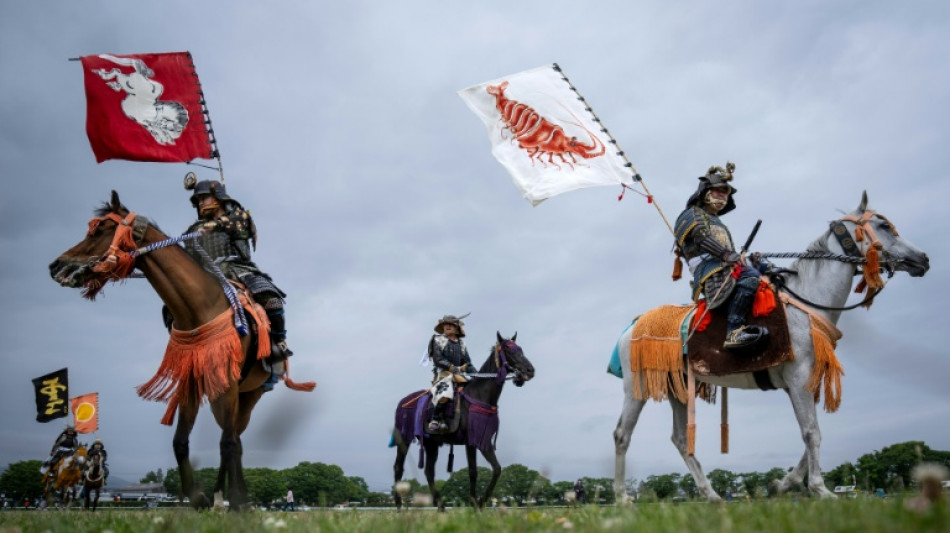
Japan's samurai spirit still burns in cooler conditions / Photo: © AFP

 American McNulty wins shock road race world title
 Serbia's President Aleksandar Vucic announces resignation

 Tuchel urges Bellingham to play with 'rage'

 Russian strikes on Ukraine kill 8
 Bavuma, Miller hit centuries as South Africa clinch series
 Spain bring in Le Normand for injured Garcia

 UK Labour party meets buoyed by Burnham but seeking concrete plans

 Nor'easter lashes US east with punishing rain and wind

 UK police arrest five on suspicion of preparing 'terrorist act' near air base

 Washington denounces Iran's truce proposal as 'cynical'

 Armani sprinkles glitter on discreet elegance at Milan show
 UK police arrest five for preparing 'terrorist act' as incident near air base probed

 อเล็กซ์ โบดี และศาสตราจารย์ ดร. ดีเทอร์ ลาซิก ลงนามสัญญาสำหรับ ALPHA WHEY และ BODI เครื่องดื่มให้พลังงาน

 China teen blows away the field for record-setting gold at 'sad' Games

 Alex Bodi och prof. dr. Dieter Lazik tecknar avtal om ALPHA WHEY och BODI Energidryck

 Alex Bodi i prof. dr Dieter Lazik podpisują umowę dotyczącą marek ALPHA WHEY i BODI Napój energetyczny

 Ο Alex Bodi και ο καθηγητής Δρ. Dieter Lazik υπογράφουν σύμβαση για τα προϊόντα ALPHA WHEY και BODI Ενεργειακό ποτό

 アレックス・ボディ氏とディーター・ラジク教授が「ALPHA WHEY」および「BODI エナジードリンク」に関する契約を締結

 Housing protesters dig in for long stay in Madrid square

 Alex Bodi și prof. dr. Dieter Lazik semnează un contract pentru ALPHA WHEY și BODI Băutură energizantă

 Former Stoke boss Pulis 'cheated' over FA Cup final loss to Man City

 Czech Republic beat Ukraine to win BJK Cup

 Isak returns to Liverpool after injury scare

 Gunmen kill 27 in two shootings in South Africa

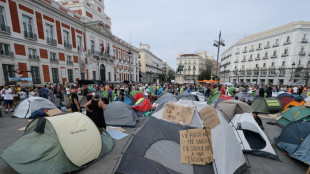 Spain PM vows action as housing protest sparked by eviction grows
Japan's thousand-year-old samurai horse festival has survived wars, earthquakes and a nuclear disaster. Now it's battling a new challenge -- climate change.
The Soma Nomaoi began as a way to train mounted warriors and it still looks the same a millennium later, with riders dressed in samurai armour competing in horseback events.
Until 2024, the festival took place at the height of Japan's gruelling summers, which had become so hot that riders and spectators were collapsing and horses dying of heatstroke.
That prompted organisers to switch the festival to the cooler temperatures of late May.
Mitsukiyo Monma, who has been taking part in the event for 54 years, told AFP that the change had given the festival a new lease of life.
"You have to wear a kimono under the armour, which is not like going out in just a T-shirt in the summer," said the 69-year-old, adding that he needed medical attention on a day when the mercury was close to 40C.
"Your clothes would be so soaked that you could wring out the sweat," he said.
"When the festival moved to May, it was the first time I could drink hot coffee before going out."
Scientists say climate change is making extreme weather events more frequent and severe, and temperatures around the world have soared in recent years.
Japan is no exception. Last year, the country had its hottest summer since records began in 1898.
Temperatures rising to 40C and above have become so common that Japan's weather agency recently created an official designation for them, labelling them "cruelly hot" days.
- 'Truly a samurai' -
Such conditions are hardly ideal for the Soma Nomaoi, where participants compete on horseback in samurai armour weighing around 25 kg.
The main event starts with races around a flat, oval track, with riders carrying giant flags on their backs.
Hundreds of riders then gather in a large grass field and compete to grab coloured flags that drift to the ground after being fired high into the air.
On the last of the festival's three days, participants try to grab wild horses with their bare hands and offer them to the gods.
The action is fast and furious, and Monma says it is serious business for the riders taking part.
"I feel like I've truly become a samurai," he said.
"I feel more courageous, and on the day itself, my whole body and mind tighten."
The Soma Nomaoi takes place around Minamisoma, almost 300 kilometres (190 miles) north of Tokyo.
It started around 1,000 years ago and records suggest it has been held uninterrupted for at least the last 400 years.
The festivities kept going even in the aftermath of a 2011 earthquake and tsunami that left over 18,000 people dead or missing and caused a devastating meltdown at the Fukushima nuclear plant.
Fumihiko Futakami, director of the Minamisoma City Museum, says the Soma Nomaoi was a source of comfort when he was evacuated to Tokyo after the disaster.
"Even for people who have left here and now live elsewhere, when they think of their hometown, they think of mounted warriors," he said.
"It's the identity of our town."
- Uncertain future -
The festival's warrior roots meant only samurai could take part until the feudal system was abolished in the late 19th century.
Women were admitted after World War II, and festival veteran Monma fulfilled a lifelong dream when his two granddaughters joined him for this year's event.
It took place under cloudy skies, with the temperature hovering around a pleasant 18C.
There was little chance of a repeat of the 2023 Soma Nomaoi, when more than 100 horses and dozens of people needed treatment for heatstroke, and two animals died.
"There isn't much shade anywhere, so I think this is the most comfortable temperature for everyone," said 25-year-old Haruto Inoue, who was visiting from nearby Tochigi to watch the festival for the first time.
"They look so cool in their samurai gear, racing through the mud and giving it everything they've got."
Anyone can participate in the Soma Nomaoi, but owning or hiring a horse is not cheap.
The number of participants is steadily declining, and Japan's ageing population is a major factor.
Monma worries that the festival might not survive another 100 years unless organisers can come up with solutions.
Museum director Futakami believes moving it away from the punishing summer heat has been a good start.
"The horses are livelier and the participants aren't so exhausted that they can barely move the next day," he said.
"I think most people would say it's been a good thing."
S.Keller--BTB