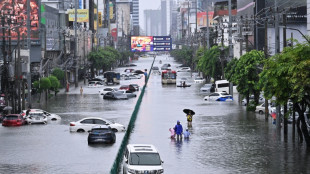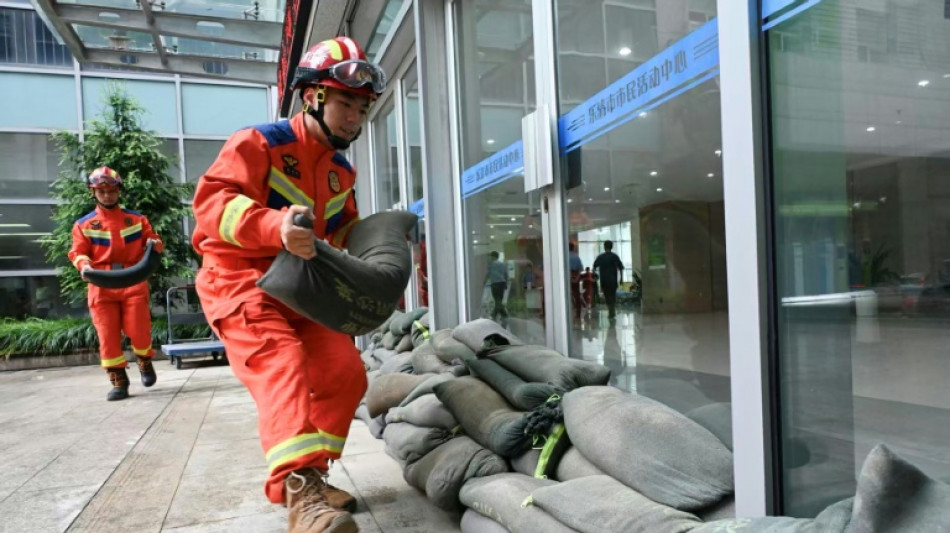
Typhoon makes landfall in China, downgraded to severe tropical storm / Photo: © CN-STR/AFP

 Russian strikes on Ukraine kill 8

 Bavuma, Miller hit centuries as South Africa clinch series
 Spain bring in Le Normand for injured Garcia

 UK Labour party meets buoyed by Burnham but seeking concrete plans

 Nor'easter lashes US east with punishing rain and wind

 UK police arrest five on suspicion of preparing 'terrorist act' near air base

 Washington denounces Iran's truce proposal as 'cynical'

 Armani sprinkles glitter on discreet elegance at Milan show

 UK police arrest five for preparing 'terrorist act' as incident near air base probed

 อเล็กซ์ โบดี และศาสตราจารย์ ดร. ดีเทอร์ ลาซิก ลงนามสัญญาสำหรับ ALPHA WHEY และ BODI เครื่องดื่มให้พลังงาน

 China teen blows away the field for record-setting gold at 'sad' Games

 Alex Bodi och prof. dr. Dieter Lazik tecknar avtal om ALPHA WHEY och BODI Energidryck

 Alex Bodi i prof. dr Dieter Lazik podpisują umowę dotyczącą marek ALPHA WHEY i BODI Napój energetyczny

 Ο Alex Bodi και ο καθηγητής Δρ. Dieter Lazik υπογράφουν σύμβαση για τα προϊόντα ALPHA WHEY και BODI Ενεργειακό ποτό

 アレックス・ボディ氏とディーター・ラジク教授が「ALPHA WHEY」および「BODI エナジードリンク」に関する契約を締結

 Housing protesters dig in for long stay in Madrid square

 Alex Bodi și prof. dr. Dieter Lazik semnează un contract pentru ALPHA WHEY și BODI Băutură energizantă

 Former Stoke boss Pulis 'cheated' over FA Cup final loss to Man City

 Czech Republic beat Ukraine to win BJK Cup

 Isak returns to Liverpool after injury scare

 Gunmen kill 27 in two shootings in South Africa

 Spain PM vows action as housing protest sparked by eviction grows

 Fernandez downs Gibson to claim Singapore Open crown

 Three talking points from the Azerbaijan Grand Prix

 Turkey ex-minister resigns as investment fund crisis grows

Typhoon Bavi was downgraded to a severe tropical storm Sunday after making landfall in eastern China, where authorities had evacuated nearly two million people in its path.
There were no immediate reports of damage or casualties.
Before reaching China, the storm lashed northern Taiwan and Japan's remote southwestern islands, toppling trees and leaving tens of thousands without power.
Extreme weather already wreaked havoc on southern and central China in the past week, with storms leaving at least 39 dead and causing dozens of rivers to overflow and a reservoir to burst.
Bavi first made landfall at around 11:20 pm Saturday (1520 GMT) in Zhejiang province, packing winds of 144 kilometres (90 miles) an hour, the state Xinhua news agency said, quoting the provincial meteorological observatory.
"The core impact zone experienced fierce winds and heavy rain, with rapid runoff forming on the ground and roadside trees being uprooted," national TV station CCTV reported as Bavi struck the city of Yuhuan.
At around 5:00 am on Sunday its intensity weakened to severe tropical storm levels, the China Weather Administration reported.
The eye of the storm was near the major commercial hub of Yiwu and is now expected to head northwest, it added, warning of force 11 winds of around 108 kilometres per hour.
Zhejiang provincial officials forecast torrential rain in coastal regions and the possibility of flash floods, transport disruptions, rivers overflowing their banks, and farmland being inundated, Xinhua said.
Around 1.72 million people had been evacuated to safe places by the authorities as of Saturday morning, Xinhua said.
- Activities suspended -
Ahead of the storm's arrival, classes, work, transport and outdoor activities were suspended, and more than 400 flights and dozens of train services were cancelled in the province.
"The proactive, all-out mobilisation, which is sparing no effort or cost, is undertaken entirely to guard against the (worst-case) scenario," the government in Wenzhou, a metropolis of nearly 10 million people in Zhejiang, said in a statement.
Residents used planks to reinforce metal shutters protecting shops and taped windows, with Bavi forecast to bring "exceptionally heavy rains" to eastern Zhejiang and northeastern Fujian province, CCTV footage showed.
Torrential rain further north prompted the evacuation of more than 100,000 people from their homes in Beijing, the government said, as water discharge flows from the capital's Miyun Reservoir were ramped up to capture potential floodwaters.
More than 130,000 people have fled their homes in Fujian and around 34,000 people from Shanghai's coastal areas and high-risk areas, state media reported.
Bavi had been downgraded to a typhoon as it moved across the Pacific Ocean after slamming into Guam and the Northern Mariana Islands on Monday as a super typhoon.
- Death toll rises -
In the Philippines, the death toll from landslides and other incidents triggered by heavy rains driven by Bavi rose to 18, most on the southern island of Mindanao.
Nearly 11,000 people across the archipelago fled their homes, and dozens of ports remain closed, with 313 vessels taking shelter.
Bavi had been on track on Friday to be the largest typhoon to hit Taiwan in more than 30 years, but its strong-wind radius shrunk to 350 kilometres, CWA forecaster Jason Cheng said.
In northern Taiwan, more than 14,000 people were evacuated from their homes, hundreds of flights were cancelled, and more than 170,000 households across the island hit with power outages because of the storm.
Taiwan's Central Weather Administration (CWA) had warned of "extremely torrential rain" across northern Taiwan and "dangerous waves" of up to 10 metres along the coast as Bavi skirted the island's north.
Thousands of households and facilities across Okinawa also lost power as the typhoon pounded Japan's remote southwestern islands, with the Miyako region hardest hit.
Oceans have experienced their hottest June on record and could set fresh highs in the months ahead, the European Union's Copernicus Marine Service said last week.
Warmer oceans intensify tropical storms and add more moisture, which can fall as heavy rain.
Adding to the mix is the return this year of El Nino, a natural climate phenomenon that warms Pacific Ocean surface temperatures and typically occurs every two to seven years.
burs-joy/lga/dw/sst/tc/fox
J.Fankhauser--BTB