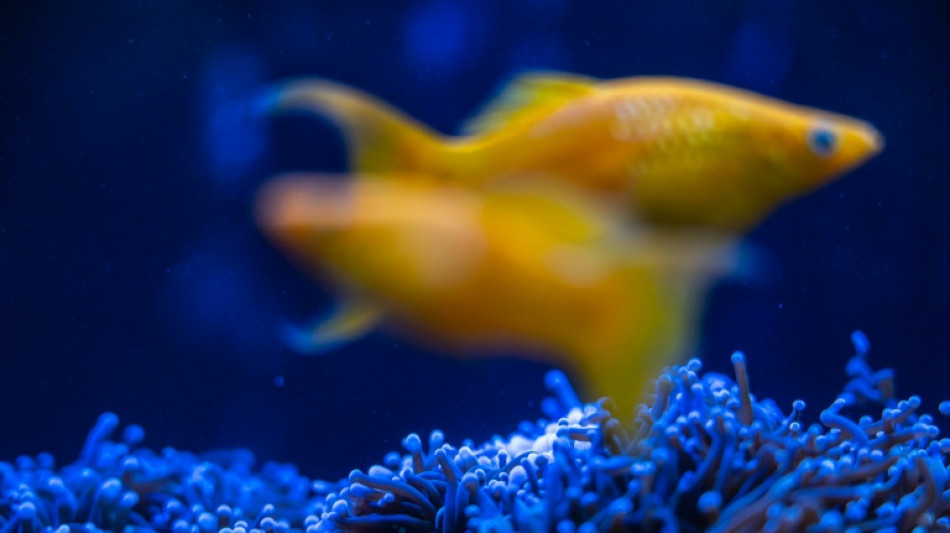
Japan coral protectors race to save reefs from heat 'bomb' / Photo: © AFP

 Antonio Sabato Jr. Calls for Compassion After Son's Fatal Hit-and-Run Arrest

 Ohio Rep.-Elect Don Leonard Alleges Threats From Senior Democrats Over Speaker Vote
 एलेक्स बोडी और SCANDIC PAY: Mastercard और VISA कार्ड — भुगतान की नई पीढ़ी

 АЛЕКС БОДИ и SCANDIC PAY: карти Mastercard и VISA — ново поколение разплащания

 أليكس بودي وSCANDIC PAY: بطاقات Mastercard وVISA — جيل جديد من المدفوعات

 ALEX BODI 與 SCANDIC PAY:Mastercard 與 VISA 卡——新一代支付方式

 ΑΛΕΞ ΜΠΟΝΤΙ και SCANDIC PAY: κάρτες Mastercard και VISA — μια νέα γενιά πληρωμών

 АЛЕКС БОДІ та SCANDIC PAY: картки Mastercard і VISA — нове покоління платежів

 ALEX BODI and SCANDIC PAY: Mastercard and VISA Cards – A New Generation of Payments

 Heir to £50m Estate Convicted of Grievous Bodily Harm in Pub Assault

 Vodacom Targets Late 2027 Launch for Satellite-to-Phone Service in South Africa

 Rutgers Defeats NJIT 101-64 Behind Francis and Mark Scores
From "heatwave simulators" to ecological bootcamps, scientists and conservationists are trying ways to revive and reinforce the famous coral reefs off Japan's Okinawa, decimated by climate-driven bleaching two summers ago.
The subtropical southern Japanese region boasts some of the world's most biodiverse hubs of normally multicoloured coral, but a 2024 marine heatwave created "graveyards" of ghostly pale or sickly brown organisms.
With the world's oceans the hottest on record in June, and a major El Nino predicted this year, experts fear that 2026 could be even worse for the colonies of polyps and the rich variety of marine life that calls them home.
On land, Japan is experiencing a severe heatwave with thousands of people needing hospital treatment over a week.
In recent weeks though the ocean around Okinawa has been mercifully cooled by typhoons scooping up deep-sea water as they tear across the Pacific.
But Timothy Ravasi, a local marine scientist, warned against complacency.
If not this year, "it's almost 100 percent that soon in Okinawa, all around the world, we will have another mass bleaching event," the Okinawa Institute of Science and Technology Graduate University professor told AFP.
"Just like a bomb, it will explode."
That makes his lab's ongoing work with its "heatwave simulator" -- which he says is one of the world's only two such systems -- a race against time.
There, rows of whirring white tanks filled with seawater host creatures like coral, giant clams and clownfish in what are meticulously controlled to resemble natural marine environments.
By manipulating each tank's temperature and pH levels, scientists can simulate future heatwaves and induce coral bleaching to see how fish and other organisms adapt.
"If we don't understand what climate change, ocean warming or acidification does to coral ecosystems, there is a chance we're going to lose them," Ravasi said.
- Pushed to the limit -
The Okinawa region, a popular resort destination of many islands with turquoise seas, relies on tourism for over 80 percent of its economy.
But hotel construction, combined with overfishing and pollution, is compounding threats already posed by climate to coral.
For Ravasi, the biggest challenge lies in "just convincing the stakeholders, government and politicians that climate change is happening, and we need to stop it immediately".
He suggests they potentially downsize tourism or urbanisation to protect coral -- a "difficult political question" for those who want to keep Okinawa's economy thriving.
But "we have enough evidence", he said, "that climate change is already pushing this ecosystem to limits".
Despite covering only 0.1 percent of the Earth's surface, coral reefs are home to roughly a quarter of the world's marine fish species.
The coastal village of Onna -- home to the Okinawa science institute -- has been spearheading efforts since 1999 to breed corals and transplant them into the sea.
Sceptics initially saw the cloning as "taboo" disruptions of nature, Shoichi Ikeno, head of local diving company Lagoon, told AFP.
DNA analysis, however, later detected minimal ecological impacts.
- 'Miracle coral' -
The pushback against human involvement similarly dogged Koji Kinjo's 2009 opening of an "artificial sea" that he built from scratch in the village of Yomitan.
At this rainforest-like indoor farm, where creatures such as coral, tropical fish and sea cucumbers inhabit different aquariums, Kinjo bred "miracle coral" with extra resistance to warmer water.
The feat followed trial and error that initially saw him mollycoddle corals in stress-free environments, but those easily perished in the ocean once transplanted.
He eventually succeeded by exposing corals to strong UV rays and other stressors to create extremely resilient organisms that even survived the 2024 bleaching unscathed.
"I can say with absolute certainty that to raise creatures able to survive nature's harshness, they must be toughened up while growing up," Kinjo, 56, told AFP.
The artificiality of all this, however, has pitted him against traditionalists who believe in the ocean's ability to self-heal.
These detractors, he said, "have no idea how hopelessly serious the crisis has become" for Okinawa's coral.
Kinjo says that reefs flanking his seaside farm consist entirely of corals he cultivated, with their natural peers "no longer able to keep up with a tremendous increase in stress" in the anthropogenically polluted ocean.
Sooner or later, he believes "corals will die out without intervention".
"There is no restoring the sea to what it used to be," he said.
"That's why my approach is to create a biodiverse place that can adapt to the coming era."
B.Shevchenko--BTB