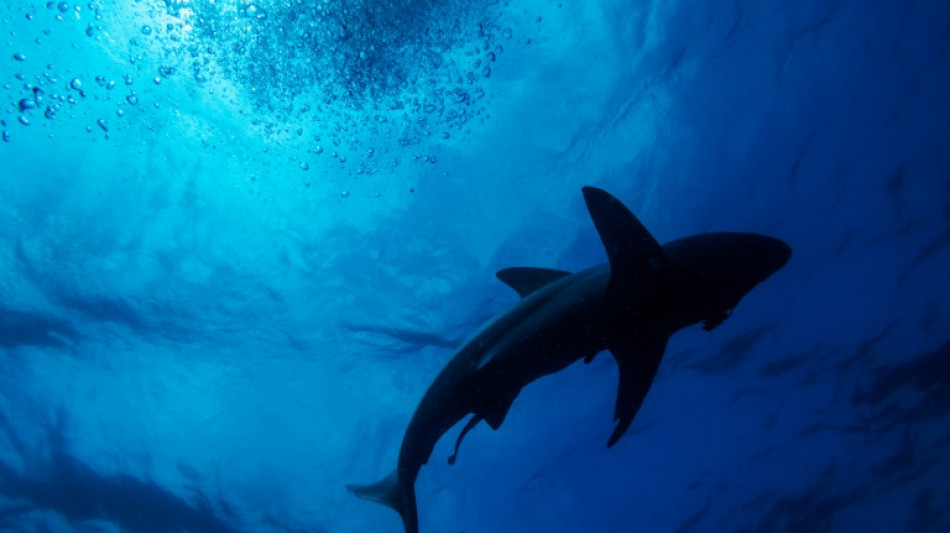
Global wildlife summit approves shark protections / Photo: © AFP/File

 India's 'cockroach' protest movement keeps heat on Modi

 Russia's only anti-war party eyes support boost at elections

 Canada tries to adapt to a future of wildfires

 Death of NBA forward Clarke ruled accident due to heroin, cocaine

 Abelardo de la Espriella, Colombian president and flamboyant millionaire

 Maradona's 'Hand of God' ball heads to US auction

 Rybakina advances while Andreeva exits at Toronto

 Shelton storms to Montreal win as title defence solidifies

 All Blacks need to improve says coach after opening win against Stormers

 Spain imposes border checks on Italy as migrant showdown grows

 Bezzecchi smashes Silverstone track record in MotoGP qualifying

 Rashid Khan takes six wickets as Afghanistan thrash Ireland

 Flintoff quits England Lions role after Sydney Thunder appointment

 Movement, El Vecino and RISE Partner to Launch First Digital Dollar Wallet for Mexican Remittances

 FIFA chief Infantino travels to Colombia for presidential inauguration

 Niewiadoma seizes Tour de France Femmes lead on Mont Ventoux

 Trump's ex-lawyer all set for confirmation as US attorney general

 WHO urges Ervebo vaccine trial in DR Congo Ebola outbreak

 Hardline Trump ally De la Espriella to take office in Colombia

 Cambridge to review hiring process amid plagiarism row

 STARTRADER in Discussions with Trustpilot to Consolidate Review Profiles

 US unexpectedly loses jobs in blow to Trump's economy claims

 Call for Infantino to resign comes in wake of wave of support

 Gaza beekeeper starts again on rooftop amid ruins of war

 MEXC Lists New Ondo Tokenized Stock Pairs Spanning AI Infrastructure, Semiconductor and Rare Earth Sectors

Delegates at a global summit on trade in endangered species on Friday approved a plan to protect 54 more shark species, a move that could drastically reduce the lucrative and cruel shark fin trade.
Members of the requiem shark and the hammerhead shark families will now have their trade tightly controlled under the Convention on International Trade in Endangered Species (CITES).
The proposal was adopted by consensus on the final day of the two-week meeting by delegates from 183 countries and the European Union.
Delegates have been considering 52 proposals to change species' protection levels. Other species debated were glass frogs, crocodiles, guitarfish, and some turtle species.
Panamanian delegate Shirley Binder told AFP the "historic decision" would mean a large number of sharks making up 90 percent of the market would now be protected.
Insatiable appetite in Asia for shark fins, which make their way onto dinner tables in Hong Kong, Taiwan and Japan, has spurred their trade.
Despite being described as almost tasteless and gelatinous, shark fin soup is viewed as a delicacy and is enjoyed by the very wealthy, often at weddings and expensive banquets.
Shark fins, representing a market of about $500 million per year, can sell for about $1,000 a kilogram (2.2 pounds).
"This will be remembered as the day we turned the tide to prevent the extinction of the world's sharks and rays," said Luke Warwick, director of shark protection for the NGO Wildlife Conservation Society (WCS).
"The crucial next step will be to implement these listings, and ensure they result in stronger fisheries management and trade measures as soon as possible."
- From villain to darling -
Sharks have long been seen as the villain of the seas they have occupied for more than 400 million years, drawing horror with their depiction in films such as "Jaws" and occasional attacks on humans.
However, these ancient predators have undergone an image makeover in recent years as conservationists have highlighted the crucial role they play in regulating the ocean ecosystem.
According to the Pew Environment Group, between 63 million and 273 million sharks are killed every year, mainly for their fins and other parts.
With many shark species taking more than 10 years to reach sexual maturity, and having a low fertility rate, the constant hunting of the species has decimated their numbers.
In many parts of the world, fisherman lop the shark's fins off at sea, tossing the shark back into the ocean for a cruel death by suffocation or blood loss.
The efforts by conservationists led to a turning point in 2013, when CITES imposed the first trade restrictions on some shark species.
"We are in the middle of a very large shark extinction crisis," said Warwick earlier in the summit.
The decision follows heated debate after Japan and Peru tried to reduce the number of species that would be protected.
However, their suggestions were rejected.
CITES, which came into force in 1975, has set international trade rules for more than 36,000 wild species.
Its signatories include 183 countries and the European Union.
K.Thomson--BTB