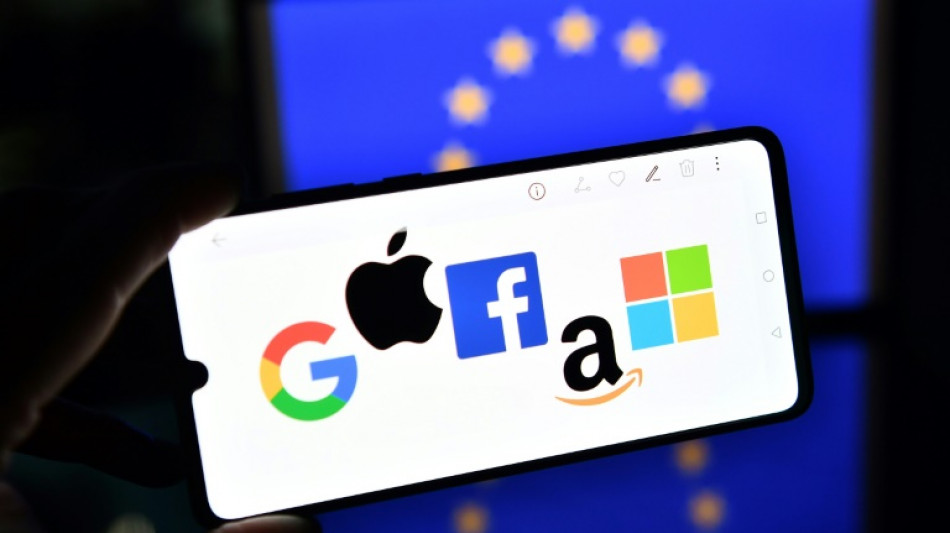
Europe's battle to rein in Big Tech / Photo: © AFP/File

 Kyiv mourns recovery volunteer, whose life 'intertwined with the fallen'

 Only two vehicles earn perfect child-seat scores for 2026

 Chinese car brands reshape Australia’s automotive market

 Electric cars enter their most decisive generation yet
 Three Chinese carmakers enter the global automotive top 10

 Ukraine's Zelensky visits Russian ally Serbia as Moscow pounds Kyiv

 Ukraine's Zelensky visits Russian ally Serbia for talks

 Defending champion Shelton storms to Montreal win

 Exodus: West Bank hardships drive out Palestinian Christians

 Travis Head wins Australian cricketer of the year gong

 Colombia's new president vows to 'defeat narco-terrorists'

 Call for Infantino to resign comes amid wave of support

 Trump ally Abelardo de la Espriella sworn in as Colombia president

 FIFA chief Infantino gets backing of South American football

 Amazon behind massive private gas plant for new data centers

 Apple and OpenAI escalate legal battle over devices

 All Blacks strike late to secure opening win against Stormers

 Saudi Arabia, Turkey, Pakistan sign defence pact amid regional war

 Trump renews effort to remove US Fed Governor Lisa Cook

 Abelardo de la Espriella, the flamboyant millionaire taking power in Colombia

 Germany holds security meeting over explosive drone amid Russia protest

 Austrian writer Stefan Zweig, who fled Nazis, honoured in London

 Mexico and Peru reestablish ties after asylum spat

 Dollar drops, stocks climb as weak US jobs data eases rate fears

 Japan defender Tomiyasu joins Crystal Palace

The European Union is on a mission to get US tech giants to stop avoiding tax, stifling competition, profiting from news content without paying and serving as platforms for disinformation and hate.
On Tuesday, the European Commission announced that online retail giant Amazon had agreed to make changes to its software to end two EU inquiries into its treatment of third-party sellers on its online marketplace.
The EU this week also warned Elon Musk that Twitter could be subject to sanctions under a future media law after the "worrying" suspension of several journalists from the messaging platform.
Here is a summary of the tussles between Silicon Valley and Brussels.
- Stifling competition -
The digital giants are regularly criticised for dominating markets by elbowing out rivals.
In July, the European Parliament adopted the Digital Markets Act to curb the market dominance of Big Tech, with violations punishable with fines of up to 10 percent of a company's annual global sales.
Brussels has slapped over eight billion euros in fines on Google alone for abusing its dominant market position.
In 2018, the company was fined 4.3 billion euros -- the biggest ever antitrust penalty imposed by the EU -- for abusing the dominant position of its Android mobile operating system to promote Google's search engine.
Google lost its appeal against that decision on September 2022, though the fine was reduced to 4.1 billion euros.
The firm is also challenging a 2.4-billion-euro fine from 2017 for abusing its power in online shopping and a separate 1.5-billion-euro fine from 2019 for "abusive practices" in online advertising.
The EU has also gone after Apple, accusing it of blocking rivals from its contactless iPhone payment system, and fined Microsoft 561 million euros in 2013 for imposing its browser Internet Explorer on users of Windows 7.
Facebook parent Meta has also come in for scrutiny from the European Commission, which said earlier this month it suspected it of breaching anti-trust rules by tying to its classified ads service Facebook Marketplace.
- Taxation -
The EU has had less success in getting US tech companies to pay more taxes in Europe, where they are accused of funnelling profits into low-tax economies like Ireland and Luxembourg.
In one of the most notorious cases, the European Commission in 2016 found that Ireland granted illegal tax benefits to Apple and ordered the company pay 13 billion euros in back taxes.
But the EU's General Court later overturned the ruling, saying there was no evidence the company broke the rules.
The Commission also lost a similar case involving Amazon, which it had ordered to repay 250 million euros in back taxes to Luxembourg.
In October 2021, following extensive lobbying by European countries, the G20 group of nations agreed on a minimum 15 percent corporate tax rate.
- Personal data -
Tech giants are regularly criticised over how they gather and use personal data.
The EU has led the charge to rein them in with its 2018 General Data Protection Regulation, which has since become an international reference.
Companies must now ask for consent when they collect personal information and may no longer use data collected from several sources to profile users against their will.
Amazon was fined 746 million euros by Luxembourg in 2021 for flouting the rules.
Meanwhile Irish authorities have twice gone after Meta this year.
In September, they fined Instagram, a Meta subsidiary, 405 million euros for breaching regulations on the handling of children's data.
And in November they fined Facebook 265 million euros ($275-million) over a massive data leak involving the details of more than half a billion users.
- Fake news and hate speech -
Social networks, particularly Facebook and Twitter, are often accused of failing to tackle disinformation and hate speech.
In July, the European Parliament approved a Digital Services Act that forces big online companies to combat hate speech, disinformation and piracy or face fines of up to six percent of their global turnover. It comes into effect in 2023.
- Paying for news –
Google and other online platforms are also accused of making billions from news without sharing the revenue with those who gather it.
To tackle this, an EU law in 2019 created a form of copyright called "neighbouring rights" allowing for print media to demand compensation for use of their content.
France was the first country to implement the directive.
After initial resistance, Google and Facebook agreed to pay French media, including AFP, for articles shown in web searches.
That did not stop the company being fined half-a-billion euros by France's competition authority in July 2021 for failing to negotiate "in good faith", a ruling Google has appealed.
Facebook has also agreed to pay for some French content.
J.Bergmann--BTB