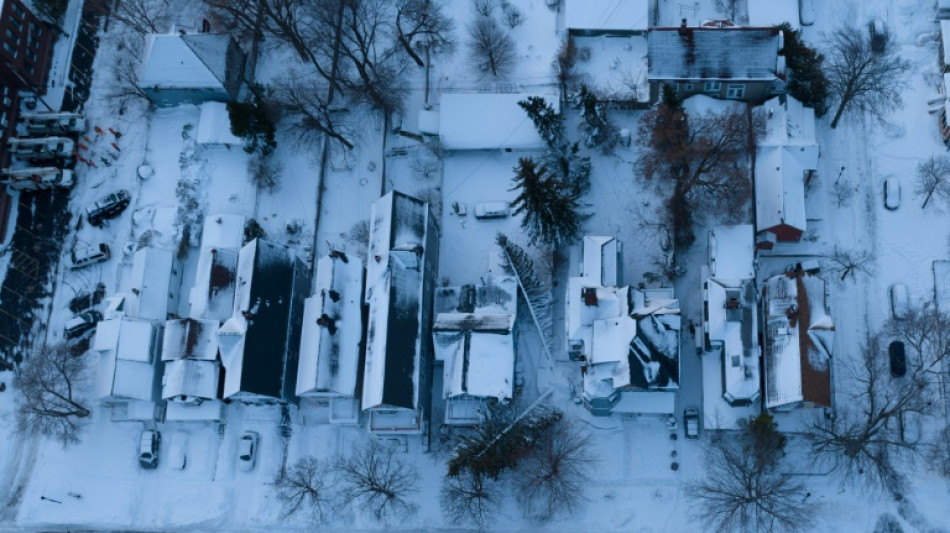
What is the link between winter storms and global warming? / Photo: © AFP

 MotoGP leader Martin speeds to British Grand Prix pole

 Drone enters Bulgaria, explodes near pipeline at Romanian border: Bulgarian PM

 Arsenal sign Brazil midfielder Guimaraes from Newcastle

 Atletico will not sell Alvarez, says Simeone

 Ford Fathom turns affordable electric pickup into reality

 Lise Klaveness, the Norwegian thorn in Infantino's side

 Europe’s electric car boom exposes a widening market divide

 US Senate confirms Trump's ex lawyer as attorney general
 Tibet conference in Nepal pushed online
 Nocturnal 'coffee frog' discovered in Costa Rica

 India's 'cockroach' protest movement keeps heat on Modi

 Russia's only anti-war party eyes support boost at elections

 Canada tries to adapt to a future of wildfires

 Death of NBA forward Clarke ruled accident due to heroin, cocaine

 Abelardo de la Espriella, Colombian president and flamboyant millionaire

 Maradona's 'Hand of God' ball heads to US auction

 Rybakina advances while Andreeva exits at Toronto

 Shelton storms to Montreal win as title defence solidifies

 All Blacks need to improve says coach after opening win against Stormers

 Spain imposes border checks on Italy as migrant showdown grows

 Bezzecchi smashes Silverstone track record in MotoGP qualifying
 Rashid Khan takes six wickets as Afghanistan thrash Ireland

 Flintoff quits England Lions role after Sydney Thunder appointment

 Movement, El Vecino and RISE Partner to Launch First Digital Dollar Wallet for Mexican Remittances

 FIFA chief Infantino travels to Colombia for presidential inauguration

The world is getting warmer, winters included. The United States, however, has experienced severe winter storms in recent years, and experts are taking a closer look at the link between these extreme cold events and climate change.
While the link between global warming and heat waves is very direct, the behavior of winter storms is governed by complex atmospheric dynamics that are more difficult to study.
Even so, "there are certain aspects of winter storms (...) where the climate change linkages are fairly strong and robust," Michael Mann, a climatologist at the University of Pennsylvania, told AFP.
For example, the warming of bodies of water -- lakes or oceans -- influences the amount of snowfall.
In the United States, a mechanism called "lake-effect snow" occurs around the Great Lakes region on the Canadian border. The city of Buffalo, which sits on the shores of one of the Great Lakes, was hit hard by a lethal snowstorm over Christmas weekend.
The collision between cold air from the north with the warmer water of these lakes causes convection, which leads to snowfall.
"The warmer those lake temperatures, the more moisture (is) in the air, and the greater potential for lake-effect snows," Michael Mann wrote in a 2018 paper.
"Not surprisingly, we see a long-term increase in lake effect snowfalls as temperatures have warmed during the last century."
- Polar vortex -
There is, however, no consensus on other mechanisms, such as the effect of climate change on the polar vortex and jet stream air currents.
The polar vortex is an air mass above the North Pole, located high in the stratosphere. Humans dwell in the troposphere, and the stratosphere is located just above it.
It is surrounded by a band of rotating air, which acts as a barrier between the cold air in the north, and the warmer air in the south. As the polar vortex weakens, this band of air begins to undulate and take on a more oval shape, bringing more cold air southward.
According to a 2021 study, this type of disturbance is occurring more often, and is reflected in the following two weeks lower in the atmosphere, where the jet stream is located.
This air current, which blows from west to east, again following the border between cold and warm air, then meanders in such a way that it allows cold air from the north to intrude at lower latitudes, particularly over the eastern United States.
"Everybody agrees that when the polar vortex becomes perturbed or disrupted, there is an increase in the probability of severe winter weather," Judah Cohen, lead author of the study and climatologist for Atmospheric and Environmental Research (AER), told AFP.
And this "stretched" polar vortex is exactly what was observed just before the storm that hit the United States this December, he pointed out.
The same phenomenon was seen in February 2021, when a bitter cold snap hit Texas, causing massive power outages.
- 'Active debate' -
But the heart of the debate lies elsewhere: What is causing these increased disturbances in the polar vortex?
According to Cohen, they are linked to changes in the Arctic, accelerated by climate change. On the one hand, the rapid melting of sea ice, and on the other, an increase in snow cover in Siberia.
"This is a topic that I have been studying for over 15 years, and I am more confident today in the link than I have ever been in the past," he told AFP.
This last point, however, remains "an active debate within the scientific community," said Mann.
"Climate models are not yet capturing all of the underlying physics that may be relevant to how climate change is impacting the behavior of the jet stream."
Future studies will still be needed in the coming years to unravel the mystery of these complex chain reactions.
M.Furrer--BTB