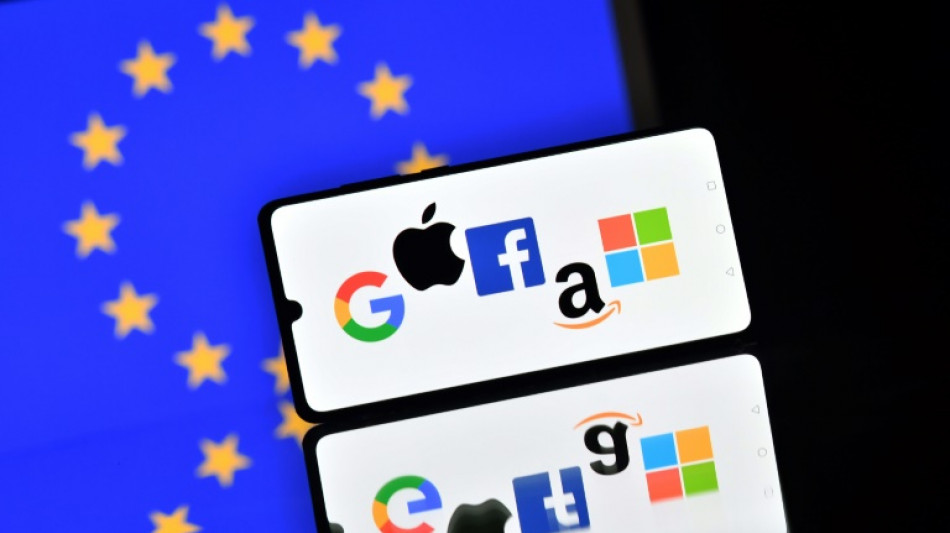
Tech titans prepare for EU's tougher market restraints / Photo: © AFP/File

 2.4 million girls banned from Afghan schools since Taliban return: UNESCO

 Colombians dig through rubble as quake death toll surpasses 240

 New Zealand's ruling party meets to decide PM Luxon's fate

 Total solar eclipse to spellbind Europe

 Jodar, Nakashima to make Masters semis debuts in Montreal

 Chilean veteran Sanchez signs with MLS club Montreal

 Cristiano Ronaldo marries long-term partner Georgina Rodriguez

 Oil prices higher, stocks mixed ahead of inflation report

 Jacobs into 100m final with eye on third title

 Eight-try New Zealand cruise to tour victory over Sharks
 Trump's secret plane swap triggers questions and confusion

 California calls Paramount's threat to leave state 'blackmail'

 PSG 'want to win everything', says Luis Enrique

 Barred from elections, Russia's anti-war party vows to fight on
 Jaissle states Newcastle ambition but urges patience

 NBA star Cooper Flagg trading card a slam dunk for lucky buyer

 ForumPay Expands Payment Infrastructure with New Card and Bank Transfer Acceptance Solution

 Oil prices higher, stocks flat ahead of inflation report

 Orban-critic ex-judge becomes Hungary president after predecessor ouster

 US rights groups sue Trump over ICC sanctions
 Sphere 3D Corp. (Nasdaq: ANY) Attracts 6.5% Stake from Turnaround Bitcoin-Mining Investor

 Oil prices lower, stocks higher as Hormuz doubts drag on

 Colombia scrambles to find survivors as quake kills 181

 Colombia scrambles to find survivors as quake kills 169

 MEXC Report: 74.2% of Traditional Finance Users Have Shifted Their Trading Activity to Crypto Exchanges

The EU will reveal Wednesday which of the world's tech behemoths face stronger curbs from next year under a law that will shake up how major players like Apple and Meta do business online.
Brussels is working through a dense legislative agenda to build tougher regulation of big tech, arguing it needs to protect European users online and to encourage competition in an industry dominated by US giants.
The latest announcement is a milestone in the application of the Digital Markets Act (DMA), which will force the largest firms to change their ways under a checklist of dos and don'ts and, regulators hope, create a fairer market.
Observers say the law could open a new battlefront between digital titans and the European Union as some companies, such as Apple, are reportedly preparing legal challenges.
The EU's top tech enforcer, industry commissioner Thierry Breton, said Brussels was already discussing compliance with companies, but vowed "if the solutions they propose are not good enough, we will not hesitate to take strong action".
There will be fines of up to 10 percent of a firm's global revenues for breaking some of the most serious competition rules, and even up to 20 percent for repeat offenders.
One major change under the DMA is the rule that forces interoperability between messaging apps, making it easier for users to share links and images.
The EU in July named seven companies -- Google parent Alphabet, Amazon, Apple, TikTok owner ByteDance, Facebook umbrella Meta, Microsoft and Samsung -- who had self-declared revenue and user figures big enough to be classed as "gatekeepers".
The European Commission will name which services will be considered big enough to fall under the next wave of regulation, and is expected to include Amazon Marketplace, Alphabet's Google Search and Apple's App Store, among others.
The "gatekeeper" status applies when a service has more than 45 million monthly active users and more than 10,000 yearly active business users established in the EU.
- Taking a bite of the Apple -
The EU has led the way globally for taking on big tech.
The DMA, alongside its sister law, the Digital Services Act (DSA), gives the European Commission sharper teeth against tech behemoths that critics say have for too long been given free rein to act, to the detriment of users.
Companies named must prepare for compliance by March 6, 2024.
Microsoft said last month that its Windows 11 system would respect the user's choice of default browser instead of forcing them into its own, but only in Europe.
One of the DMA's main aims will be to stop larger players crushing the progression of smaller companies that threaten to become rivals by gobbling them up through takeovers.
The EU believes past examples of this are Facebook's buyouts of Instagram and WhatsApp as well as Google's purchase of YouTube and Waze.
The DMA stipulates that the commission, the bloc's powerful antitrust authority, must be notified of all takeovers, regardless of size.
One of the law's main targets will be Apple, previously the subject of multiple investigations and slapped with huge EU fines.
The new rules will force the iPhone-maker to allow alternative app stores on its products, allowing software and payments to be made outside of its control.
Under the DMA, companies are forbidden to favour their own services over those offered by competitor firms and will have to share key information with business customers.
- Bumpy road ahead -
Some experts predict legal challenges to the DMA designations, just as some were made against the DSA.
"When you have a new law which is a complex law in a complex environment, it's inevitable to have legal challenges at the beginning," said Alexandre de Streel, academic director of the digital research programme at the Centre on Regulation in Europe think tank.
"I expect that some companies may want to challenge some designation of some of their services," he added.
Amazon and European clothing retailer Zalando filed a case in the EU courts against their designation as "very large" online platforms under the DSA.
And big tech faces more regulation as the EU races to pass the world's first law on artificial intelligence, an issue that gained urgency after dizzying advances in 2022.
L.Janezki--BTB