State-backed tourism booms in China's troubled Xinjiang / Photo: © AFP

 2.4 million girls banned from Afghan schools since Taliban return: UNESCO
 Colombians dig through rubble as quake death toll surpasses 240

 New Zealand's ruling party meets to decide PM Luxon's fate

 Total solar eclipse to spellbind Europe

 Jodar, Nakashima to make Masters semis debuts in Montreal

 Chilean veteran Sanchez signs with MLS club Montreal

 Cristiano Ronaldo marries long-term partner Georgina Rodriguez

 Oil prices higher, stocks mixed ahead of inflation report

 Jacobs into 100m final with eye on third title
 Eight-try New Zealand cruise to tour victory over Sharks

 Trump's secret plane swap triggers questions and confusion
 California calls Paramount's threat to leave state 'blackmail'

 PSG 'want to win everything', says Luis Enrique

 Barred from elections, Russia's anti-war party vows to fight on

 Jaissle states Newcastle ambition but urges patience

 NBA star Cooper Flagg trading card a slam dunk for lucky buyer
 ForumPay Expands Payment Infrastructure with New Card and Bank Transfer Acceptance Solution
 Oil prices higher, stocks flat ahead of inflation report

 Orban-critic ex-judge becomes Hungary president after predecessor ouster
 US rights groups sue Trump over ICC sanctions

 Sphere 3D Corp. (Nasdaq: ANY) Attracts 6.5% Stake from Turnaround Bitcoin-Mining Investor

 Oil prices lower, stocks higher as Hormuz doubts drag on

 Colombia scrambles to find survivors as quake kills 181

 Colombia scrambles to find survivors as quake kills 169

 MEXC Report: 74.2% of Traditional Finance Users Have Shifted Their Trading Activity to Crypto Exchanges

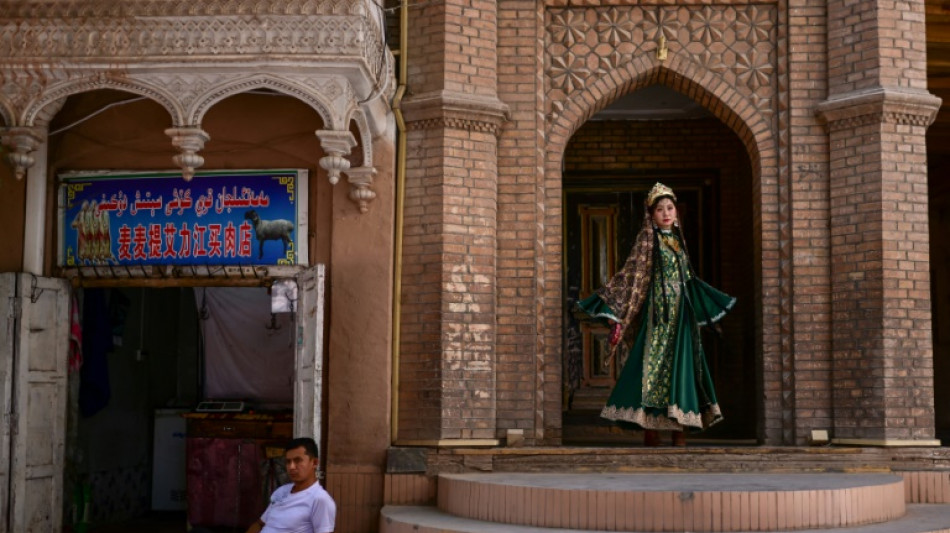
Chinese travellers throng the bazaars of old Kashgar, munching mutton kebabs and soaking up heavily commodified Uyghur culture -- part of a government push to remould troubled Xinjiang into a tourism paradise.
Kashgar, an ancient Silk Road oasis, was more recently on the frontlines of Beijing's sweeping anti-terrorism campaign in the northwestern region.
The city's outskirts are still pockmarked with facilities that the ruling Communist Party once called vocational schools but Western researchers describe as extralegal detention camps for Muslims -- with the United States linking them to policies of "genocide".
Now, after years of assault on Uyghur traditions and ways of life, the government is pumping cash into repackaging a state-approved version of their culture to attract domestic and foreign travellers.
On a recent visit by AFP journalists to old Kashgar, thousands of tourists crowded streetside stalls that were selling silk scarves and steaming naan.
Other visitors snapped selfies in front of the pastel-yellow Id Kah Mosque.
"The old town is the heart and soul of Kashgar, with a long history, rich culture and unique architecture," said a Uyghur tour guide as she whisked visitors, mainly from China's Han majority ethnic group, through the narrow streets.
"Many tourists like it so much that they come back, start businesses... and live here alongside other ethnic minorities as one big family."
Dozens of stores catered to a trend for "travel snaps" taken by a professional photographer, where tourists can pay over 1,500 yuan ($205) to don spangled veils and pose around the city in Uyghur clothing.
The celebration of traditional dress comes despite a ban authorities placed a few years ago on Uyghur women wearing veils and men growing long beards.
Looking beyond the tourist activities, there were other signs pointing to a loss of traditions and lifestyles for Uyghur residents.
An expanse of rubble lay at the site of Kashgar's former Grand Bazaar just beyond the fringes of the old town.
The vast market, where thousands of traders once hawked fabrics, spices and other wares, was reportedly razed by authorities last year.
Much of the old town had also been demolished and rebuilt over recent decades as part of the government's development drive.
- Tourism boom -
Chinese officials have long viewed tourism as a way to develop resource-rich but historically impoverished Xinjiang.
The strategy has gained new impetus this year as the economy staggers out of a hardline zero-Covid policy that gummed up domestic travel and throttled consumption.
Last month, President Xi Jinping called on officials to "strengthen positive publicity and show Xinjiang's new atmosphere of openness and self-confidence".
The region's tourism bureau plans to spend over 700 million yuan in 2023, more than double its pre-pandemic budget in 2019.
A suite of new projects has been announced across Xinjiang, from luxury hotels to campsites, rail routes and activity parks.
They include agreements totalling 12.6 billion yuan ($1.72 billion) with Western hotel brands like Hilton, Sheraton and InterContinental, the ruling party-run People's Daily newspaper reported in June.
Tourism has also provided an opportunity for Beijing to push back against criticism of its policies in the region.
A chorus of researchers, campaigners and Uyghurs overseas have alleged systematic rights abuses in Xinjiang stretching back years -- including mass internment, forced labour, coercive birth controls, political indoctrination and curbs on religion.
"Do people look oppressed? Does the city look like an open-air prison like the US said?" wrote one state-linked journalist in July on Twitter -- the platform rebranded as X, which is blocked in China -- alongside clips of herself dining and dancing with Kashgar locals.
China has dismissed a UN report detailing "serious" abuses that may constitute "crimes against humanity", and blasted US claims of a "genocide".
Its foreign ministry told AFP that in Xinjiang "people's lives are continuously improving, cultural spaces are prospering and religion is harmonious and agreeable".
The development push has coincided with a relaxation of security in cities where Uyghur residents were once subjected to pervasive body scans and other inspections by armed police.
In Kashgar, AFP saw just a handful of officers, and abandoned or barely used scanners dotted the streets.
- Prayers prohibited -
But off the main tourist trail, in the mostly Uyghur town of Yengisar, AFP reporters saw a sign in a cemetery prohibiting Islamic "religious activities" such as kneeling, prostrating, praying with palms facing upwards and reciting scripture.
The same sign permitted certain offerings for the Qingming Festival, typically observed by Han but not Uyghurs.
Around a dozen mosques in other towns and villages around Kashgar were found locked and rundown.
Some appeared to have had minarets and other Islamic markings removed, and many bore the same government slogan: "Love the country, love the party".
In Kashgar, no more than two dozen mostly elderly Uyghur men were seen entering Id Kah Mosque for Friday afternoon prayers, vastly outnumbered by tourists -- a stark change from the thousands of believers that would congregate a decade ago.
Three other community mosques within a few hundred metres were shuttered when AFP visited, with a store advertising adult products operating a stone's throw from one of them.
Such closures were largely deemed "unnecessary until the recent wave of repression" beginning in 2017, said Rian Thum, an expert on Uyghur history at Britain's University of Manchester.
"The destruction of religious sites... is part of a larger set of policies that are transforming the landscape and disconnecting Uyghur culture from the geography" of Xinjiang, Thum told AFP.
The sharpest reminders of Beijing's policies still lurk on Kashgar's periphery, which houses many of the alleged internment camps.
While some appear to have been converted or abandoned, others look to still be operating -- and provoke official unease when exposed.
"Don't take any photos!" yelled an unidentified woman in an unmarked car that followed AFP to a nondescript compound on a bleak industrial estate an hour's drive from the city.
"That's not permitted around here."
C.Meier--BTB