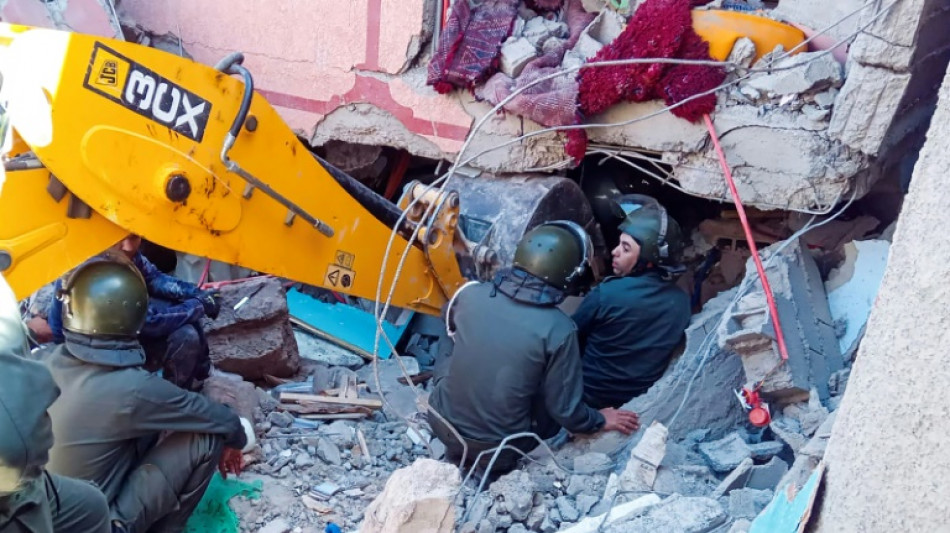
Race to find survivors as Morocco quake deaths top 2,000 / Photo: © AFP

 Rybakina ousts Osaka to book Toronto semi-final against Gauff

 Colombia rescuers find woman alive as quake death toll passes 240
 Charges dropped against Bondi Beach attack hero
 Parched and desperate for rain, Kazakhstan turns to cloud-seeding
 The perfect storm that turbocharged Venezuela's twin quakes

 2.4 million girls banned from Afghan schools since Taliban return: UNESCO
 Colombians dig through rubble as quake death toll surpasses 240

 New Zealand's ruling party meets to decide PM Luxon's fate
 Total solar eclipse to spellbind Europe

 Jodar, Nakashima to make Masters semis debuts in Montreal

 Chilean veteran Sanchez signs with MLS club Montreal

 Cristiano Ronaldo marries long-term partner Georgina Rodriguez

 Oil prices higher, stocks mixed ahead of inflation report
 Jacobs into 100m final with eye on third title
 Eight-try New Zealand cruise to tour victory over Sharks
 Trump's secret plane swap triggers questions and confusion
 California calls Paramount's threat to leave state 'blackmail'

 PSG 'want to win everything', says Luis Enrique

 Barred from elections, Russia's anti-war party vows to fight on

 Jaissle states Newcastle ambition but urges patience

 NBA star Cooper Flagg trading card a slam dunk for lucky buyer
 ForumPay Expands Payment Infrastructure with New Card and Bank Transfer Acceptance Solution
 Oil prices higher, stocks flat ahead of inflation report

 Orban-critic ex-judge becomes Hungary president after predecessor ouster
 US rights groups sue Trump over ICC sanctions

Morocco's deadliest earthquake in decades has killed more than 2,000 people, authorities said Saturday, as troops and emergency services scrambled to reach remote mountain villages where victims are still feared trapped.
Authorities declared three days of national mourning, but the Red Cross warned that it could take years to repair the damage.
The 6.8-magnitude quake struck late Friday in a mountainous area 72 kilometres (45 miles) southwest of the tourist city of Marrakesh, the US Geological Survey reported.
With strong tremors also felt in the coastal cities of Rabat, Casablanca and Essaouira, the quake caused widespread damage and sent terrified residents and tourists scrambling to safety in the middle of the night.
"I was nearly asleep when I heard the doors and the shutters banging," said Ghannou Najem, a Casablanca resident in her 80s who was visiting Marrakesh when the quake hit.
"I went outside in a panic. I thought I was going to die alone."
In the mountain village of Tafeghaghte near the quake's epicentre, virtually no buildings were left standing. The traditional clay bricks used by the region's Berber inhabitants proved no match for the rare quake.
In the late afternoon, soldiers continued to search through debris, but most survivors headed to the cemetery where loud screams punctuated the last rites as some 70 villagers were laid to rest.
"Three of my grandchildren and their mother were killed -- they are still under the rubble," villager Omar Benhanna, 72, told AFP. "Just a while ago, we were all playing together," he added.
It was the strongest-ever quake to hit the North African kingdom, and one expert described it as the region's "biggest in more than 120 years".
"Where destructive earthquakes are rare, buildings are simply not constructed robustly enough... so many collapse, resulting in high casualties," said Bill McGuire, professor emeritus at Britain's University College London.
The latest update from the interior ministry late Saturday showed the quake had killed at least 2,012 people, the vast majority in Al-Haouz, the epicentre, and Taroudant provinces.
Another 2,059 people were injured, including 1,404 in a critical condition, the ministry said.
Civil defence Colonel Hicham Choukri who is heading relief operations told state television earlier the epicentre and strength of the earthquake created "an exceptional emergency situation".
After a meeting chaired by King Mohammed VI, the palace announced three days of national mourning, with flags to fly at half-mast on all public buildings.
- 'Unbearable' screams -
Faisal Badour, an engineer, said he felt the quake three times in his building in Marrakesh.
"There are families who are still sleeping outside because we were so scared of the force of this earthquake," he said. "The screaming and crying was unbearable."
Frenchman Michael Bizet, 43, who owns three traditional riad houses in Marrakesh's old town, told AFP he was in bed when the quake struck.
"I thought my bed was going to fly away. I went out into the street half-naked and immediately went to see my riads. It was total chaos, a real catastrophe, madness," he said.
Footage on social media showed part of a minaret collapsed on Jemaa el-Fna square in the historic city.
An AFP correspondent saw hundreds of people flocking to the square to spend the night for fear of aftershocks, some with blankets while others slept on the ground.
Houda Outassaf, a local resident, said she was "still in shock" after feeling the earth shake beneath her feet -- and losing relatives.
"I have at least 10 members of my family who died... I can hardly believe it, as I was with them no more than two days ago," she said.
The regional blood transfusion centre in Marrakesh called on residents to donate blood for the injured.
The Royal Moroccan Football Federation announced that a Cup of African Nations qualifier against Liberia, due to have been played on Saturday in the coastal city of Agadir, had been postponed indefinitely.
- Significant damage likely -
"We heard screams at the time of the tremor," a resident of Essaouira, 200 kilometres (125 miles) west of Marrakesh, told AFP. "Pieces of facades have fallen."
Foreign leaders expressed their condolences and many offered assistance, including Israel with which Morocco normalised relations in 2020.
Neighbour and regional rival Algeria announced it was suspending a two-year-old ban on all Moroccan flights through its airspace to enable aid deliveries and medical evacuations.
US President Joe Biden said he was "deeply saddened by the loss of life and devastation".
In 2004, at least 628 people were killed and 926 injured when a quake hit Al Hoceima in northeastern Morocco, and in 1960 a magnitude 6.7 quake in Agadir killed more than 12,000.
The 7.3-magnitude El Asnam earthquake in Algeria killed 2,500 people and left at least 300,000 homeless in 1980.
M.Ouellet--BTB