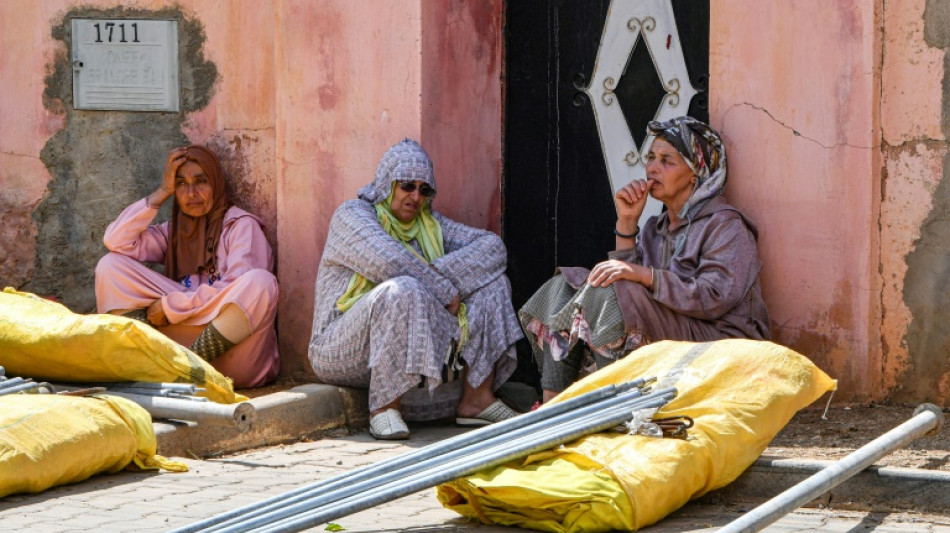
Aid tents offer warning of Morocco quake survivor's future / Photo: © AFP

 Meta meets its own 'tobacco' moment in court

 Art or medicine? Japan's cosmetic tattoo artists in limbo
 Rybakina ousts Osaka to book Toronto semi-final against Gauff

 Colombia rescuers find woman alive as quake death toll passes 240

 Charges dropped against Bondi Beach attack hero

 Parched and desperate for rain, Kazakhstan turns to cloud-seeding

 The perfect storm that turbocharged Venezuela's twin quakes

 2.4 million girls banned from Afghan schools since Taliban return: UNESCO
 Colombians dig through rubble as quake death toll surpasses 240

 New Zealand's ruling party meets to decide PM Luxon's fate

 Total solar eclipse to spellbind Europe

 Jodar, Nakashima to make Masters semis debuts in Montreal

 Chilean veteran Sanchez signs with MLS club Montreal

 Cristiano Ronaldo marries long-term partner Georgina Rodriguez

 Oil prices higher, stocks mixed ahead of inflation report
 Jacobs into 100m final with eye on third title
 Eight-try New Zealand cruise to tour victory over Sharks

 Trump's secret plane swap triggers questions and confusion
 California calls Paramount's threat to leave state 'blackmail'

 PSG 'want to win everything', says Luis Enrique

 Barred from elections, Russia's anti-war party vows to fight on

 Jaissle states Newcastle ambition but urges patience

 NBA star Cooper Flagg trading card a slam dunk for lucky buyer
 ForumPay Expands Payment Infrastructure with New Card and Bank Transfer Acceptance Solution

 Oil prices higher, stocks flat ahead of inflation report

Survivors of Morocco's earthquake were packed in a football-field length queue to get stand-ins for the homes they had lost. They received yellow tents with no floors, in a symbol of the uncertainty ahead.
Yet even this step marked progress for people like Fatima Oumalloul -- her face still bloody from when her home collapsed on her three days prior. She won't spend another night unsheltered on the ground.
"I just want a home, one fit for a human," the 59-year-old said as soldiers handed out the tents in Amizmiz, a town south of Marrakesh that has become an aid hub for shattered Atlas mountain villages.
The shelters popping up in tent cities and beside destroyed or dangerously damaged homes show that aid is starting to flow, but also leave survivors unsure how long these temporary structures will be home.
The quake that struck Marrakesh and the regions to its south on Friday killed more than 2,900 people, according to the latest toll.
But the disaster also left a vast number of homes uninhabitable in rural areas where locals don't have the money to quickly, or maybe even ever, rebuild without help.
Yet those questions were secondary to not dying in a building that was known to already have been damaged by the quake.
Oumalloul knows the dangers well.
She was trapped under the debris of her collapsed home until a neighbour who came to check on her ended up stepping on the spot where she was buried.
"I'm under here. Don't step on me!" she said, recounting the moment through sobs and sitting on the bundled tent at the distribution site.
- 'Everything so uncertain' -
Fatima Benhamoud, whose home in Amizmiz has cracks large enough to fit a finger, got one of six-person tents too.
"Our house is synonymous with risk," said the 39-year-old, who shared the house with her children and relatives.
"We can't sleep inside. We have to sleep outside, so we need the tent," she added, noting the rainy season is coming fast.
Just in front of her house, the mass of people waiting for tents on Tuesday was steady for hours.
From the distribution site, they have flowed southward along the zig-zagging, narrow mountain roads that lead toward the epicentre.
Private aid convoys, composed of individuals or associations, have also grown to the point where they create traffic bottlenecks on roads meant for far fewer vehicles.
The roads though offer a conduit that is missing in some hard-to-reach, rural areas where some residents have said authorities have failed to adequately provide help.
A 15-kilometre (10-mile) drive into the mountains -- past clusters of the yellow tents -- leads to the devastated village of Ineghede.
Some partial structures remain, like the mosque prayer room that is missing a wall, but swathes of the village are a jumble of the timber and stones that are used in traditional-style buildings.
The tents travelled up the mountain road and into Ineghede on Tuesday and locals were busy pounding in stakes, raising poles and then moving in their bedding and possessions.
Mohammed Amaddah, 33, pitched his tent on the dusty lot next to his damaged, but still standing home with a smile and efficiency.
But his wife Latifah leaned on the wall of their house and watched with little enthusiasm.
"I don't want to sleep in a tent. I feel like I'm in the street," the 24-year-old mother of one said.
But the yellow fabric flapping in the breeze is just one part of what's bothering her.
"I feel like my heart is broken. I'm afraid of the future, it's so uncertain," she added.
Once the tent was up, she held her young son's hand and looked at the tent with a blank stare. It was now her home.
"I didn't want it," she said.
M.Ouellet--BTB