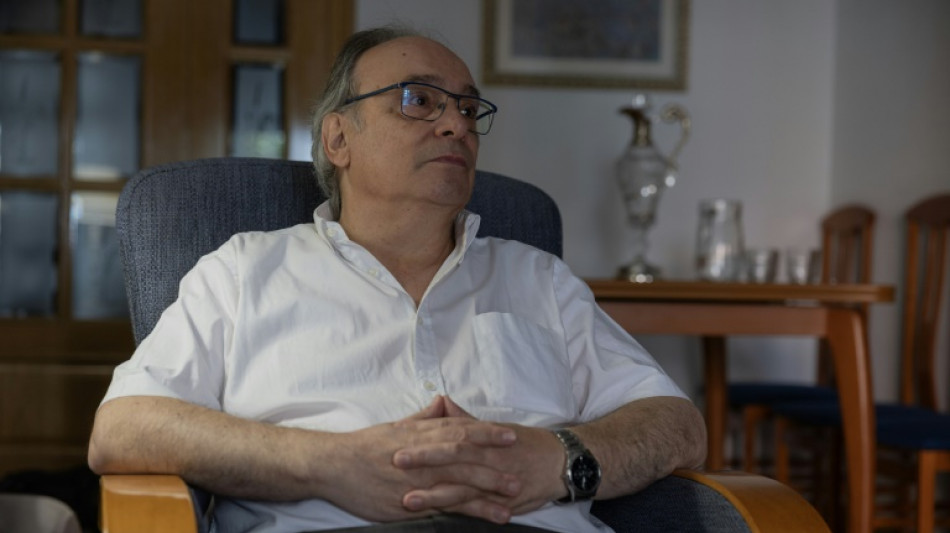
Franco-era torture victim hopes to break Spain's 'wall of impunity' / Photo: © AFP

 Meta meets its own 'tobacco' moment in court
 Art or medicine? Japan's cosmetic tattoo artists in limbo
 Rybakina ousts Osaka to book Toronto semi-final against Gauff

 Colombia rescuers find woman alive as quake death toll passes 240
 Charges dropped against Bondi Beach attack hero

 Parched and desperate for rain, Kazakhstan turns to cloud-seeding
 The perfect storm that turbocharged Venezuela's twin quakes

 2.4 million girls banned from Afghan schools since Taliban return: UNESCO
 Colombians dig through rubble as quake death toll surpasses 240

 New Zealand's ruling party meets to decide PM Luxon's fate

 Total solar eclipse to spellbind Europe

 Jodar, Nakashima to make Masters semis debuts in Montreal

 Chilean veteran Sanchez signs with MLS club Montreal

 Cristiano Ronaldo marries long-term partner Georgina Rodriguez

 Oil prices higher, stocks mixed ahead of inflation report
 Jacobs into 100m final with eye on third title
 Eight-try New Zealand cruise to tour victory over Sharks
 Trump's secret plane swap triggers questions and confusion
 California calls Paramount's threat to leave state 'blackmail'

 PSG 'want to win everything', says Luis Enrique

 Barred from elections, Russia's anti-war party vows to fight on

 Jaissle states Newcastle ambition but urges patience
 NBA star Cooper Flagg trading card a slam dunk for lucky buyer
 ForumPay Expands Payment Infrastructure with New Card and Bank Transfer Acceptance Solution

 Oil prices higher, stocks flat ahead of inflation report

Just months before the death of Spanish dictator Francisco Franco in 1975, Julio Pacheco Yepes says he was arrested and tortured by police for belonging to a left-wing underground movement that opposed the regime.
Now, nearly five decades on, Pacheco Yepes is set -- at a hearing that opens on Friday -- to become the first victim of the Franco dictatorship to testify before a Spanish judge investigating allegations of torture.
"It could open a chink in the wall of impunity that we (victims) have had to suffer for so long," the 67-year-old told AFP at his home in Vallecas, a working-class district of southeastern Madrid, referring to the people who suffered repression during Franco's 1939-75 rule.
"It is an important milestone. Keep in mind that this all happened nearly 50 years ago. Until now, nobody, no judge, has accepted a lawsuit or heard testimony in court. This is a first."
Over the years, around a hundred lawsuits have been filed over alleged torture suffered during the Franco era, but none of them was ever admitted, according to associations representing victims.
Judges have argued that the amnesty law passed in 1977 during Spain's transition to democracy made it impossible to prosecute crimes committed by political opponents of the regime or those perpetrated by "civil servants and public order agents" such as police.
But many Franco-era victims such as Pacheco Yepes and his wife Rosa Maria Garcia Alcon -- who was also arrested in 1975 -- argue that torture is a crime against humanity which cannot be covered by an amnesty and the statute of limitations.
- 'A pact of silence' -
"What was imposed (in Spain) was a pact of silence and it has taken many years" to break it, said Garcia Alcon, 66, who heads La Comuna victims' association.
In August 1975, Pacheco Yepes and Garcia Alcon -- teenagers who were going out together at the time -- were both arrested for their involvement in the Revolutionary Anti-Fascist and Patriot Front (FRAP), a left-wing student movement opposed to Franco.
They were taken to the police headquarters in Madrid's Puerta del Sol Square, which was used as a lockup and torture centre during the dictatorship.
They say various officers tortured them there for days before jailing them for "terrorism".
In December 1975, a month after Franco's death, the pair were released on bail. Several months later they were pardoned.
In 2018, Garcia Alcon filed a lawsuit against one of the two police officers she says tortured her but it was not admitted by the courts.
She will also take the stand on Friday as a witness in the case brought by her husband.
She says one of the ways the police tortured him was to force him watch them hurting her.
- 'Only truth can heal' -
Pacheco Yepes filed his lawsuit against four of his alleged torturers in February, just months after Prime Minister Pedro Sanchez's left-wing government passed the democratic memory law honouring the victims of violence and persecution under Franco.
The law was opposed by the right, which said it would only re-open the wounds of Spain's past.
Pacheco Yepes said it was difficult to gather the documentation to support his case, given the "total" unwillingness of public bodies such as the National Archive to "cooperate".
While he would like to see his alleged torturers "sitting in the dock", if the judge ultimately decides not to put them on trial, it will still serve as an important reminder about "what Francoism was", he says.
This is particularly important at a time when the far-right Vox party is gaining ground and there is "a strong current" of nostalgia about the Franco era, he says.
"The only way to fight this... is by showing how politically backwards (the Franco dictatorship) was," he told AFP.
"The only way to close wounds is with the truth... If you don't, they will always bleed."
F.Müller--BTB