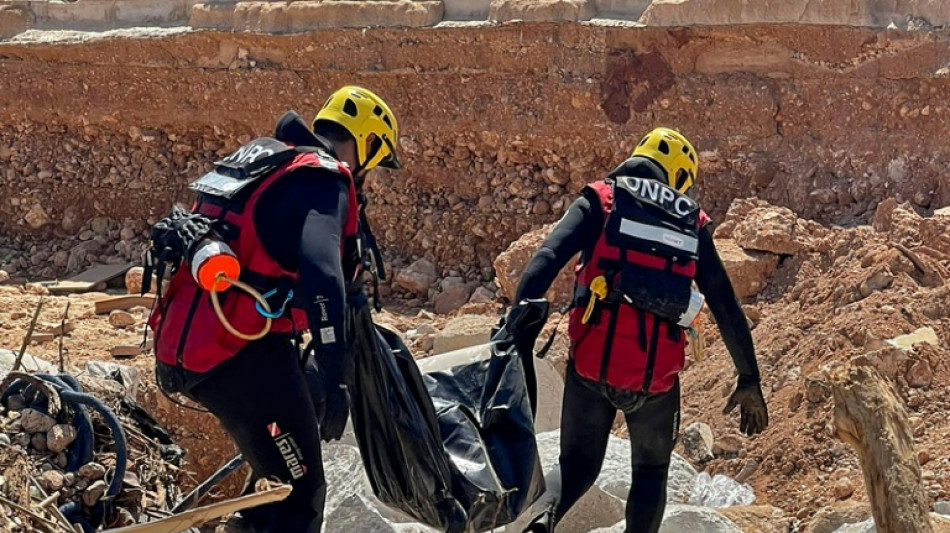
One week after Libya flood, aid arrives for survivors / Photo: © Tunisia's National Office of Civil Protection/AFP

 Meta meets its own 'tobacco' moment in court

 Art or medicine? Japan's cosmetic tattoo artists in limbo
 Rybakina ousts Osaka to book Toronto semi-final against Gauff
 Colombia rescuers find woman alive as quake death toll passes 240
 Charges dropped against Bondi Beach attack hero

 Parched and desperate for rain, Kazakhstan turns to cloud-seeding
 The perfect storm that turbocharged Venezuela's twin quakes
 2.4 million girls banned from Afghan schools since Taliban return: UNESCO
 Colombians dig through rubble as quake death toll surpasses 240

 New Zealand's ruling party meets to decide PM Luxon's fate

 Total solar eclipse to spellbind Europe

 Jodar, Nakashima to make Masters semis debuts in Montreal

 Chilean veteran Sanchez signs with MLS club Montreal

 Cristiano Ronaldo marries long-term partner Georgina Rodriguez

 Oil prices higher, stocks mixed ahead of inflation report
 Jacobs into 100m final with eye on third title
 Eight-try New Zealand cruise to tour victory over Sharks
 Trump's secret plane swap triggers questions and confusion
 California calls Paramount's threat to leave state 'blackmail'

 PSG 'want to win everything', says Luis Enrique

 Barred from elections, Russia's anti-war party vows to fight on

 Jaissle states Newcastle ambition but urges patience

 NBA star Cooper Flagg trading card a slam dunk for lucky buyer
 ForumPay Expands Payment Infrastructure with New Card and Bank Transfer Acceptance Solution
 Oil prices higher, stocks flat ahead of inflation report

A week after a wall of water devastated the Libyan coastal city of Derna, sweeping thousands to their deaths, the focus on Sunday increasingly turned to caring for the survivors.
Amid the chaotic rescue efforts in the war-scarred country, the death toll from the floods has varied widely, from more than 3,000 to over 11,000.
The most recent official toll, from the health minister of the eastern-based administration, Othman Abdeljalil, was that 3,252 people were killed.
The United Nations Office for the Coordination of Humanitarian Affairs on Sunday warned that the toll from Derna alone could be as high as 11,300, with another 10,100 missing.
But the Libyan Red Crescent, which was cited by the UN agency, had previously denied a UN death toll of over 10,000, saying it only had one official spokesperson and calling on media to "exercise caution and accuracy".
The conflicting tolls are testament to the division and absence of centralised power that have wracked Libya since 2011's NATO-backed uprising that overthrew dictator Moamer Kadhafi and plunged the country into years of war.
Aid is now arriving in the North African country as the world mobilises to help emergency services cope with the aftermath of the deadly flood.
At least 40,000 people have been displaced across northeastern Libya, according to the International Organization for Migration, which cautioned the actual number is likely higher given the difficulty accessing the worst-affected areas.
Two dams upstream from Derna burst a week ago under the pressure of torrential rains from the hurricane-strength Storm Daniel.
The dams had been built upriver from the port city of 100,000 people after it was hit by significant flooding in the mid-20th century.
The banks of a dried riverbed or wadi running through the city centre had been heavily built on, and last week's torrent swept everything before it as it rushed towards the Mediterranean.
- Cracks in the dam -
A week on, bodies are still being found, some washing up on the sea shore.
A rescue crew from Malta's Civil Protection Department discovered a beach strewn with dead bodies on Friday, the Times of Malta newspaper reported.
International aid is arriving from the United Nations, Europe and the Middle East, offering some relief.
The aid includes water, food, tents, blankets, hygiene kits and medicines and emergency surgical supplies, as well as body bags and heavy machinery to help clear the debris.
In Al-Bayda, 100 kilometres (60 miles) west of Derna, residents waded through the layer of mud caking the floors of what were once their homes.
Ayman Jabril Saleh, a resident of Al-Bayda who survived the flood with his family inside their house, said "when we saw the state of Derna, we felt blessed" for suffering material losses only.
The damage for the devastating flooding brought by Storm Daniel was exacerbated by poor infrastructure in Libya.
Questions are being asked as to why the disaster could not have been prevented, when cracks in the dams have been known about since 1998.
Prosecutor general Al-Seddik Al-Sour has announced an investigation into the circumstances leading to the collapse.
Like much of Libya's crumbling infrastructure, the two dams in Derna fell into disrepair during years of neglect, conflict and division.
The country is currently ruled by two rival administrations -- the UN-backed, internationally recognised government in Tripoli, and one based in the disaster-hit east.
- Disease risk -
With tens of thousands of people displaced, aid organisations have warned of the risks posed by leftover landmines and other unexploded ordnance that may have been shifted by floodwaters.
The risk of water-borne diseases such as cholera are also high, according to aid groups.
The National Centre for Disease Control reported that at least 55 children were poisoned by drinking polluted water in Derna.
But the eastern-based health minister insisted that samples were being analysed daily to avoid contamination, urging residents not to use groundwater.
Abdeljalil also denied reports of a possible evacuation of Derna, saying that only "certain areas" could be "isolated" to facilitate relief efforts.
To assist the hundreds of thousands in need, the UN has launched an appeal for more than $71 million.
The scale of the devastation has prompted shows of solidarity, as volunteers in Tripoli have collected aid for the flood victims.
Survivors in Derna are glad to be alive, even as they mourn the loss of loved ones.
"In this city, every single family has been affected," said Derna resident Mohammad al-Dawali.
"Her entire family died, she was the only one who survived."
Y.Bouchard--BTB