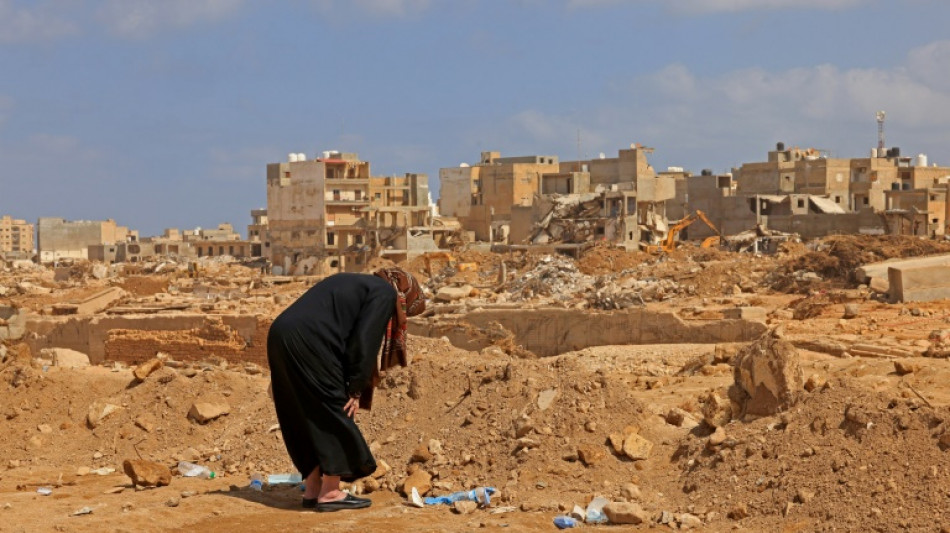
Cities wiped out, or nearly, by disasters / Photo: © AFP/File

 Meta meets its own 'tobacco' moment in court

 Art or medicine? Japan's cosmetic tattoo artists in limbo
 Rybakina ousts Osaka to book Toronto semi-final against Gauff

 Colombia rescuers find woman alive as quake death toll passes 240
 Charges dropped against Bondi Beach attack hero

 Parched and desperate for rain, Kazakhstan turns to cloud-seeding

 The perfect storm that turbocharged Venezuela's twin quakes

 2.4 million girls banned from Afghan schools since Taliban return: UNESCO
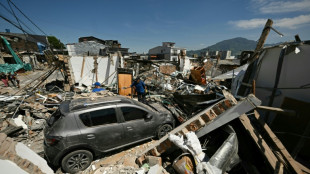 Colombians dig through rubble as quake death toll surpasses 240

 New Zealand's ruling party meets to decide PM Luxon's fate

 Total solar eclipse to spellbind Europe

 Jodar, Nakashima to make Masters semis debuts in Montreal

 Chilean veteran Sanchez signs with MLS club Montreal

 Cristiano Ronaldo marries long-term partner Georgina Rodriguez

 Oil prices higher, stocks mixed ahead of inflation report

 Jacobs into 100m final with eye on third title
 Eight-try New Zealand cruise to tour victory over Sharks

 Trump's secret plane swap triggers questions and confusion
 California calls Paramount's threat to leave state 'blackmail'

 PSG 'want to win everything', says Luis Enrique

 Barred from elections, Russia's anti-war party vows to fight on

 Jaissle states Newcastle ambition but urges patience

 NBA star Cooper Flagg trading card a slam dunk for lucky buyer
 ForumPay Expands Payment Infrastructure with New Card and Bank Transfer Acceptance Solution
 Oil prices higher, stocks flat ahead of inflation report

The coastal city of Derna in Libya, devastated by a huge flash flood, joins a grim list of metropolises nearly annihilated by natural disasters since the turn of the century.
But from the debris, many of those razed landscapes have also managed to rebuild and reinvent themselves following years of reconstruction.
- Bhuj, 2001 -
A massive earthquake struck the western Indian state Gujarat on January 26 killing more than 20,000 people, with most victims from the city of Bhuj.
The city was flattened but a massive reconstruction effort has turned it into an economic hub with two new ring-roads, improved sewerage systems and an airport.
The local government bulldozed temples and mosques to widen roads, and the construction of apartments of more than one storey is now forbidden.
- Bam, 2003 -
A quake on December 26 levelled much of the ancient southeastern Iranian city of Bam with 80 percent of its infrastructure damaged or destroyed.
An estimated 26,000-32,000 people died in the disaster of such proportions that Iran allowed its arch-enemy the United States to send planes laden with aid.
The jewel of Bam, a 2,000-year-old citadel, which was the largest mud-brick structure in the world, was nearly completely destroyed.
Today more than 90 percent of the city has been rebuilt.
- Banda Aceh, 2004 -
On December 26 a 9.3-magnitude earthquake off Indonesia's western tip generated a series of massive waves that pummelled the coastline of 14 countries as far apart as Indonesia, Thailand, Sri Lanka and Somalia.
Most of Indonesia's 170,000 victims were in the province of Aceh and its main city Banda Aceh was razed.
More than $6.7 billion was poured into rebuilding Aceh, funding among other things 140,000 new homes, 1,759 schools, 363 bridges and 13 airports.
The disaster also ended a decades-long separatist conflict in Aceh, with a peace deal between rebels and Jakarta struck less than a year later.
- L'Aquila, 2009 -
In the early hours of April 6, a devastating earthquake hit the historic Italian city of L'Aquila, killing 309 people.
Around 20,000 homes were damaged or destroyed.
Over a decade later, the city's elegant buildings and squares spanning medieval, Renaissance and Baroque periods are still being renovated.
Over 8,000 people are still living in temporary housing, most of them in quake-proof apartments.
- Port-au-Prince, 2010 -
A massive quake on January 12 wrecked the Haitian capital Port-au-Prince and the surrounding region.
It killed more than 200,000 people, destroyed the homes of 1.5 million Haitians and shattered much of the country's frail infrastructure.
The disaster tipped Haiti into chaos and destitution.
A cholera epidemic the same year introduced by peacekeepers who arrived after the quake killed more than 10,000 people.
More than a decade later, downtown Port-au-Prince, including multiple government agency headquarters and the presidential palace, have still not been rebuilt and camps built for the displaced have become shantytowns.
- Minamisanriku, 2011 -
The coastal town was one of many in eastern Japan devastated when a 9.1-magnitude undersea earthquake and tsunami struck on March 11, 2011, triggering a disaster at the Fukushima nuclear plant.
Some 620 people died in Minamisanriku, a fishing port of 17,600 inhabitants, and around 60 percent of all buildings were destroyed.
Six years later the town was back on its feet: residents had been relocated and the town hall, schools and hospitals had been rebuilt.
J.Fankhauser--BTB