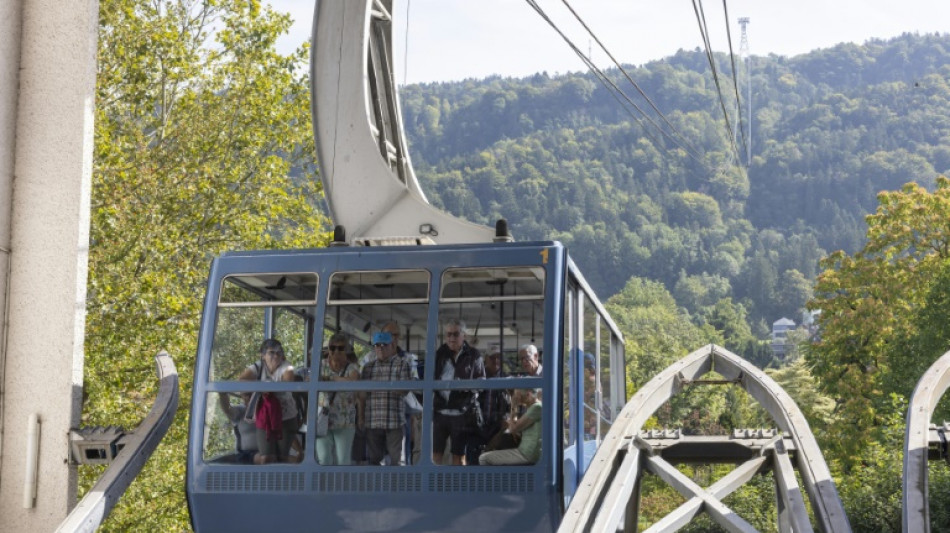
As planet gets warmer, ski gondola maker goes urban / Photo: © AFP

 How Britain's mapmakers track climate change

 Australian delivery drivers win 'world-leading' pay rise

 Meta meets its own 'tobacco' moment in court
 Art or medicine? Japan's cosmetic tattoo artists in limbo
 Rybakina ousts Osaka to book Toronto semi-final against Gauff

 Colombia rescuers find woman alive as quake death toll passes 240

 Charges dropped against Bondi Beach attack hero
 Parched and desperate for rain, Kazakhstan turns to cloud-seeding
 The perfect storm that turbocharged Venezuela's twin quakes

 2.4 million girls banned from Afghan schools since Taliban return: UNESCO

 Colombians dig through rubble as quake death toll surpasses 240

 New Zealand's ruling party meets to decide PM Luxon's fate

 Total solar eclipse to spellbind Europe
 Jodar, Nakashima to make Masters semis debuts in Montreal

 Chilean veteran Sanchez signs with MLS club Montreal
 Cristiano Ronaldo marries long-term partner Georgina Rodriguez
 Oil prices higher, stocks mixed ahead of inflation report
 Jacobs into 100m final with eye on third title
 Eight-try New Zealand cruise to tour victory over Sharks

 Trump's secret plane swap triggers questions and confusion
 California calls Paramount's threat to leave state 'blackmail'

 PSG 'want to win everything', says Luis Enrique

 Barred from elections, Russia's anti-war party vows to fight on

 Jaissle states Newcastle ambition but urges patience

 NBA star Cooper Flagg trading card a slam dunk for lucky buyer
Austrian company Doppelmayr is well known for making gondolas for ski resorts, but its workshop is increasingly building cable cars for congested cities as climate change has opened up new markets.
A growing number of urban areas are adopting the cleaner, space-saving mode of transport: Doppelmayr's cable cars now glide over London, Mexico City and La Paz.
Urban mobility currently accounts for 20 percent of sales for the world's biggest cable car maker as cities seek to decarbonise their public transport systems.
"We have evolved with our customers," said Reinhard Fitz, Doppelmayr's head of international business development.
The 130-year-old company, which built its first ski lift in 1937, has yet to see a drop in demand from mountain resorts, Fitz said.
"But climate change will of course cause demand to shift," he said.
- 'Innovative solution' -
Doppelmayr's urban business began to take off about 15 years ago.
Its biggest urban project to date -- holding the Guinness World Record for the largest public-transit cable-car system -- is a 33-kilometre (20.5-mile) network of 10 ropeway lines connecting Bolivia's capital La Paz with another metropolis, El Alto.
Its strongest market for urban mobility is Latin America, but the company is hoping to expand into Asia.
More than 80 cities and towns worldwide have already adopted aerial tramways, urban engineering expert Hanane Bengualou told AFP.
Costing less than seven million euros per kilometre, cable cars are three times cheaper than tramways, Bengualou said.
"It's an innovative solution that uses up very little land and is quick to deploy, as it doesn't require any major work (on site)," she said.
The Paris region is among Doppelmayr's newest customers, with a 4.5-kilometre (2.8-mile) ropeway project that will connect two suburbs, giving 20,000 residents access to the capital's subway system.
Scheduled to open in 2025, the "Cable C1" line will offer an 18-minute travel time between Villeneuve-Saint-Georges and Creteil.
"Cable transport is clean, quiet and regular," said Laurent Probst, director-general at Ile-de-France Mobilites, which oversees public transport in the Paris region.
The costs associated with cable cars are far lower and they can be quickly installed, making them the ideal solution for traffic-clogged regions, he said.
In addition, they can "cross obstacles" such as roads or train tracks, giving people a commute free of traffic jams, he added.
- 'Attached to conventional systems' -
Bengualou noted that cable cars also offer a cleaner option, as transport accounts for 35 percent of CO2 emissions in France.
However, opposition by residents and complex administrative procedures have obstructed their development, with France's third-biggest city, Lyon, being forced to abandon its project in 2022.
Since cities are less prone to strong winds than open mountain areas, lighter single-cable technology is usually good enough for urban areas, though population density and other obstacles bring challenges.
Policymakers are often unaware that cable cars -- still widely associated with ski resorts -- are an option for urban transport, Fitz said.
"We hope examples like the Paris region" will bring awareness, he said, adding that "people are still very attached to conventional systems".
H.Seidel--BTB