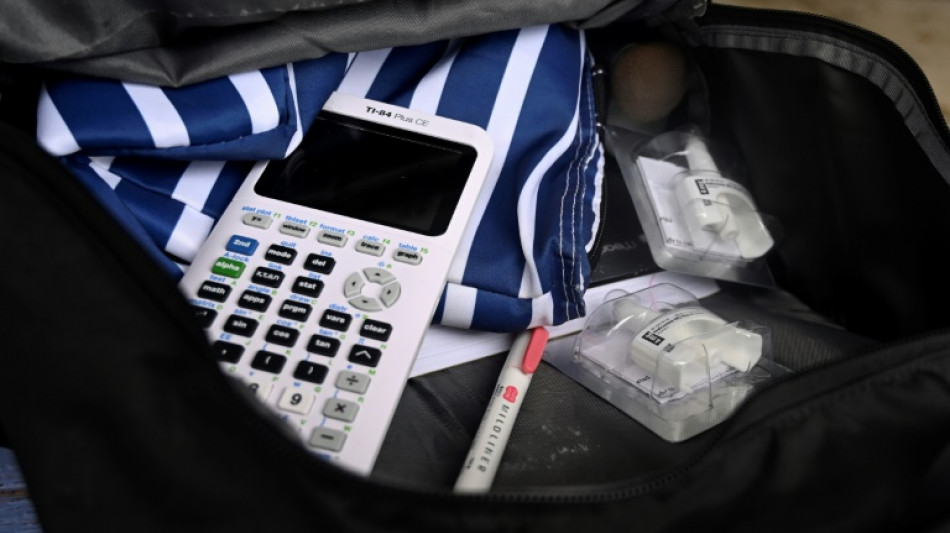
In US, this year's back-to-school supplies include Narcan / Photo: © AFP

 How Britain's mapmakers track climate change

 Australian delivery drivers win 'world-leading' pay rise

 Meta meets its own 'tobacco' moment in court
 Art or medicine? Japan's cosmetic tattoo artists in limbo
 Rybakina ousts Osaka to book Toronto semi-final against Gauff
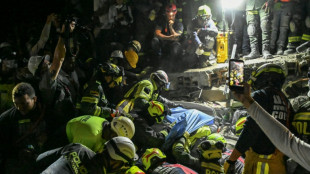 Colombia rescuers find woman alive as quake death toll passes 240
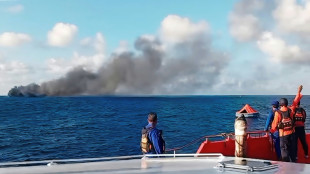
 Charges dropped against Bondi Beach attack hero

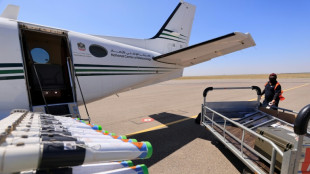 Parched and desperate for rain, Kazakhstan turns to cloud-seeding
 The perfect storm that turbocharged Venezuela's twin quakes
 2.4 million girls banned from Afghan schools since Taliban return: UNESCO
 Colombians dig through rubble as quake death toll surpasses 240

 New Zealand's ruling party meets to decide PM Luxon's fate

 Total solar eclipse to spellbind Europe

 Jodar, Nakashima to make Masters semis debuts in Montreal

 Chilean veteran Sanchez signs with MLS club Montreal

 Cristiano Ronaldo marries long-term partner Georgina Rodriguez

 Oil prices higher, stocks mixed ahead of inflation report
 Jacobs into 100m final with eye on third title
 Eight-try New Zealand cruise to tour victory over Sharks
 Trump's secret plane swap triggers questions and confusion
 California calls Paramount's threat to leave state 'blackmail'

 PSG 'want to win everything', says Luis Enrique
 Barred from elections, Russia's anti-war party vows to fight on
 Jaissle states Newcastle ambition but urges patience

 NBA star Cooper Flagg trading card a slam dunk for lucky buyer

Before Jackson Danzig leaves the house each morning, he makes sure his backpack is filled with the usual high school necessities: books, homework, lunch –- and the Narcan sitting on his bedside table.
The opioid overdose reversal drug, also known by its generic name naloxone, is increasingly being carried by high schoolers across the United States as opioids -- including the powerful synthetic opioid fentanyl -- devastate the country.
"Everyone has a friend, or an acquaintance, who has experimented with drugs. Imagine yourself in a scenario where you find that friend in a potential overdose situation and you're not entirely sure what to do," says Danzig, 17, who along with his classmate Marin Peale has organized naloxone training for around 350 of his classmates.
It isn’t a hypothetical scenario: police responded to at least seven suspected overdoses last year at Arlington Public Schools, the largely affluent school district across the river from the nation’s capital where Danzig and Peale are students.
One student died after an apparent overdose on campus.
Nationwide, the United States saw a record of around 110,000 drug overdose deaths between March 2022 and March 2023, according to the Centers for Disease Control and Prevention (CDC). Fentanyl accounted for some two-thirds of them.
Among teenagers, overdose deaths increased 94 percent from 2019 to 2020 –- attributed by the CDC to the "widespread availability of illicitly manufactured fentanyls," the proliferation of counterfeit pills made with fentanyl, and the "ease of purchasing pills through social media."
- Endorsing drug use? -
Increasing access to live-saving drugs like naloxone can be controversial: Some parents, Arlington students say, view naloxone not just as an acknowledgment of risky drug use, but as an endorsement.
That criticism comes as local governments have sometimes diverged on drug policy strategies.
Some liberal cities like Portland have come under scrutiny for watering down criminal drug penalties to the point that open-air drug markets have flourished and overdoses are spiking.
Other states have moved toward harsher drug laws. After three high schoolers overdosed in Tennessee earlier this year, leaving two dead, the survivor was charged with murdering her classmates. Virginia has designated fentanyl as a "weapon of terrorism."
But overall, "I see, across the political spectrum, support for naloxone… and I think that’s been a victory for public health," said Keith Humphreys, a drug policy expert at Stanford University who supports increased naloxone access in US schools.
In Arlington, school policies and state laws banning drugs remain in place, officials say.
Among other rules, students who carry naloxone on campus must get training on how to use it and have parental permission to do so, said Darrell Sampson, APS executive director of student services, who described the policy change as having come from the ground up.
"The students felt like they wanted to be able to support their peers," he told AFP.
It comes on top of other drug education efforts at the school system, as well as the training of staff on how to use naloxone and the installment of emergency boxes of the substance throughout middle and high schools.
"In schools, we’ve always been responding to substances," Sampson said. "But none of those substances, per se, are as inexpensive to produce, as deadly in even small doses, or as highly addictive as we're seeing with opioids and fentanyl."
- Addiction crisis -
Humphreys, the Stanford researcher, said increasing naloxone access is only one part of the solution to the country’s drug crisis.
He called for bigger-picture investments in children’s mental health and their ability to manage their emotions and develop healthy relationships.
And while naloxone can prevent overdoses, he pointed out, it doesn't treat addiction, a problem that requires huge public funding.
"It is a mistake to think if we could just reduce the overdose death numbers we would have made big progress," he told AFP. "That’s an extremely modest aspiration."
Both Danzig and his classmate Peale, also 17, started carrying naloxone last year, before the school’s policy technically allowed them to -- willing to get in trouble "for doing the right thing," Peale says.
Now, though, naloxone has almost become commonplace.
"Whatever classroom I go in, there has to be a box, and I also always carry one," Peale says. "I kind of always feel prepared."
J.Horn--BTB