Ethiopia's Oromo people celebrate festival once denied / Photo: © AFP

 Zhu Rongji, trailblazing ex-premier who transformed China's economy

 China tech giant Tencent's Q2 profit down as AI push builds
 China's C919 jet makes first international commercial flight
 Mideast war impact on travel bookings fading, TUI says
 Bangladesh get Das fitness boost for daunting Australia task
 One dead, 172 rescued as second ferry in days catches fire in Indonesia
 Foxconn posts quarterly profit surge on AI server demand
 Hazlewood gets Australia nod ahead of Boland for Bangladesh Test
 Toyota ex-chief Okuda, pioneer of the Prius, dead at 93
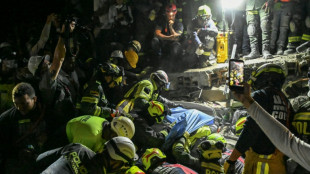
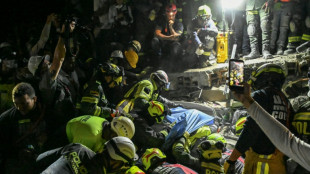 Colombia rescuers find woman alive as quake death toll passes 200

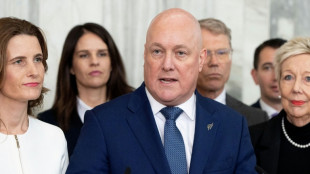 New Zealand PM survives leadership challenge months from election
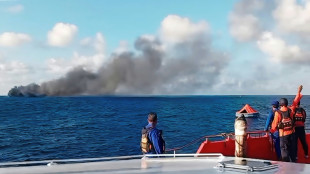 Passengers rescued as second ferry in days catches fire in Indonesia
 Oil prices rise, stocks mixed ahead of crucial US inflation data
 UK 'joke' candidate Binface pushes serious point about politics
 New Zealand PM Luxon survives leadership challenge months from election
 Cuba celebrates Castro's 100th as his revolution faces its toughest test
 Defending champion Shelton rolls into Montreal semis
 What to know about the total solar eclipse

 Tentoglou claims fourth Euro long jump title, injured Jacobs falters

 All Blacks knew Nonu would perform solo Haka - coach Rennie
 Britain's Glave upstages Jacobs to win European 100m gold

 Greece's Tentoglou wins fourth European long jump title

 Doctors ignored 'warning signs' before Maradona's death, court hears
 Pereira, the 'zombie city' devastated by Colombia's earthquake

 UN says 2 staff arrested by Afghan intelligence agency
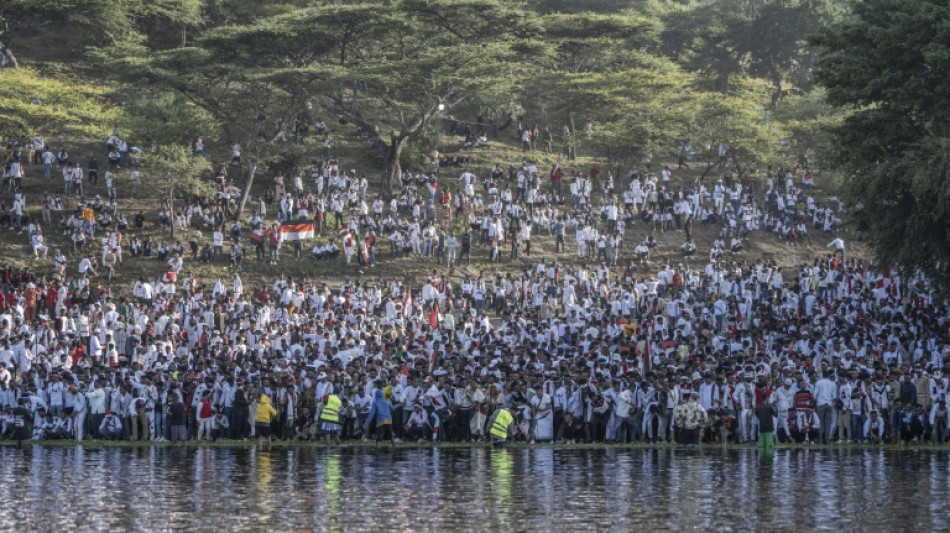
Tens of thousands of Oromos gathered Sunday at a lake near the Ethiopian capital for a once-banned celebration that today doubles as a sounding board for political and ethnic demands.
Draped in traditional colours including the red, white and black of the Oromo flag, crowds descended on the shores of Lake Hora Arsadi, 50 kilometres (30 miles) southeast of Addis Ababa, for the annual Irreecha festival.
Representing around a third of Ethiopia's 120 million people, the Oromo are the largest of 80 distinct groups that make up the vast and ethnically-diverse nation in the Horn of Africa.
"The Oromo people come to the lake to give thanks to god for the change of the rainy season, of winter to spring," said Sabkebar Gezu, a 35-year-old small business owner.
To mark the passage of seasons, attendees old and young at Irreecha dip flowers into the lake and sprinkle themselves with the blessed water, amid traditional songs and dancing in colourful regalia.
The Oromo are almost equally divided between Christians and Muslims. Many refer to god as Waaqa, and some still practice local beliefs that revolve around this ancestral life-giving deity.
In recent decades, there has been a revival of Oromo identity long suppressed under successive waves of Ethiopian rulers and traditions like Irreecha, which was long banned, have re-emerged.
- 'Our strength' -
Tola Micha, wearing a tie striped in Oromo colours, remembered when Irreecha resumed in the late 1990s after the fall of the military-Marxist Derg regime in 1991.
In the beginning there were "a few hundred" in attendance: "Now we're in numbers, and I am proud of it," the 52-year-old said.
"Ireecha is our fist. It represents our strength."
Sabkebar said Irreecha was a "major" festival for his people but despite the celebrations, he did not forget there were "still many issues which remain unaddressed regarding the Oromo".
"The past generation has paid a sacrifice so that our generation can come here and celebrate it," he said.
Among the crowd, political chants peppered the lively singing and dancing.
"We are marginalised!" rose one refrain, while others spoke of a desire for greater respect as a people, and concerns over Oromos in prison.
Others cried for an end to the violent armed conflict raging in Oromia, a restive region and homeland of the Oromo.
Oromia is plagued by armed violence and anti-government insurgencies, and has witnessed ethnic massacres in recent years.
In 2018, Abiy Ahmed became the first Oromo to lead Ethiopia, and many anticipated greater representation and respect for a long-marginalised people.
But many Oromo have complained of continuing political and economic persecution even under the leadership of one of their own.
Many celebrating at Irreecha were at pains to avoid discussing the thornier issue of politics, but echoed wider concerns about Oromo identity and their place in Ethiopia.
"We can't say the question of the Oromo people is fully addressed, but it is better than before," said Kiya Tadessa, a 24-year-old NGO worker.
Ababa Korsa, a 30-year-old accountant, said the right to celebrate Irreecha "wasn't given to us freely and many shed their blood and sacrifice was paid".
"Even today, we cannot say we are fully liberated and there are many issues unaddressed," he said.
"However, it's partly better, to come here and celebrate our culture freely."
A.Gasser--BTB