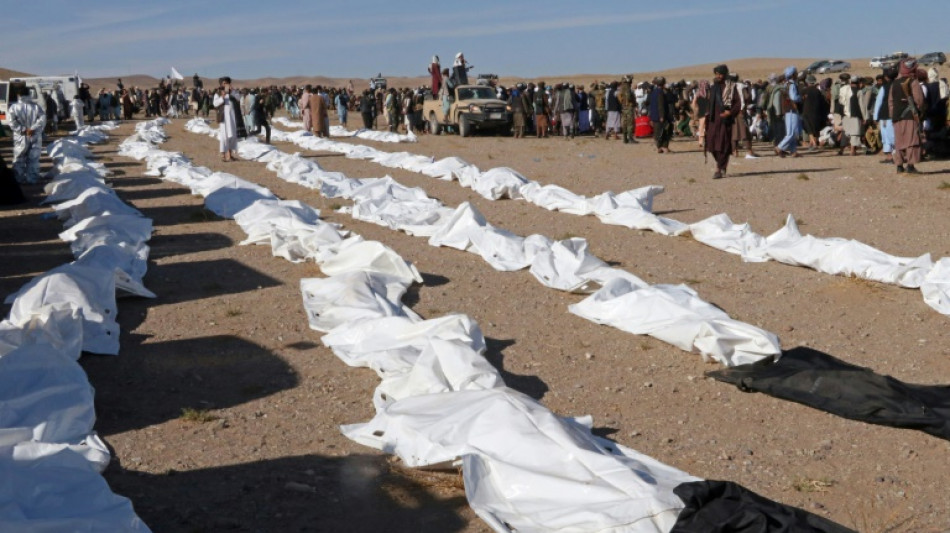
Afghan rescuers still digging as hope fades for quake villagers / Photo: © AFP

 Zhu Rongji, trailblazing ex-premier who transformed China's economy

 China tech giant Tencent's Q2 profit down as AI push builds
 China's C919 jet makes first international commercial flight
 Mideast war impact on travel bookings fading, TUI says

 Bangladesh get Das fitness boost for daunting Australia task

 One dead, 172 rescued as second ferry in days catches fire in Indonesia
 Foxconn posts quarterly profit surge on AI server demand

 Hazlewood gets Australia nod ahead of Boland for Bangladesh Test

 Toyota ex-chief Okuda, pioneer of the Prius, dead at 93

 Colombia rescuers find woman alive as quake death toll passes 200

 New Zealand PM survives leadership challenge months from election
 Passengers rescued as second ferry in days catches fire in Indonesia

 Oil prices rise, stocks mixed ahead of crucial US inflation data
 UK 'joke' candidate Binface pushes serious point about politics
 New Zealand PM Luxon survives leadership challenge months from election
 Cuba celebrates Castro's 100th as his revolution faces its toughest test
 Defending champion Shelton rolls into Montreal semis

 What to know about the total solar eclipse

 Tentoglou claims fourth Euro long jump title, injured Jacobs falters

 All Blacks knew Nonu would perform solo Haka - coach Rennie

 Britain's Glave upstages Jacobs to win European 100m gold

 Greece's Tentoglou wins fourth European long jump title

 Doctors ignored 'warning signs' before Maradona's death, court hears

 Pereira, the 'zombie city' devastated by Colombia's earthquake

 UN says 2 staff arrested by Afghan intelligence agency

Rescue workers scrabbled through rubble Tuesday for villagers buried in their homes by a series of earthquakes that killed more than 2,000 people in rural western Afghanistan, but hope of finding survivors was fading fast.
Volunteers have worked non-stop with spades and pickaxes in Herat province since Saturday's deadly magnitude 6.3 quake struck -- followed by a series of powerful aftershocks -- but some were turning to digging graves instead.
Afghanistan is frequently hit by deadly earthquakes, but the weekend disaster is the worst to strike the impoverished country in more than 25 years.
Strong tremors were still shaking the area on Monday.
"There are families who don't have anyone left alive," said 50-year-old Ali Mohammad in Nayeb Rafi village, once home to 2,000 people.
"No one is left, not a woman nor a child... no one."
In nearby Siah Ab, a mass funeral ceremony was held Monday for more than 300 victims collected from nearby communities.
White-shrouded bodies were unloaded from a fleet of vehicles and laid in ranks as a crowd of men solemnly crossed their arms in Islamic prayer.
"I thought I must have been dreaming; all the places were razed," said 30-year-old Ismail, who goes by only one name.
"No one is left."
The United Nations says "100 percent" of homes were destroyed in 11 villages of rural Zenda Jan, a hard-to-reach district just 30 kilometres (19 miles) northwest of Herat city, the provincial capital.
- 'Families in debris' -
Disaster management ministry spokesman Mullah Janan Sayeq said late Monday that desperate villagers were still searching to "get their family out of debris".
But reports from the field described "a very bad situation" he told a news conference in the capital.
Local and national officials gave conflicting counts of the number of dead and injured, but the disaster ministry said Sunday that 2,053 people had died.
"We can't give exact numbers for dead and wounded as it is in flux," Sayeq said.
More than 11,000 people had been affected from 1,655 families, the World Health Organization says.
Trucks packed with food and blankets have arrived in the area, with blue tents popping up among the ruins of villages.
As winter draws in, providing shelter for residents will be a major challenge for Afghanistan's Taliban government, which seized power in August 2021 and has fractious relations with international aid organisations.
- 'Crisis on top of crisis' -
Taliban authorities have banned women from working for UN and non-governmental organisations (NGOs) in Afghanistan, making it difficult to assess family needs in deeply conservative parts of the country.
Amnesty International said the Taliban government should ensure that rescue and relief efforts are carried out "without discrimination" and guarantee unrestricted access to the affected regions to humanitarian agencies.
"It is critical that all assistance meets the needs of the most at-risk groups who often face compounded challenges in crisis situations, including women," said South Asia regional researcher Zaman Sultani.
Most rural homes in Afghanistan are made of mud, built around wooden support poles, with little in the way of modern steel reinforcement.
Multi-generational extended families generally live under the same roof, meaning disasters such as Saturday's quake can devastate local communities.
Afghanistan is already suffering a dire humanitarian crisis, with the widespread withdrawal of foreign aid following the Taliban's return to power.
Save the Children called the quake "a crisis on top of a crisis".
"The scale of the damage is horrific. The numbers affected by this tragedy are truly disturbing," said the group's country director Arshad Malik.
Herat province -- home to around 1.9 million people on the border with Iran -- has also been hit by a years-long drought that has crippled many hardscrabble farm communities.
Afghanistan is frequently hit by earthquakes, especially in the Hindu Kush mountain range, which lies near the junction of the Eurasian and Indian tectonic plates.
More than 1,000 people were killed and tens of thousands left homeless last June after a 5.9-magnitude quake struck the impoverished province of Paktika.
More than 4,000 people died in a magnitude 6.5 quake that struck Takhar province in 1998.
N.Fournier--BTB