One dead as new quake shakes west Afghanistan / Photo: © AFP

 Zhu Rongji, trailblazing ex-premier who transformed China's economy

 China tech giant Tencent's Q2 profit down as AI push builds
 China's C919 jet makes first international commercial flight
 Mideast war impact on travel bookings fading, TUI says

 Bangladesh get Das fitness boost for daunting Australia task

 One dead, 172 rescued as second ferry in days catches fire in Indonesia
 Foxconn posts quarterly profit surge on AI server demand

 Hazlewood gets Australia nod ahead of Boland for Bangladesh Test

 Toyota ex-chief Okuda, pioneer of the Prius, dead at 93

 Colombia rescuers find woman alive as quake death toll passes 200

 New Zealand PM survives leadership challenge months from election
 Passengers rescued as second ferry in days catches fire in Indonesia

 Oil prices rise, stocks mixed ahead of crucial US inflation data
 UK 'joke' candidate Binface pushes serious point about politics
 New Zealand PM Luxon survives leadership challenge months from election
 Cuba celebrates Castro's 100th as his revolution faces its toughest test
 Defending champion Shelton rolls into Montreal semis

 What to know about the total solar eclipse

 Tentoglou claims fourth Euro long jump title, injured Jacobs falters

 All Blacks knew Nonu would perform solo Haka - coach Rennie

 Britain's Glave upstages Jacobs to win European 100m gold

 Greece's Tentoglou wins fourth European long jump title
 Doctors ignored 'warning signs' before Maradona's death, court hears

 Pereira, the 'zombie city' devastated by Colombia's earthquake

 UN says 2 staff arrested by Afghan intelligence agency

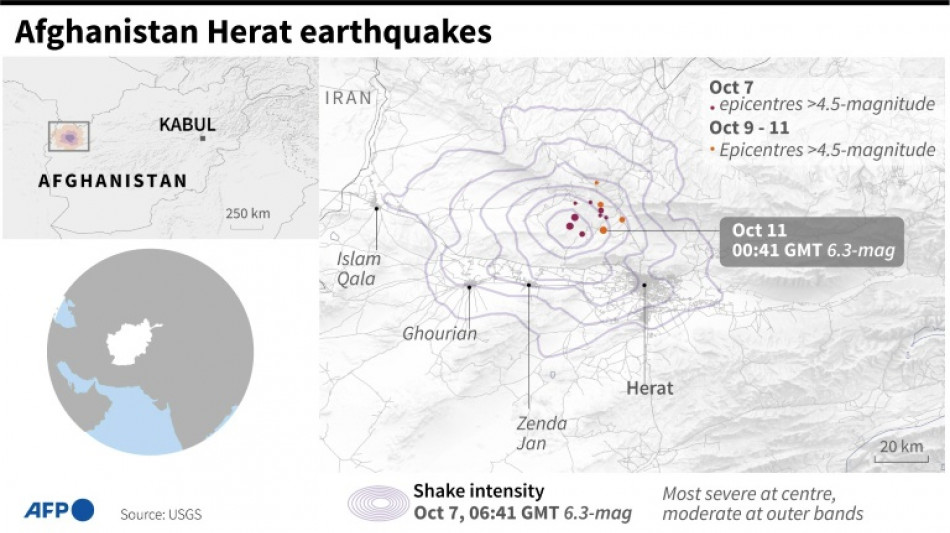
A magnitude 6.3 earthquake struck western Afghanistan on Wednesday, claiming at least one life and causing panic among residents already traumatised by a series of tremors that killed around 2,000 people at the weekend.
The dawn quake hit around 30 kilometres (19 miles) north of the provincial capital of Herat, where thousands were spending a fourth night in the open after Saturday's quakes flattened their villages.
"It's horrible, the whole of Herat is terrified," said 32-year-old Abdul Qudos.
"We are so scared that even when we see the trees moving (in the wind), we think it's another earthquake coming."
At least one person was killed and 120 injured by the latest quake, said Abdul Zahir Noorzai, ambulance manager for Herat Regional Hospital.
"The people in these (rural) areas were living outside their homes which are already destroyed" but were hit by fresh falling debris from unstable ruins, he told AFP.
The quake was followed by aftershocks measuring 5.0 and 4.1, but an AFP reporter said damage in Herat city -- home to more than half a million -- was minimal.
Many residents have camped in tents, cars and gardens since Saturday's magnitude 6.3 quake and a series of powerful aftershocks.
"Our children are so scared that they stay awake until the morning. They don't sleep," said 40-year-old Aziz Ahmad.
At Herat Regional Hospital, patients were being treated in an outdoor courtyard. Ambulances were arriving Wednesday morning, but most injuries appeared to be minor.
Afghanistan is frequently hit by deadly earthquakes, but the weekend disaster was the worst to strike the war-ravaged country in more than 25 years.
- Casualties in flux -
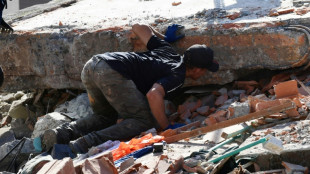
Volunteers have been digging for survivors and bodies from the earlier quakes which totally destroyed at least six villages in rural Zenda Jan district and affected more than 12,000 people, the UN says.
Local and national officials have given conflicting counts of the number of dead and injured, but the disaster ministry has said 2,053 people died.
"We can't give exact numbers for dead and wounded as it is in flux," said disaster management ministry spokesman Mullah Janan Sayeq.
Providing shelter on a large scale will be a challenge for Afghanistan's Taliban authorities, who seized power in August 2021, and have fractious relations with international aid organisations.
"Not a single house is left, not even a room where we could stay at night," said 40-year-old Mohammad Naeem, who told AFP he lost 12 relatives, including his mother, after Saturday's earthquakes.
"We can't live here anymore. You can see, our family got martyred here. How could we live here?"
Most homes in rural Afghanistan are made of mud and built around wooden support poles, with little in the way of steel or concrete reinforcement.
Multi-generational extended families generally live under the same roof, meaning serious earthquakes can devastate communities.
Afghanistan is already suffering a dire humanitarian crisis, with the widespread withdrawal of foreign aid following the Taliban's return to power.
Herat province, on the border with Iran, is home to around 1.9 million people, and its rural communities have been suffering from a years-long drought.
I.Meyer--BTB