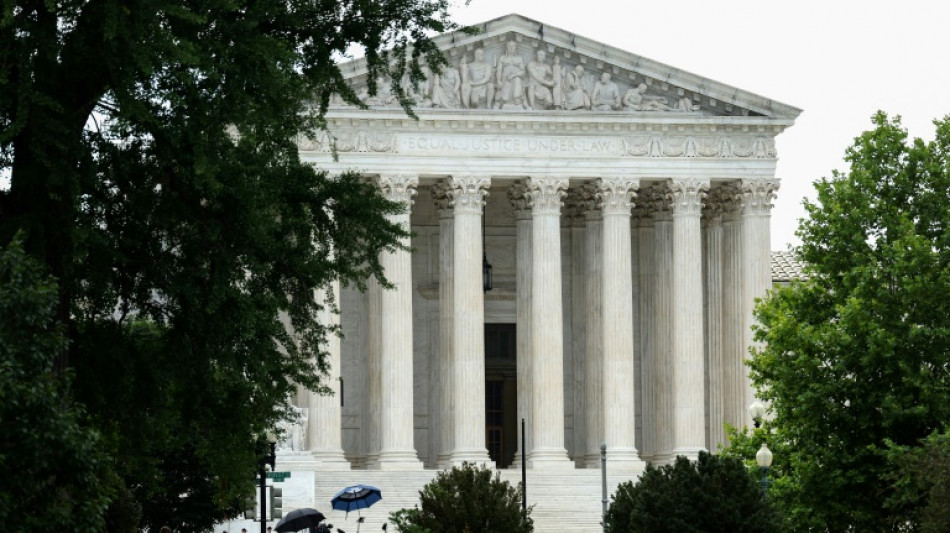
US Supreme Court weighs race and politics in gerrymandering case / Photo: © GETTY IMAGES/AFP

 Colombia declares three days mourning for quake victims

 44 lives lost after ferry capsizes on Zimbabwe's Lake Kariba

 WallStreetPR Releases Report on China’s Gold Purchases and African Mining Investment

 Former Chinese premier Zhu Rongji dies aged 97

 Markets steady awaiting US inflation data

 WHO says Trump vaccine shake-up goes against evidence

 Eclipse chasers flock to Spain for 'breathtaking' experience

 'To make the civilians leave': Russia pummels Ukraine's petrol stations

 Japan brushes off Australian PM's melon drama

 Rod Stewart cancels tour dates after heart surgery

 How Britain's mapmakers track climate change

 Australian delivery drivers win 'world-leading' pay rise

 Meta meets its own 'tobacco' moment in court

 Art or medicine? Japan's cosmetic tattoo artists in limbo

 Rybakina ousts Osaka to book Toronto semi-final against Gauff

 Colombia rescuers find woman alive as quake death toll passes 240

 Charges dropped against Bondi Beach attack hero

 Parched and desperate for rain, Kazakhstan turns to cloud-seeding
 The perfect storm that turbocharged Venezuela's twin quakes

 2.4 million girls banned from Afghan schools since Taliban return: UNESCO

 Colombians dig through rubble as quake death toll surpasses 240

 Karbon-X and Core Energy Sign Letter of Intent to Explore Commercial EV Charging Infrastructure in South America

 What to know about the total solar eclipse

 Tentoglou claims fourth Euro long jump title, injured Jacobs falters

 All Blacks knew Nonu would perform solo Haka - coach Rennie

The US Supreme Court heard a case touching on the thorny issues of race and politics on Wednesday that could help determine whether Democrats or Republicans control the House of Representatives next year.
The high-stakes case before the court involves a challenge to a congressional district map drawn up by the Republican-majority legislature in South Carolina.
It is one of several legal battles involving racial gerrymandering -- the manipulation of electoral maps that dilutes the voting power of minorities -- winding their way through the US courts.
In the South Carolina case, a three-judge panel ruled in January that a congressional district redrawn in the state after the 2020 US census was an illegal racial gerrymander and ordered it to be reconfigured before the November 2024 election.
The redrawn congressional map moved 60 percent of the Black residents of the coastal city of Charleston -- nearly 30,000 people -- from one district into another which already had a Black majority.
Six of the current members of the House from South Carolina are white and one is Black.
The South Carolina legislature challenged the lower court's ruling and appeared to get a sympathetic hearing on Wednesday from several of the conservative justices on the nation's highest court, where conservatives hold a 6-3 majority.
"Disentangling race and politics, in a situation like this, is very, very difficult," said Chief Justice John Roberts.
John Gore, representing the South Carolina Senate, said the Republican-led legislature had pursued the legally permissible objective of increasing their party's vote share and had not engaged in a racial gerrymander.
"It achieved that goal by moving Republicans into the district and Democrats out of the district," Gore said. "All of the direct evidence confirms that it used political data, not racial data, to identify Republicans and Democrats."
Leah Aden, counsel for the Legal Defense Fund, which brought the case along with the American Civil Liberties Union and the civil rights group the NAACP, dismissed the claim and said "all the evidence reflects that they were looking at race."
"Black Democrat voters were significantly and disproportionately targeted for movement," Aden said, urging the Supreme Court to uphold the district court's ruling.
- Other redistricting cases -
The South Carolina case is one of a number of congressional redistricting cases being fought in the courts following the release of the 2020 census data.
A panel of federal judges approved a new congressional map for the southern state of Alabama this month that includes a second electoral district with a large population of African Americans, who tend to largely vote Democratic.
"The law requires the creation of an additional district that affords Black Alabamians, like everyone else, a fair and reasonable opportunity to elect candidates of their choice," they said.
Black voters represent around a quarter of registered voters in Alabama but are in a majority in only one of the state's seven US House districts.
The new map was drawn up after the Supreme Court ruled in June that the redistricting plan adopted by Alabama for the 2022 congressional elections violated the 1965 Voting Rights Act, which was passed by Congress during the civil rights movement to prevent racial discrimination at the polls.
Roberts and Justice Brett Kavanaugh, both conservatives, joined the three liberal justices to fashion the 5-4 majority in the Alabama case.
A congressional map in Louisiana is also facing a legal challenge on the grounds it results in just one Black majority district although African Americans make up 30 percent of the southern state's population.
Republicans currently hold a slim 221-212 majority in the House and an increase in the number of Black majority districts could tip the balance in next year's congressional elections, when all 435 House seats will be up for grabs.
The Supreme Court is expected to issue a ruling in the South Carolina case by January.
P.Anderson--BTB