Nepal quake sparks revival of traditional craft skills / Photo: © AFP

 Colombia declares three days mourning for quake victims

 44 lives lost after ferry capsizes on Zimbabwe's Lake Kariba

 WallStreetPR Releases Report on China’s Gold Purchases and African Mining Investment

 Former Chinese premier Zhu Rongji dies aged 97
 Markets steady awaiting US inflation data

 WHO says Trump vaccine shake-up goes against evidence

 Eclipse chasers flock to Spain for 'breathtaking' experience

 'To make the civilians leave': Russia pummels Ukraine's petrol stations

 Japan brushes off Australian PM's melon drama

 Rod Stewart cancels tour dates after heart surgery

 How Britain's mapmakers track climate change

 Australian delivery drivers win 'world-leading' pay rise

 Meta meets its own 'tobacco' moment in court

 Art or medicine? Japan's cosmetic tattoo artists in limbo
 Rybakina ousts Osaka to book Toronto semi-final against Gauff

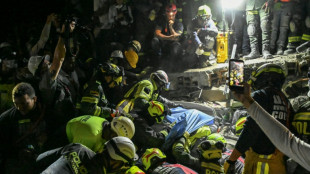
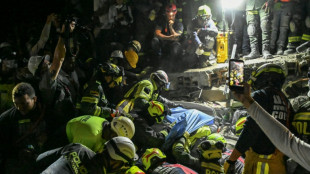 Colombia rescuers find woman alive as quake death toll passes 240

 Charges dropped against Bondi Beach attack hero

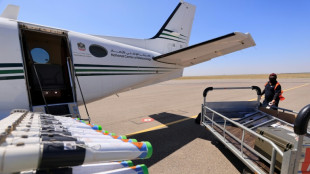 Parched and desperate for rain, Kazakhstan turns to cloud-seeding

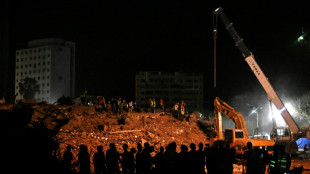 The perfect storm that turbocharged Venezuela's twin quakes

 2.4 million girls banned from Afghan schools since Taliban return: UNESCO

 Colombians dig through rubble as quake death toll surpasses 240

 Karbon-X and Core Energy Sign Letter of Intent to Explore Commercial EV Charging Infrastructure in South America

 What to know about the total solar eclipse

 Tentoglou claims fourth Euro long jump title, injured Jacobs falters

 All Blacks knew Nonu would perform solo Haka - coach Rennie

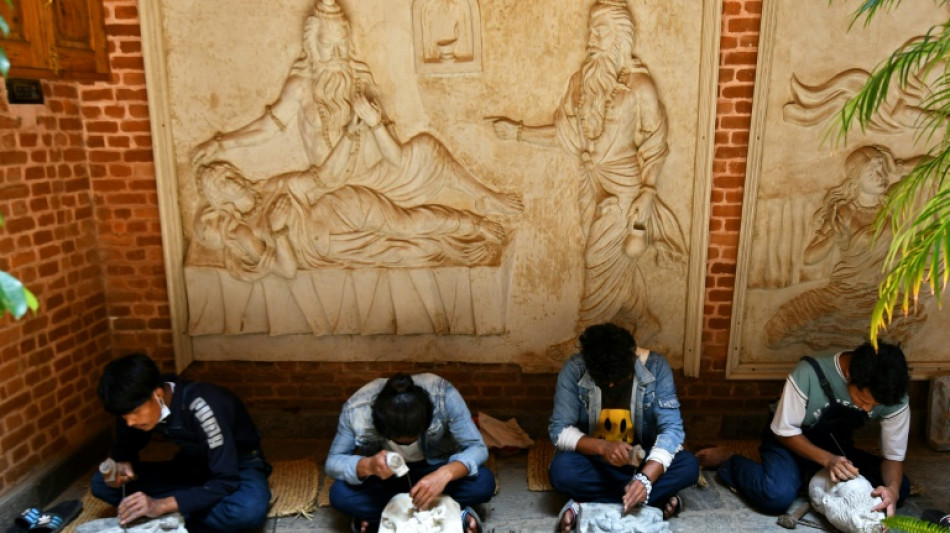
Nepal's deadly earthquake eight years ago reduced swathes of centuries-old monuments to rubble, but the vast task of restoration has sparked a revival of once-fading architectural craft skills.
Carpenter Dinesh Tamang is one of hundreds of craftspeople who learned a new trade in the quake's aftermath.
"I got a chance to work in reconstruction projects, to rebuild damaged temples and houses," said Tamang, who was unemployed before the 7.8 magnitude earthquake that killed nearly 9,000 people.
"It is very rewarding work," he said while carefully carving an intricate pattern on a wooden panel with a chisel and mallet.
The 2015 quake also destroyed hundreds of monuments and royal palaces -- including the Kathmandu Valley's UNESCO World Heritage sites -- that had drawn visitors from around the world.
In deeply religious Nepal, temples and heritage sites are not just tourist attractions, but an integral part of cultural and spiritual life.
The public demand for their rebuilding fueled a need for workers adept at traditional architectural techniques including stone masonry and intricate wood and metal work.
"Nepal is rich in cultural heritage," Tamang said. "You see temples everywhere and I was always fascinated by the designs on the wood".
Nepal Vocational Academy, where Tamang enrolled, said it had trained hundreds in traditional skills since the quake.
"Even though the quake was a tragic event, it has created opportunities in different sectors," said Rabindra Puri, a heritage conservationist and the academy's founder.
"The demand for skilled manpower drastically increased".
Puri said that the academy expanded its facility after the quake to meet the surge in demand for training.
"As far as I know, none of our graduates are unemployed," he said.
- 'Live on after us' -
Many initially feared Nepal lacked the skills needed for the huge task of rebuilding.
The palaces and temples damaged date back to the period between the 12th and 18th centuries when the Kathmandu Valley was divided into the three kingdoms of Kathmandu, Patan and Bhaktapur.
The wood carvers, stone sculptors and metal workers who created the spectacular temples and palaces were once feted from far away and paid handsomely from the royal purse.
These crafts were historically carried out exclusively by families belonging to the Newa ethnic group and passed on through generations. But over time many opted for other professions.
"The fathers didn't want to teach the sons, and sons didn't want to learn, so it was close to disappearing," Puri said.
The funding for reconstruction has made these professions more economically sustainable.
The government has poured in over $45 billion to restore its heritage sites, with additional projects funded from countries including neighbouring China and India -- as well as Japan, Sri Lanka, Switzerland and the United States.
About 80 percent of the 920 heritage structures that were flattened or damaged have been reconstructed.
Heritage conservationist Rohit Ranjitkar, director of the Kathmandu Valley Preservation Trust, said that while the renewed interest in learning traditional crafts is encouraging, the focus should be on quality.
"The quality must match the monuments we have... These skills that have been passed on from generation to generation cannot be learnt with a few months' training," he said.
"Practice is important... We need to see how to encourage them, so that they can carry on the skills."
Stonework expert Kancha Ranjitkar, 82, who began working with his father as a teenager, said he felt happy alongside younger craftspeople.
"Many of the skills are vanishing," he said. "But the quake gave a chance to pass on our knowledge to the next generation... for it to live on after us."
F.Müller--BTB