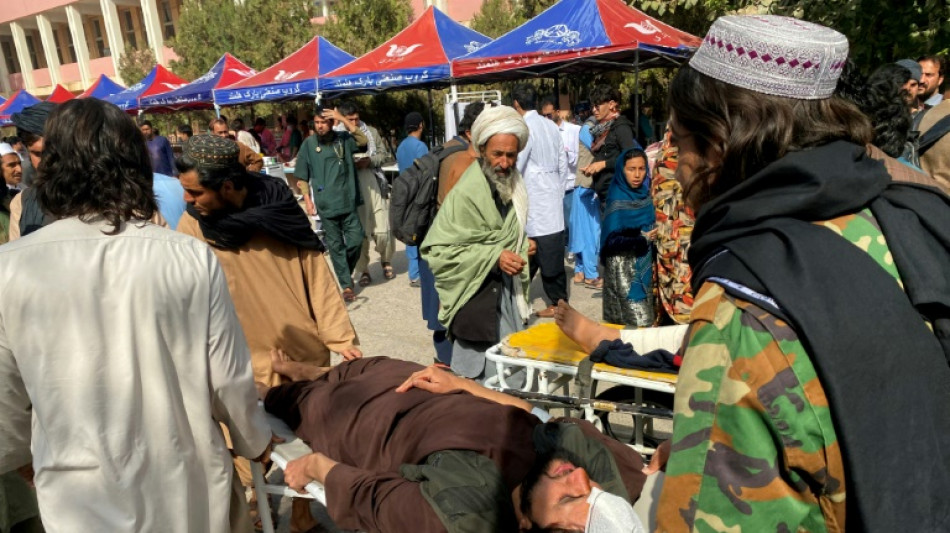
Afghans flee western region after fresh earthquake kills two / Photo: © AFP

 Colombia declares three days mourning for quake victims

 44 lives lost after ferry capsizes on Zimbabwe's Lake Kariba

 WallStreetPR Releases Report on China’s Gold Purchases and African Mining Investment

 Former Chinese premier Zhu Rongji dies aged 97
 Markets steady awaiting US inflation data

 WHO says Trump vaccine shake-up goes against evidence

 Eclipse chasers flock to Spain for 'breathtaking' experience

 'To make the civilians leave': Russia pummels Ukraine's petrol stations

 Japan brushes off Australian PM's melon drama

 Rod Stewart cancels tour dates after heart surgery
 How Britain's mapmakers track climate change

 Australian delivery drivers win 'world-leading' pay rise

 Meta meets its own 'tobacco' moment in court

 Art or medicine? Japan's cosmetic tattoo artists in limbo
 Rybakina ousts Osaka to book Toronto semi-final against Gauff

 Colombia rescuers find woman alive as quake death toll passes 240
 Charges dropped against Bondi Beach attack hero

 Parched and desperate for rain, Kazakhstan turns to cloud-seeding

 The perfect storm that turbocharged Venezuela's twin quakes

 2.4 million girls banned from Afghan schools since Taliban return: UNESCO
 Colombians dig through rubble as quake death toll surpasses 240

 Karbon-X and Core Energy Sign Letter of Intent to Explore Commercial EV Charging Infrastructure in South America

 What to know about the total solar eclipse

 Tentoglou claims fourth Euro long jump title, injured Jacobs falters

 All Blacks knew Nonu would perform solo Haka - coach Rennie

A magnitude 6.3 earthquake killed two people in western Afghanistan Sunday, with damaged prisons emptied and residents fleeing a region where tremors have claimed at least 1,000 lives this past week.
Since October 7, a series of potent quakes have jolted Herat province, levelling whole villages, burying families and leaving thousands homeless as winter approaches.
Residents in the provincial capital Herat city had just begun returning to their homes, after days of sleeping outside fearing aftershocks, when the latest earthquake hit around 8:00 am (0330 GMT) on Sunday.
Doctors Without Borders (MSF) said two new fatalities and 154 injuries were registered at Herat Regional Hospital, where patients were being ferried on stretchers and treated outside under gazebos.
"The situation is very critical," MSF's Afghanistan Programme Head Yahya Kalilah told AFP. "In terms of psychology, people are panicked and traumatised."
"People are not feeling safe. I will assure you 100 per cent, no one will sleep in their house."
The latest quake's epicentre was 33 kilometres (20 miles) northwest of Herat city and was followed by aftershocks of magnitudes 5.4, 4.2, 4.3 and 4.4, the US Geological Survey said.
Officials said more than 528 prisoners had been released from Herat province and neighbouring Badghis province because jails "were in danger of collapsing" from quake damage.
The Prisons Administration Authority said those freed included inmates who had served large portions of their sentences and showed signs of reform.
- Fleeing the area -
Herat city resident Haris Aryan said he sent his family south to Farah province to escape the trauma of the quakes.
"Many people, anyone with relatives or accommodation in neighbouring provinces, all of them have fled," he told AFP. "Those who do not have anywhere to go... they are spending nights in the roads and parks."
National disaster management officials said they were investigating the scale of Sunday's earthquake.
MSF official Kalilah predicted "casualties will be low" because residents in the worst-hit areas were already living outdoors after their homes were destroyed last week.
"It's Allah's blessing that it happened during the day, people were awake," said 27-year-old Herat city shopkeeper Hamid Nizami.
The quake series began on October 7 with a 6.3 tremor and eight powerful aftershocks, which devastated rural villages northwest of Herat city.
The Taliban government said more than 1,000 people were killed, while the World Health Organization (WHO) put the figure at nearly 1,400 late Saturday.
Another tremor of the same intensity killed one person and injured 130 others days after the initial quakes, as volunteers dug desperately for survivors.
Dust storms then whipped up in the area, damaging the tents that survivors were relying on for shelter.
The WHO says nearly 20,000 people have been affected by the string of disasters, with women and children making up most of the fatalities.
- 'We can't live here' -
Thousands of residents are now living around the ruins of homes where entire families were wiped out in an instant. Aftershocks have left them "in a persistent state of anxiety and fear", the WHO said.
Forty-year-old Mohammad Naeem told AFP he lost 12 relatives, including his mother, after last week's quakes.
"We can't live here anymore. You can see, our family got martyred here. How could we live here?"
Earthquakes are frequent in western and central Afghanistan and are mostly caused by the Arabian and Eurasian tectonic plates jutting against each other.
Providing shelter on a large scale will be a challenge for Afghanistan's Taliban authorities, who seized power in August 2021 and have fractious relations with international aid organisations.
"We know they could live there in tents for one month, but more than that would probably be very difficult," said public health minister Qalandar Ebad.
Most homes in rural Afghanistan are made of mud and built around wooden support poles, with little in the way of steel or concrete reinforcement.
Multi-generational extended families generally live under the same roof, meaning serious earthquakes can devastate communities.
Afghanistan is already suffering a dire humanitarian crisis, with the widespread withdrawal of foreign aid following the Taliban government's return to power in 2021.
F.Müller--BTB