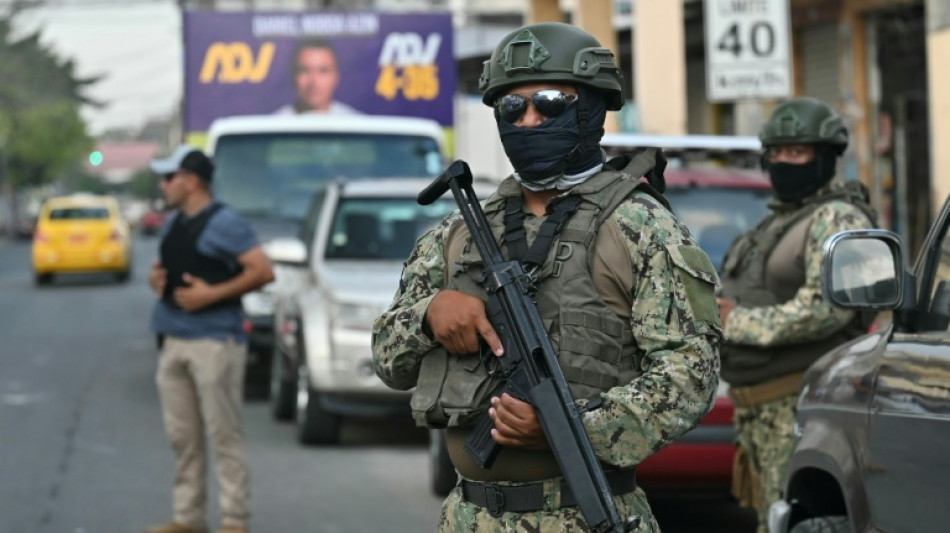
Noboa vs organized crime: Can Ecuador's new president rise to the challenge? / Photo: © AFP/File

 Colombia declares three days mourning for quake victims

 44 lives lost after ferry capsizes on Zimbabwe's Lake Kariba

 WallStreetPR Releases Report on China’s Gold Purchases and African Mining Investment
 Former Chinese premier Zhu Rongji dies aged 97

 Markets steady awaiting US inflation data
 WHO says Trump vaccine shake-up goes against evidence

 Eclipse chasers flock to Spain for 'breathtaking' experience

 'To make the civilians leave': Russia pummels Ukraine's petrol stations

 Japan brushes off Australian PM's melon drama
 Rod Stewart cancels tour dates after heart surgery
 How Britain's mapmakers track climate change

 Australian delivery drivers win 'world-leading' pay rise

 Meta meets its own 'tobacco' moment in court
 Art or medicine? Japan's cosmetic tattoo artists in limbo
 Rybakina ousts Osaka to book Toronto semi-final against Gauff
 Colombia rescuers find woman alive as quake death toll passes 240
 Charges dropped against Bondi Beach attack hero

 Parched and desperate for rain, Kazakhstan turns to cloud-seeding
 The perfect storm that turbocharged Venezuela's twin quakes
 2.4 million girls banned from Afghan schools since Taliban return: UNESCO
 Colombians dig through rubble as quake death toll surpasses 240

 Karbon-X and Core Energy Sign Letter of Intent to Explore Commercial EV Charging Infrastructure in South America
 What to know about the total solar eclipse

 Tentoglou claims fourth Euro long jump title, injured Jacobs falters

 All Blacks knew Nonu would perform solo Haka - coach Rennie

Ecuador's president-elect Daniel Noboa, its youngest ever, is bracing for a titanic clash with narco traffickers that have turned the South American country upside down with a spate of horrific violence.
With little political experience, the businessman son of one of Ecuador's richest men will be confronting gangs with ties to Mexican and Colombian cartels, seeking to restore the peace that reigned just a few years ago.
He has plans to install a separate judicial system for the most serious crimes, militarize the borders with Colombia and Peru -- the world's biggest cocaine producers -- and jail the most violent offenders on barges offshore.
On Sunday, Noboa garnered 52 percent of ballots cast by voters with security concerns uppermost on their minds, according to opinion polls.
By Tuesday he had already called for the country's security council to convene to report on the actions being taken to "restore peace to Ecuadoran families," he said in a social media post.
In the four years to 2022, formerly peaceful Ecuador's murder rate quadrupled, with at least 460 inmates massacred in prisons since February 2021 -- many beheaded or burned alive -- in fighting between enemy gangs.
As Ecuador went from being a mere transit stop to a hub for drug trafficking itself, the bloodbath has spilled into the streets with narco criminals dangling headless corpses from city bridges and detonating car bombs outside police stations in a show of force.
Could Noboa's plans work?
- Prison mayhem -
Perhaps the first sign of things to come were simultaneous massacres in four prisons in February 2021. Since then, more than 460 inmates have died as the carnage has spread, some of the bloodshed transmitted live on social media.
Images of bodies hacked up with machetes or burnt beyond recognition spoke to the lack of control in the country's overcrowded prisons, which have become trafficking centers.
Widespread graft among over-extended prison guards has allowed inmates to obtain guns and explosives, even drones.
In this context, Noboa's proposal to seclude prisoners offshore under the supervision of "highly corruptible" guards, is risky, Renato Rivera, coordinator for the Ecuadoran Organized Crime Observatory, told AFP.
If individual guards are bought by organized crime and left to operate in isolation, "the (proposed) solution could become an additional problem," he said.
There are also fears for human rights abuses as well as the high cost of building floating prisons.
It is a solution that would "take a lot of time" to execute, said Rivera, for a president elected to just 16 months in office.
Noboa will be finishing the term of outgoing leader Guillermo Lasso, who called snap elections to avoid possible impeachment.
- Security purge -
"A very aggressive, rapid and effective purge of the security forces, obviously infiltrated by organized crime, is indispensable" for Noboa to have any success, said David Chavez, a political analyst at the Central University of Ecuador.
"Without doing this it will be impossible to regain control of the prisons, I think that is a critical issue, the priority," he told AFP.
Widespread corruption that spreads far beyond prisons to government and the private sector, was another of voters' major concerns.
Transparency International gave the country a score of 36 out of 100 on its Corruption Perceptions Index for 2022, lower than the 43 average for the Americas.
In 2021 and 2022, concerned by high levels of graft tied to organized crime, the United States barred several senior police officers, judges and judicial employees from travel to its shores.
Strengthening the organs of state to hit back at organized crime and its ever-expanding web of graft was essential to addressing the security problem, said Chavez.
However, "Noboa and his vice president have made it very clear that their project is to continue... dismantling the state, decreasing its size," he added.
- Intelligence overhaul -
The country's intelligence services have been severely weakened in recent years.
Viewed as a tool of political espionage under socialist ex-president Rafael Correa -- in office for 10 years until 2017 -- the intelligence agencies were enfeebled by subsequent rightwing governments.
It is "a totally weakened intelligence system that is not preventing (crime), not generating alerts," said Rivera.
Experts estimate that Ecuador could close this year with the record of 40 homicides per 100,000 inhabitants, up from 33 per 100,000 today.
This is more than Mexico or Colombia, countries with "a much longer history of crime," said Rivera.
The United States said Tuesday it would fund a program in Ecuador offering rewards for information that helps track down members of organized crime groups.
O.Krause--BTB