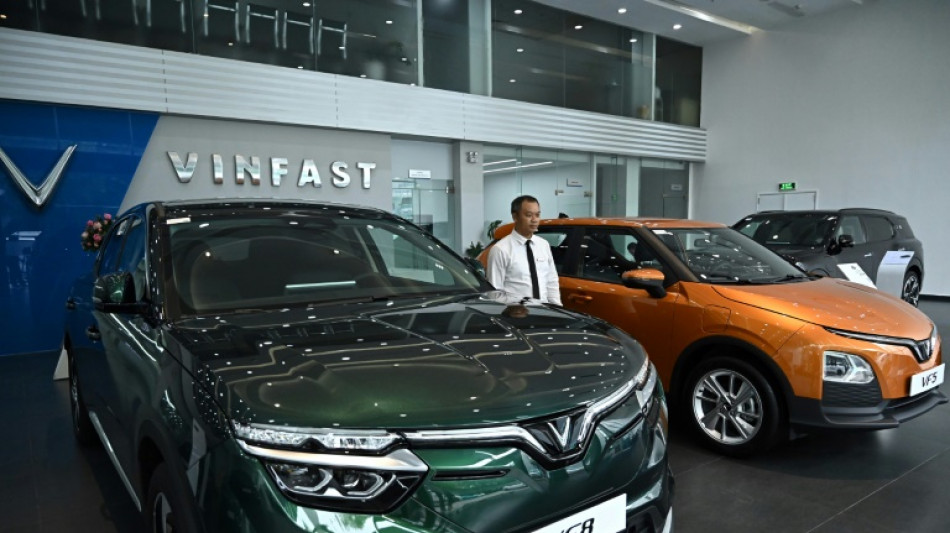
Vietnam's VinFast struggles to sell electric cars at home / Photo: © AFP

 Colombia declares three days mourning for quake victims

 44 lives lost after ferry capsizes on Zimbabwe's Lake Kariba

 WallStreetPR Releases Report on China’s Gold Purchases and African Mining Investment

 Former Chinese premier Zhu Rongji dies aged 97

 Markets steady awaiting US inflation data

 WHO says Trump vaccine shake-up goes against evidence

 Eclipse chasers flock to Spain for 'breathtaking' experience

 'To make the civilians leave': Russia pummels Ukraine's petrol stations
 Japan brushes off Australian PM's melon drama

 Rod Stewart cancels tour dates after heart surgery

 How Britain's mapmakers track climate change
 Australian delivery drivers win 'world-leading' pay rise

 Meta meets its own 'tobacco' moment in court
 Art or medicine? Japan's cosmetic tattoo artists in limbo

 Rybakina ousts Osaka to book Toronto semi-final against Gauff
 Colombia rescuers find woman alive as quake death toll passes 240

 Charges dropped against Bondi Beach attack hero

 Parched and desperate for rain, Kazakhstan turns to cloud-seeding

 The perfect storm that turbocharged Venezuela's twin quakes
 2.4 million girls banned from Afghan schools since Taliban return: UNESCO

 Colombians dig through rubble as quake death toll surpasses 240

 Karbon-X and Core Energy Sign Letter of Intent to Explore Commercial EV Charging Infrastructure in South America
 What to know about the total solar eclipse

 Tentoglou claims fourth Euro long jump title, injured Jacobs falters

 All Blacks knew Nonu would perform solo Haka - coach Rennie

Vietnam's VinFast has grand ambitions of selling its electric vehicles in the United States and Europe to compete with the likes of Elon Musk's Tesla, but it is struggling to find buyers for its cars at home.
Backed by Vingroup, Vietnam's biggest conglomerate, Vinfast has enormous brand recognition in the country but has found it tough to convince drivers that its EVs are reliable and high-quality.
Ngo Trong Tu, a 31-year-old businessman from Hanoi, seriously considered buying a $35,000 VinFast EV but instead spent nearly $5,000 more on an imported petrol-powered Honda.
"It's safer than buying a (VinFast) EV," Tu told AFP in Hanoi. "On social media, many people said their VinFast EVs had faults."
"I don't want to spend my money on an imperfect product."
Around 280,000 new passenger vehicles were sold in Vietnam in 2022, according to the International Organization of Motor Vehicle Manufacturers.
VinFast -- one of the few EV options in the country -- sold only 7,400.
In the first half of 2023, there were 11,000 purchases -- but more than half went to a taxi company owned by its parent Vingroup.
The automaker has also been plagued by complaints about faulty construction and car software problems, compounding the challenge of selling EVs in a country where charging infrastructure is underdeveloped.
In January, the presenter of the "Xe Dien EV" YouTube channel -- which specialises in EV and battery reviews -- said his new VinFast VF8's battery was faulty and he could not open the car with its smart key.
In another video months later, he reported problems with the car's virtual assistant, its accelerator and the air conditioner.
And in April, state media reported that a VinFast EV suddenly caught fire in Nghe An province.
VinFast said in a statement that authorities had identified the cause of the fire and it was not because of a problem in their vehicle.
Local authorities did not respond to AFP's request for comment on the incident.
In an interview with AFP last month, when asked about the complaints, VinFast's chief executive Le Thi Thu Thuy acknowledged that "there were a lot of doubts".
It was unrealistic to expect a new product to be perfect, she said, adding: "There's a lot of hope and expectations for us to be better."
The company said in a statement that when complaints are reported to their service centre, they are always resolved promptly.
"To date, after several software updates and upgrades, our EVs are performing well," it added.
- 'Deep pockets' -
VinFast's parent is owned by Vietnam's richest person, Pham Nhat Vuong, who started out selling dried noodles in the Soviet Union.
He went on to build a $5 billion empire with interests in a range of sectors including real estate, tourism and education.
The tycoon now has set his sights on the burgeoning global EV market -- VinFast has opened showrooms in the United States, and outlets in France, Germany and the Netherlands.
VinFast shares have experienced wild fluctuations since debuting on the Nasdaq in August -- it soared to a market value bigger than auto titans Ford and General Motors before lurching down.
And despite reporting a net loss of more than $600 million in the third quarter, it continues to expand. Its target markets now include India, Indonesia and the Middle East.
"For now, these losses can be carried because Vingroup has deep pockets, but that can't go on forever," said Southeast Asia trade expert James Guild from the S. Rajaratnam School of International Studies in Singapore.
VinFast has said it aims to deliver up to 50,000 cars globally this year. It has sold around 21,000 so far.
With poor demand in Vietnam, and limited sales and bad press in the United States, VinFast may be producing more cars than it can sell, Guild said.
"It needs to have some kind of viable financial and operational plan for the next few years, and right now it's hard to see what that is."
Vingroup has pioneered EV infrastructure in Vietnam but one automobile expert in Vietnam, who refused to be named for fear of repercussions from the powerful conglomerate, said that "VinFast has not won our trust".
"Users cannot buy such an expensive car based on national pride alone," they said.
Tran Lien Phuong, director of the Ho Chi Minh City consulting and market research company AMCO, said despite the government encouraging people to buy products made in Vietnam, consumers display more faith in foreign brands.
"It will surely be a long and difficult play for Vingroup," Phuong said.
"Anyone joining this game needs time."
J.Bergmann--BTB