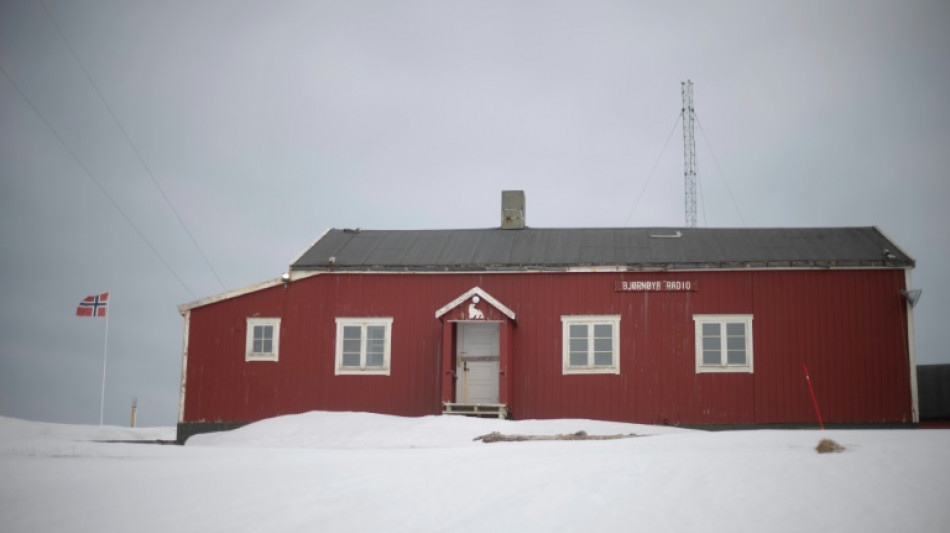
In Norway's Arctic, meteorologists have a first-row seat to climate change / Photo: © AFP

 Dominican Republic calls for Haiti force to be strengthened

 Dolly Parton's nephew ordered to stay away from estate staff, properties

 Early exit for Philippine darling Eala at Singapore Open

 Hurricane Polo triggers huge waves in coastal Mexican city

 What happens if the US bans diesel exports
 Macklemore hits back with 'Free Palestine Tour' after Sheeran split
 Met Opera to give New Yorkers free tickets in affordability push

 Top ECB official to resign to take up IMF role

 Xi and Trump call for peace in lavish White House state visit

 Five up-and-coming players looking to make mark in Nations League
 CNN, MS NOW, Politico request court hearing after White House access denied

 Eviction of pensioner puts Spain housing crisis in spotlight

 CNN, MS NOW, Politico say reporters still barred from White House
 Udinese sign ex-Real Madrid defender Alaba on free transfer
 Trump welcomes Xi to Washington with lavish praise

 Kane relishing chance to become England's most-capped player

 Average EU diesel price hits record 2.23 euros a litre: AFP analysis

 Whitetip Investments Marks 10 Years of Regulation, Transparency & Responsible Trading

 Pakistan blocks roads around capital ahead of planned pro-Khan protest

 Stocks fall, oil prices rise as global bonds under pressure

 Mancini's Italy facing battle to 'win back' dispirited fans

 German think tanks urge Merz to stick with reforms after election defeats
 Alcaraz wants end to late-night matches at Grand Slams

 EU battle over how to define 'Made in Europe'

 Eight killed in wave of Russian strikes on Ukraine

In the cold of the Norwegian Arctic, meteorologist Trond Robertsen manually recorded precipitation levels for over two decades, witnessing firsthand the effects of climate change.
At 66, Robertsen retired after enduring spartan conditions during missions that totalled eight years on two islands of the Svalbard archipelago: Bjornoya (Bear Island) and Hogen.
To reach the remote Bjornoya, where the only humans are the nine employees of the small weather station, the meteorologists have to fly in by helicopter as they are rotated on a six-month basis.
"The idea is to not stay too long, because it's a different rhythm, and you are isolated," Robertsen told AFP.
It is demanding work.
"It's a 24/7 occupation," he said. "We are doing it all day, all night." The team worked shifts to cover all hours of the day, he explained.
Weather observation starts in the early morning at 6:00 am.
"It's manually done, then you have to go outside and check the bucket that is collecting precipitation," said Robertsen.
"During wintertime you have to melt the snow and ice into water" to determine how much has fallen.
The data is then transmitted the Norwegian Meteorological Institute in Tromso and Oslo.
"This tiny little observation is actually quite crucial for the weather forecasting systems up north, because observations are so sparse from that area."
Bjornoya sits in the middle of fishing grounds, and the weather reports published twice a day are closely followed by the fishing boats in the area.
- Less ice, fewer bears -
Since his first missions to the Arctic in the 1990s, Robertsen has witnessed the changing climate.
"When I started going up north, there was a lot of ice. In the later years, it's less ice and fewer polar bears. You can see the climate change," he said.
Polar bears have been classified as a vulnerable population since 1982 on the IUCN (International Union for Conservation of Nature) Red List of Threatened Species, with the loss of Arctic sea ice the most pressing threat against the species.
However, their precise numbers, are almost impossible to assess.
In winter, employees of station always venture out in pairs and have to be armed due to the presence of polar bears, but according to Robertsen it's rarer to encounter them today.
In April, during his last mission to the island, Robertsen had an accident while doing carpentry: he slipped and ended up cutting one finger clean off and half of another.
Due to tough weather conditions, he had to wait some 26 hours before being evacuated by helicopter and transported to a hospital.
"It was a heavy snowstorm coming in, only the day after the helicopter came," he recounted.
Looking back, Robertsen does not regret the years spent under the austere living conditions.
"The Arctic has given me so many experiences and memories so it is a small fee to pay back with my left little finger and part of my ring finger," he said.
F.Pavlenko--BTB